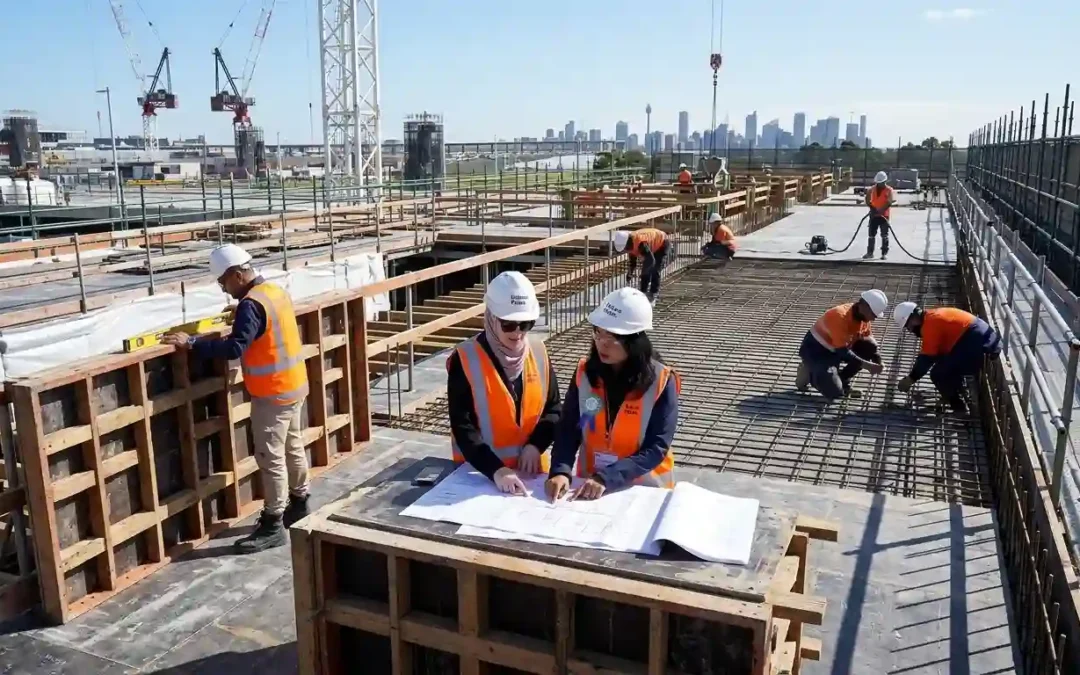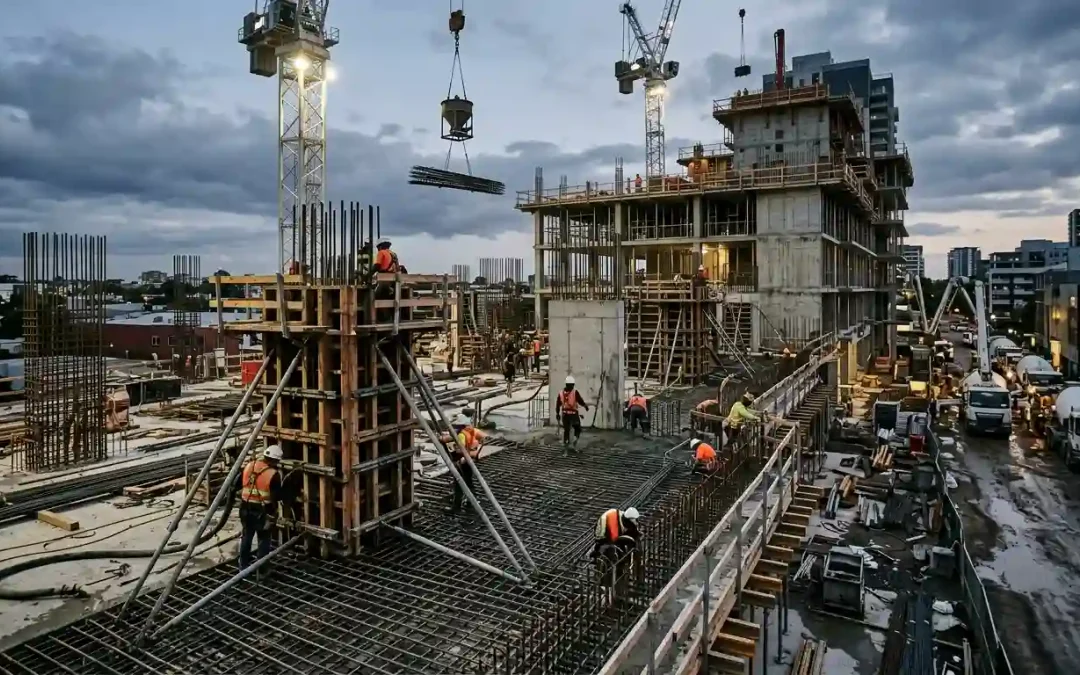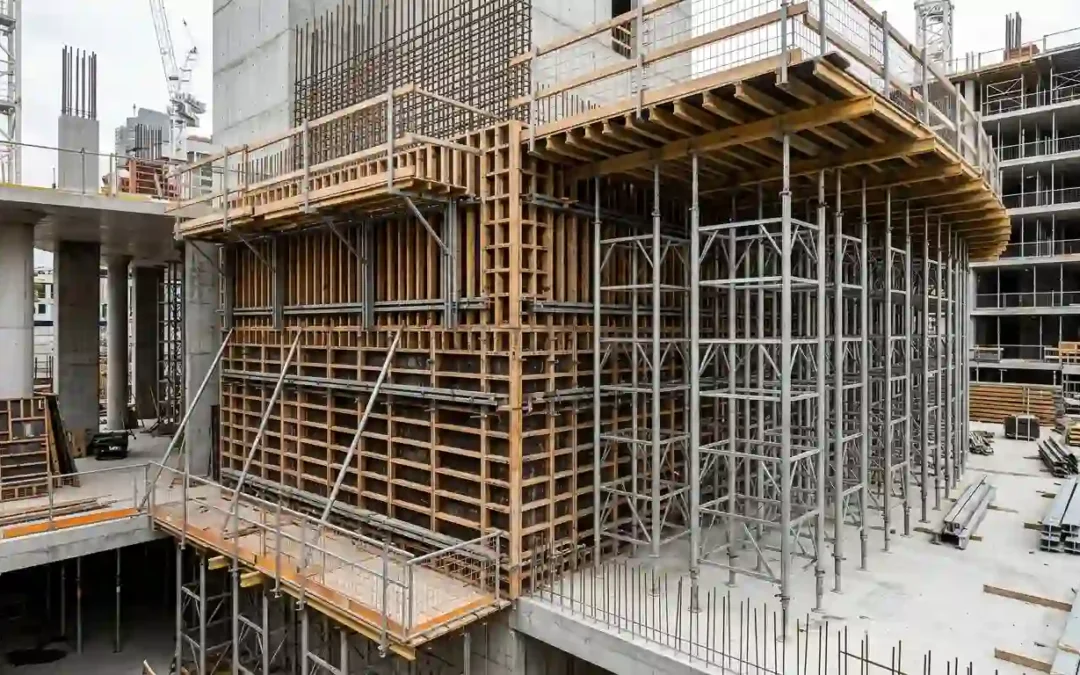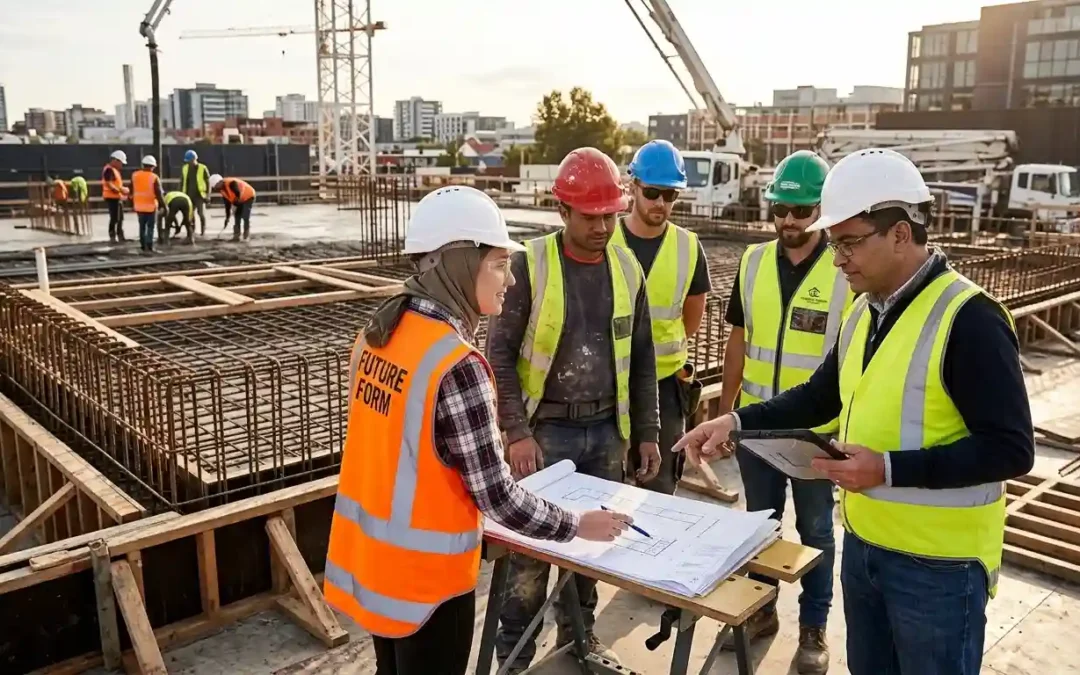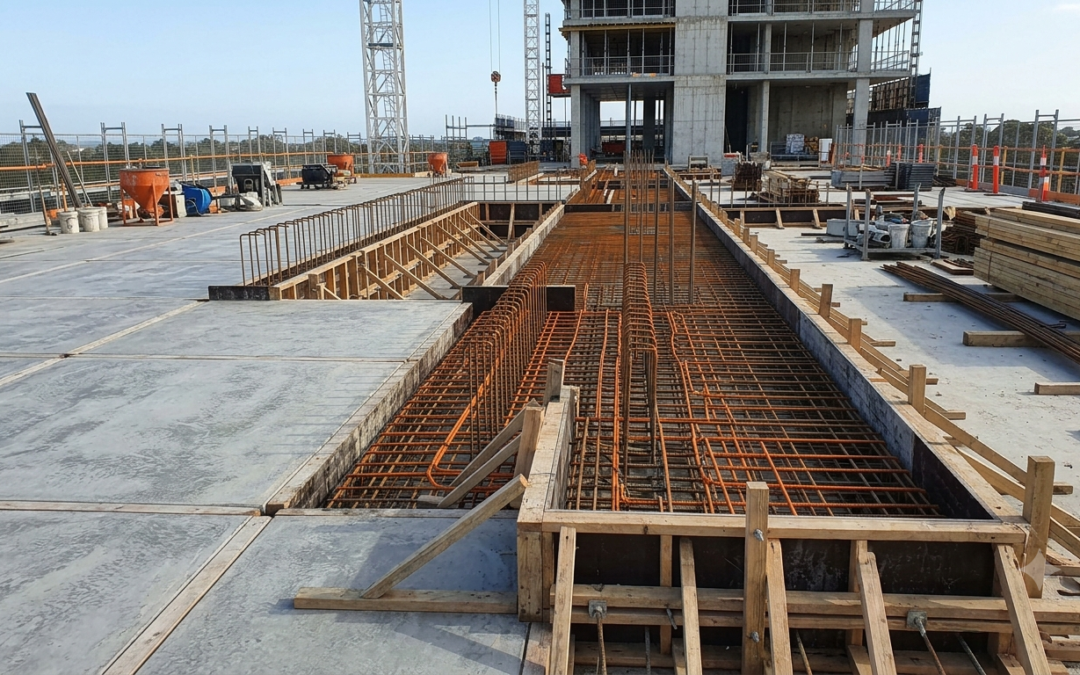
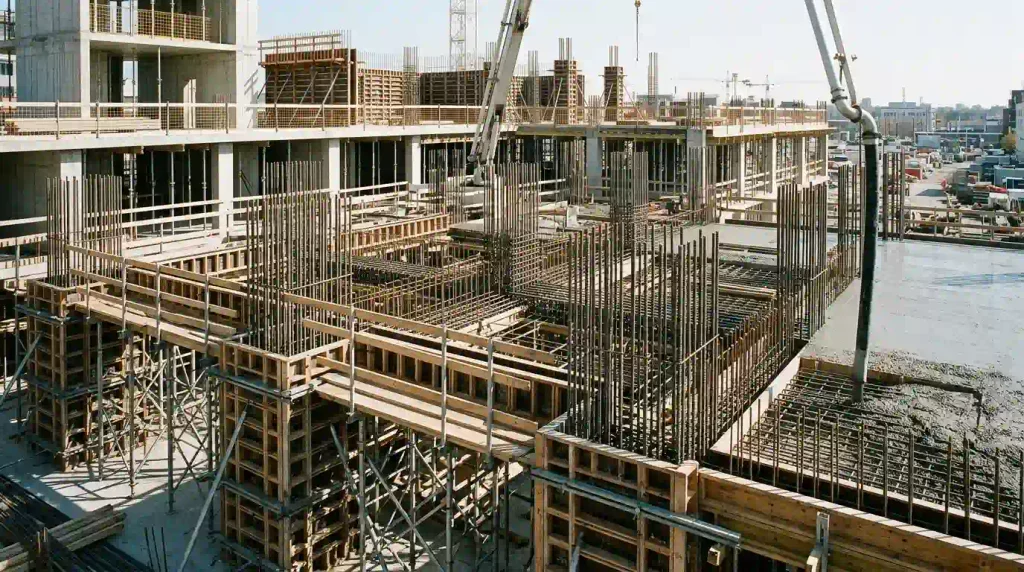
FRP in construction means form, reo and pour — the three trades that build a concrete structure. Form is the temporary mould, reo is the steel reinforcement fixed inside it, and pour is the concrete placed, compacted and cured within it. An integrated FRP package hands all three to one subcontractor under one structural scope of works.
That last sentence is where the commercial interest sits. Anyone can look up the acronym. What estimators and project managers want to know is what falls inside the line item, where the trades hand over, and what changes when one contractor carries the whole slab cycle.
Key takeaways
- FRP stands for form, reo and pour — formwork, steel reinforcement and concrete placement, delivered as one continuous structural cycle.
- An FRP package covers formwork design and certification, falsework, backpropping, bar and mesh fixing, cover control, cast-in items, placement, finishing, curing and stripping.
- The trades are strictly sequential. Concrete cannot be placed until the formwork is certified and the reo passes pre-pour inspection.
- Compliance sits inside the scope: formwork to AS 3610, reinforcement to AS/NZS 4671, structural design to AS 3600, supplied concrete to AS 1379.
- Builders let FRP as one package to remove interface risk — one programme, one supervision structure, one party accountable for the floor cycle.
- Acceleration is a coordination problem, not a headcount problem. More labour on a deck with fixed crane hours buys congestion, not output.
What does FRP mean in construction?
FRP is the shorthand Australian builders use for the structural concrete cycle: form, reo and pour. It is not a product or a proprietary system. It is the sequence that turns structural drawings into a finished slab, core, column or wall.
In materials engineering the same acronym means fibre-reinforced polymer. On site, if a foreman says “the FRP crew are on level 12”, they mean the form, reo and pour team — the meaning used here and in this complete guide to form, reo and pour.
What is included in an FRP package?
An FRP package covers every activity required to produce a structural concrete element, from setting out the formwork to stripping it.
Form
Formwork is the temporary structure holding wet concrete in shape until it carries itself: design and documentation, falsework and props, deck and table forms, wall and column forms, jumpform on cores, edge protection, box-outs, stripping and backpropping.
It carries a real engineering obligation. Formwork must be built in line with AS 3610 Formwork for concrete, and Safe Work Australia’s formwork and falsework guidance requires certification by a competent person before the deck is loaded. SafeWork NSW treats formwork collapse as one of the highest-consequence risks on site, so that sign-off is non-negotiable.
Reo
Reo — or steel fixing — is the placement and tying of reinforcement inside the form: bottom and top bar, mesh, ligatures, chairs and spacers, laps, starter bars, trimming to penetrations, and cast-in items such as ferrules, dowels and conduit.
Reo is where tolerance discipline lives. Cover, lap length and bar spacing deliver the capacity and durability assumed in AS 3600, and the bar must meet AS/NZS 4671. Get cover wrong and you have not saved a day — you have created a defect that surfaces years later.
Pour
The pour package runs from preparation to curing: pre-pour hold points, pump and plant set-up, placement, compaction, screeding, levels and falls, finish, joint formation, curing and protection, plus slump acceptance and testing under AS 1379. Placing equipment carries its own risks, covered in SafeWork NSW’s concrete placing guidance.
FRP scope of works at a glance
| Trade | Core scope | Key control points | Standards |
| Form | Deck, wall, column and core formwork; falsework, backpropping, box-outs, stripping | Design certification; competent-person sign-off before loading; strip timing | AS 3610 |
| Reo | Bottom and top steel, mesh, ligatures, chairs, laps, starters, cast-in items | Cover, spacing and lap compliance; pre-pour inspection; set-out | AS/NZS 4671, AS 3600 |
| Pour | Pump set-up, placement, compaction, screed, finish, joints, curing | Pre-pour hold point; slump and cylinders; placement rate | AS 1379, AS 3600 |
How form, reo and pour sequence on a real structure
The trades are sequential and every handover has a gate. On a typical suspended floor, the sequence runs like this.
| Step | Activity | Gate before the next step |
| 1 | Survey, set out, erect falsework and deck | Level and stability confirmed |
| 2 | Complete formwork, edge protection, penetrations | Formwork certified |
| 3 | Fix bottom reo, chairs and spacers | Cover and spacing checked |
| 4 | Install services, conduit, cast-in items | Services coordination complete |
| 5 | Fix top reo and trimming steel | Pre-pour reo inspection passed |
| 6 | Place, compact and finish concrete | Slump and finish accepted |
| 7 | Cure and protect | Strength gain confirmed |
| 8 | Strip forms and backprop | Backpropping design followed |
| 9 | Cycle materials to the next level | Crane and hoist available |
Nine steps, one crane, one deck. That is why the floor cycle — not the fitout — usually dictates the overall programme.
FRP coordination: where the three trades actually meet
Most structural delay is not a trade failure. It is an interface failure. The deck is ready but the reo delivery is short. The reo is fixed but the electrician still needs to run conduit. The pour is booked but the formwork certificate is outstanding. Small problems, large idle crews.
Good FRP coordination attacks those interfaces before they exist: buildability checks well ahead of the deck, reo schedules aligned to fixing sequence rather than delivery convenience, penetrations agreed before the top layer goes down, and pours booked against realistic placement rates. On a large-scale project, that discipline separates a seven-day floor cycle from a ten-day one.
Why builders let form, reo and pour as one structural package
Splitting FRP across three subcontractors creates three programmes and three sets of commercial incentives that do not naturally align. When the deck runs late, each party has a defensible position and the builder still has a late slab.
Integrated FRP solutions remove those seams: one programme, one supervision structure, labour that flexes between form, reo and pour, a single quality and safety system, and one contractor answering for the structural package. The subcontract simplifies too — one scope, one variation path. Estimators often find the integrated option prices better once interface risk and standing time are allowed for, which is why it pays to understand what separates capable FRP contractors.
What happens when the structural programme needs to accelerate
Programmes accelerate for familiar reasons: a wet start, a late design change, a delayed approval, a funding milestone. The instinct is to add labour.
It rarely works alone. A deck has finite crane hours, finite hoist capacity, a finite number of work faces and inspection windows that cannot be compressed. Doubling the steel fixing crew on a deck already at capacity produces congestion, material queues, rework on cover and higher incident risk — the conditions WorkSafe ACT’s formwork guidance warns about. A compressed cycle also shortens curing time and tightens backpropping.
Practical ways to lift output without losing safety, quality or sequence
- Buy back crane time. Move materials by hoist or pre-stage them so crane hours go to critical lifts.
- Increase form area, not crew size. Extra table forms or a second deck set creates a genuine work face.
- Pour in stages. Splitting a large deck into two pours can shorten the critical path more than one big pour.
- Prefabricate reo. Pre-tied cages and mats shift labour off the deck into a controlled yard.
- Front-load inspections. Book surveyors, engineers and hold points ahead of the sequence.
- Protect the curing regime. Strength gain is not negotiable — accelerate everything around it.
- Run one programme. Sequencing that treats form, reo and pour as a single cycle recovers more days than any of the above alone.
How Future Form can help
Future Form delivers formwork, reinforcement and pour as one integrated package, self-performing the full FRP scope so the builder manages a single interface across the entire slab cycle rather than three.
That scope covers formwork systems designed to the structure and the programme, jumpform for cores, high strutting and engineered scaffold systems, steel fixing across decks, walls, columns and cores, and concrete works through to finish and curing — with the engineering, supervision and certification capability behind each. Backing it is an experienced structural team, ISO-certified safety, quality and environmental systems, and a delivery record across major projects in NSW and the ACT.
A scope conversation starts with structural drawings, a target floor cycle and a programme. From there we work through buildability, formwork strategy, reo scheduling, pour sizing and crane demand, then return a priced structural package with a sequence attached. If you are carving up a structure subcontract, get in touch.
Frequently Asked Question
1. What does FRP mean in construction?
FRP means form, reo and pour — the three trades that build a concrete structure. Form is the temporary mould, reo is the steel reinforcement, and pour is the concrete placement, compaction and curing. In materials engineering the acronym means fibre-reinforced polymer, but on an Australian site it refers to form, reo and pour.
2. What is included in an FRP package?
Formwork design, falsework, decks, walls and columns, stripping and backpropping; bar and mesh fixing, cover control and cast-in items; and pour preparation, placement, compaction, finishing, joints and curing — plus the inspection and certification obligations between each stage.
3. Who provides integrated formwork, reinforcement and pour packages in Australia?
Specialist FRP contractors that self-perform all three trades, usually on high-rise residential, commercial and infrastructure work. Future Form is one, delivering integrated FRP solutions across Sydney, Western Sydney and Canberra.
4. How does an FRP structure package work on an Australian high-rise?
As a repeating floor cycle: set-out, formwork erection and certification, bottom reo, services coordination, top reo and pre-pour inspection, pour and finish, curing, then stripping and backpropping — with the core climbed ahead of the deck using jumpform. One contractor holding all three keeps that cycle continuous.
5. How do you accelerate structural works without compromising safety or quality?
Remove constraints rather than add labour: create more work faces, prefabricate reinforcement off the deck, split large pours, buy back crane time, and book inspections ahead of the sequence. Curing time and formwork certification are fixed gates — compress around them, never through them.
6. What should builders look for in an FRP contractor?
Genuine self-performance across all three trades, in-house engineering and formwork design capability, certified safety and quality systems, a record on comparable large-scale projects, and resourcing depth to hold a floor cycle — the criteria set out in this guide to choosing an FRP contractor.
One package, one accountable floor cycle
FRP in construction is simply form, reo and pour — but the value sits in how tightly those three are held together. Split them and every handover becomes a commercial interface. Combine them into one structural package and the floor cycle becomes something a builder can genuinely programme against.
If you are scoping a structure subcontract and want to test what an integrated formwork, reinforcement and pour package looks like on your job, start a scope conversation with Future Form.
Because form, reo and pour only look like three trades on paper. On the deck they are one cycle — and the whole programme is standing on it.