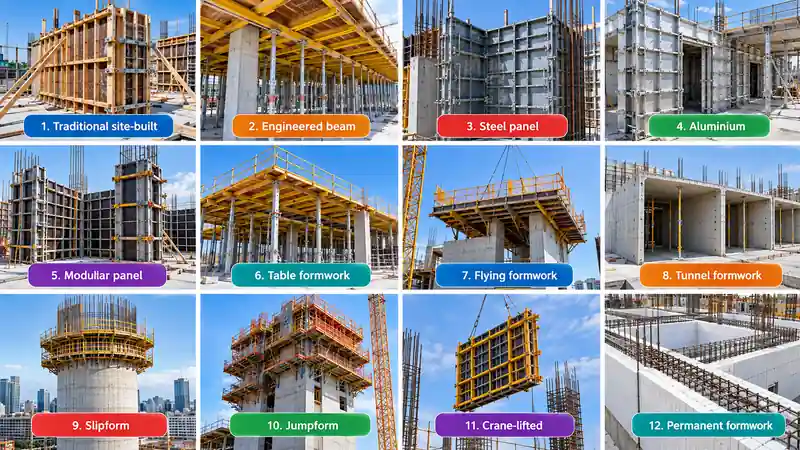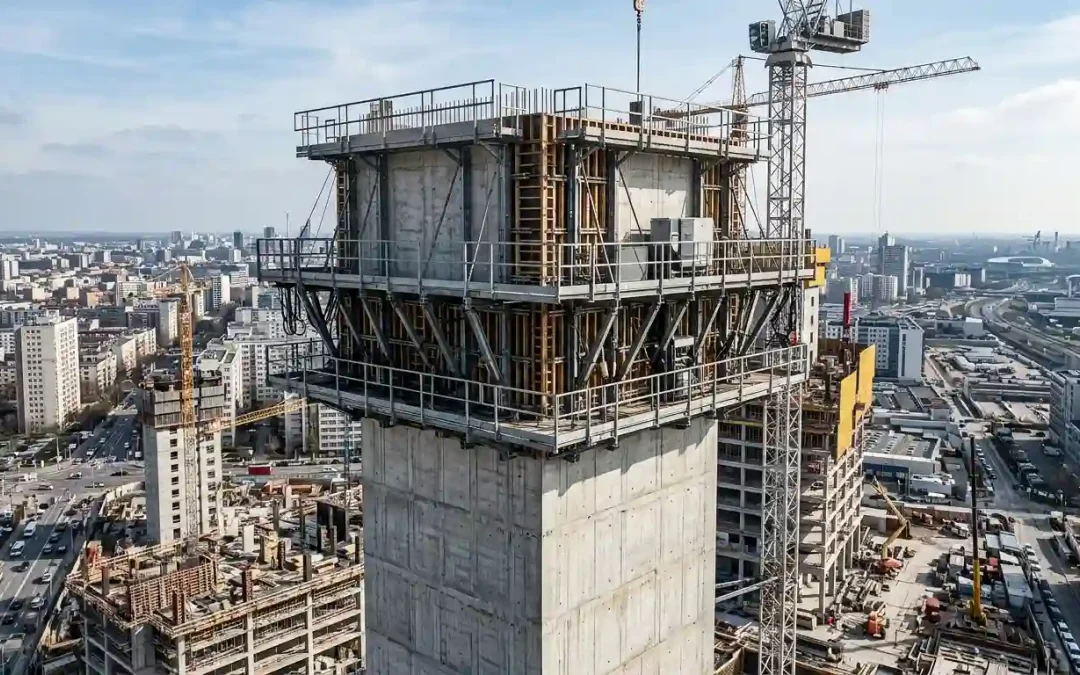
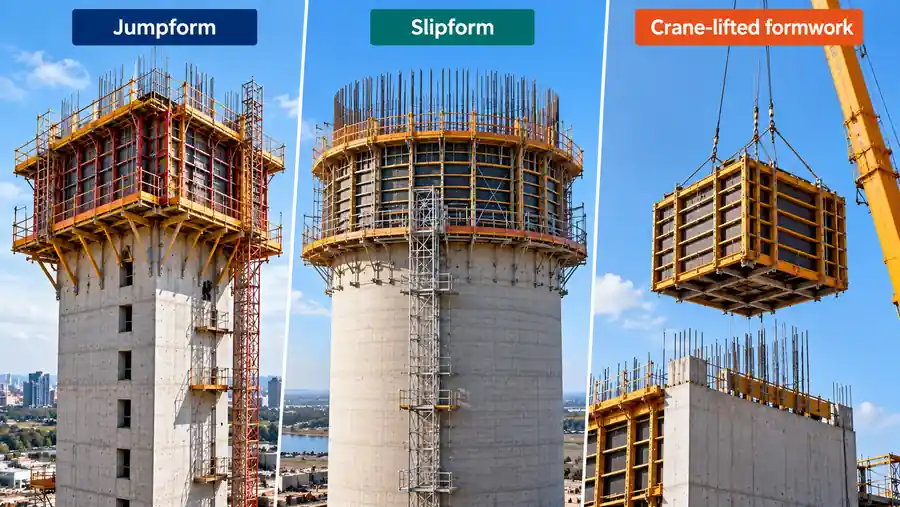
Jumpform climbs in stages: formwork and platforms rise after each pour reaches the required condition. Slipform climbs continuously while concrete is placed. Crane-lifted formwork is stripped and repositioned by crane between pours. The right choice for a high-rise core depends on height, geometry, repetition, programme pressure, crane availability, concrete supply, labour, tolerance, cost and site logistics.
Key takeaways
- Movement is the core difference. Jumpform climbs in stages, slipform climbs during the pour, and crane-lifted formwork relies on the crane between pours.
- No method is universally fastest. A core only finishes sooner if the slab cycle, concrete supply, crane and crews can keep up.
- Height and geometry are inputs, not rules. Floor count and core area matter, but repetition and geometry often decide it.
- Crane dependency is about when, not whether. Fewer core formwork lifts don’t remove the tower crane from the project.
- A stopped pour hurts differently. Slipform is the most exposed, because forms and concrete move together.
- Compare the whole project. Programme, risk, logistics and cost beat any single metric.
What is the difference between jumpform and slipform?
The difference is continuity. Safe Work Australia’s guide to slip, jump and travelling formwork notes that slip forms climb continuously during the pour, while jump forms climb in steps after each pour, which suits building cores with regular floors. Crane-lifted formwork sits outside both.
What is jumpform?
Jumpform is a climbing formwork methodology. Core wall forms and working platforms rise together, usually by hydraulic or mechanical climbing. Each lift is poured in a defined stage, the concrete reaches the condition the engineer requires, then the system climbs and repeats one level higher. It is engineered around the core’s lift shafts and stairs, with enclosed platforms and edge protection. Staged pours create natural inspection points, and no two systems are identical. Think of it as a self-climbing work site that rides the core up with the crew inside it, and the reason jumpform systems have become a staple of high-rise construction in Australia.
What is slipform?
Slipform is continuous vertical construction. Forms move progressively while concrete is placed, with reinforcement fixed on the move, often around the clock. Because it climbs steadily with the pour, Safe Work Australia’s formwork guidance notes it can build tall structures without obvious joints. It can be highly effective where the programme supports one uninterrupted operation, but it isn’t simply a faster jumpform: it needs continuous concrete, crews and alignment monitoring, and little can change once started. Pit those two against each other on a real core and you get the full jumpform vs slipform debate.
What is crane-lifted formwork?
Crane-lifted formwork uses conventional panel or gang systems that are poured, stripped, lifted and refixed level by level. It’s flexible and simple to mobilise, and remains appropriate where geometry is complex, crane capacity is available, levels are limited, or programme pressure doesn’t justify a climbing system. The cost is crane and crew time at every level. It’s one entry in a much bigger toolkit of different types of formwork, and a tower often uses several.
How do the three methodologies compare?
| Jumpform | Slipform | Crane-lifted | |
| Movement | Stages after each pour | Continuous with pour | Craned per level |
| Crane dependency | Lower for forms; still needed | Lower for forms; still needed | Highest for core forms |
| Labour | Repeating cycle crews | Continuous, often 24-hour | Crane-paced crews |
| Concrete supply | Reliable per pour | Continuous, very sensitive | Reliable per pour |
| Interruption risk | Natural stop points | Highest exposure | Natural stops; crane key |
| Geometry | Engineered per core | Best when consistent | Most adaptable |
| Key limitation | Engineering, mobilisation | Little flexibility once started | Crane time per level |
Which core construction method is fastest?
None, universally. The better question is: which system can deliver the required core progression reliably within this project’s constraints?
A jump cycle includes reinforcement, pour, concrete reaching the required condition, release, climb, reposition and inspection. Slipform progresses continuously but is tied to supply and set-up. Crane-lifted cycles depend on hook time. The fastest method on paper loses if the slab cycle can’t follow the core, supply is unreliable, the crane is constrained, crews can’t be kept continuous, or mobilisation is heavy. Much of that comes down to how form, reo and pour are sequenced behind the core, which is the heart of any FRP package.
How do building height and core geometry affect the choice?
More repetitive levels give a climbing system more cycles to recover mobilisation, engineering, set-up and dismantling effort. But there’s no universal floor-count rule. Figures such as 20, 28 or 40 storeys are decision points to investigate, not thresholds. Geometry is often more decisive: footprint, wall layout, lift shafts, stairs, openings, wall thickness changes and transfer conditions. Highly repetitive cores favour systems built for repetition; complex or changing cores favour adaptability. Core area affects concrete volume and platform design.
How do crane, labour and concrete supply differ?
Crane. The crane serves reo, embeds, materials, façade and every trade. Crane-lifted formwork adds core lifts at every level. Jumpform and slipform reduce that, never to zero, since the crane still lifts reinforcement and installs the system. Ask how much crane capacity the core consumes, and when.
Labour. Slipform demands continuity: crews, supervisors, reo and concrete teams on a fixed rhythm, often across shifts. Jumpform runs in repeating cycles with hold points.
Concrete. All three need reliable supply, but slipform needs continuous delivery and pumping at a rate matched to the rig, with backup for plant, pump and weather. For staged pours, a delay usually means rescheduling a pour.
What happens if the pour stops?
Slipform can stop, but not freely. Forms advance with the concrete, so supply failure, pump or equipment failure, weather, labour or quality issues need careful management. Consequences depend on system design, concrete condition, construction stage and contingency planning. Jumpform separates placement from climbing, so a delay is usually a programme issue. Crane-lifted formwork moves in discrete steps, so crane unavailability is the main dependency. Nothing is risk-free.
How do tolerance, finish and cost compare?
Verticality and alignment depend on form stability and monitoring in every method. Finish isn’t set by method alone: form face, condition, joints, placement, vibration and release agents all count. Specify tolerances early against the project specification and the AS 3610 formwork series.
Cost belongs at whole-strategy level: mobilisation, engineering, set-up, dismantling, labour, supervision, crane demand, concrete arrangements, reuse and programme impact. A higher direct cost can be commercially stronger if it protects the critical path. A sophisticated system can be poor value if the project doesn’t justify it.
Practical decision table
| Project condition | Jumpform | Slipform | Crane-lifted | Key risk to check |
| 10–20 storeys | Worth pricing | Check geometry | Often competitive | Crane time, mobilisation |
| 20–40 storeys | Strong candidate | Candidate if uniform | Crane load rises | Slab cycle, supply |
| 40+ storeys | Strong candidate | Strong if uniform | Heavy crane demand | Logistics, concrete |
| Complex or changing core | Strong if engineered | Poor fit | Strong | Geometry changes |
| Repetitive residential tower | Strong | Candidate | Viable | Slab following core |
| Limited crane availability | Favoured | Favoured | Weak | Material lifts |
| Variable concrete supply | Favoured | High risk | Favoured | Pour reliability |
| Very high programme pressure | Strong | Strong if conditions allow | Rarely | Whole-programme fit |
These rows are directions to investigate, not rules. Where the answer needs project data, it needs a project assessment.
How should a 28-storey tower choose its core method?
Hypothetical example, not a Future Form project. Picture a 28-storey residential tower with a consistent core, one tower crane shared with façade and slab works, reliable ready-mix and a slab cycle that sets the pace.
- Jumpform: repetition is high and the crane is contested, so it warrants close assessment. Check engineering and mobilisation lead time.
- Slipform: worth assessing if geometry is uniform and supply proven. Check backup, crew continuity and whether the slab can use the speed.
- Crane-lifted: still viable if crane time is spare. Check cumulative core lifts against other demand.
Jumpform may merit the closest look, but the assumptions, not the storey count, decide it.
How does Future Form compare core methodology options?
Future Form assesses the method against the actual project: core geometry, height, programme, formwork system, crane arrangement, structural sequencing, concrete cycle, engineering, logistics and slab integration, early enough for engineering, procurement and mobilisation to influence the decision.
One example is Smith Street, Parramatta, a 28-storey tower with jumpform curved cores, one of the high-rise and large-scale projects Future Form has delivered. Future Form’s project write-up reports a five-day cycle, the core finishing three weeks ahead of the core schedule, and a 25% reduction in formwork crane lifts. That is a reported result for one project, not a benchmark. Lessons from other jobs surface in Future Form’s project updates as sites progress.
How Future Form can help
Future Form is a structural package specialist with ISO 9001, 14001 and 45001 certification and over 20 years in formwork. We can model jumpform, slipform and crane-lifted options against building height, core geometry and area, programme, crane arrangement, concrete supply, labour and site constraints, so the decision rests on the project, not a floor-count rule.
That covers jumpform and formwork systems, formwork engineering, crane interface planning, structural sequencing, slab integration and coordination with builders and engineers. Those capabilities sit within a wider range of formwork and structural services, and the same thinking applies when choosing an FRP contractor or engaging a Sydney formwork contractor. We don’t promise cycle times or savings; they depend on your project.
6 FAQ
1. What is the difference between jumpform and slipform?
Jumpform climbs in stages after each pour is ready; slipform climbs continuously while concrete is placed. Slipform is more sensitive to supply and crew continuity, jumpform more flexible between pours.
2. Which core construction method is fastest?
None is universally fastest. Speed depends on whether the slab cycle, crane, concrete supply, crews and geometry can sustain the method.
3. Does jumpform eliminate crane dependency?
No. It can reduce core formwork lifts, but the crane still handles reinforcement, materials, other trades and system assembly and removal.
4. What happens if concrete supply stops during slipforming?
It’s a significant event, because forms and concrete advance together. The consequences depend on system design, concrete condition, stage and contingency planning.
5. When is crane-lifted formwork suitable for a high-rise?
When geometry is complex or changing, crane capacity is genuinely available, levels are limited, or programme pressure doesn’t justify a climbing system.
6. How does Future Form select a core construction system?
By assessing geometry, height, programme, crane arrangement, concrete supply, sequencing and site constraints for the specific project. The quickest way to test it on your own tower is to talk it through with the team.
The fastest core is the one the project can sustain
Jumpform climbs in stages, slipform climbs with the pour, and crane-lifted formwork moves with the crane. Height alone never settles it. Geometry, crane availability, concrete supply, labour continuity, programme pressure, interruption risk and whole-of-job cost all count. If you’re comparing core methodologies for an upcoming project, speak with a Future Form expert before the decision is locked in.
The right core system isn’t the one that looks fastest in isolation; it’s the one your project can reliably sustain.