Awarding a structural package is one of the higher-risk decisions on a Sydney build. The formwork subcontractor sets the floor cycle, and the floor cycle sets the programme. Get it wrong and you spend the next twelve months managing standing time, rework and variations nobody budgeted for.
Here is what a formwork contractor does, how they differ from suppliers, how pricing and mobilisation work, and what to verify before you sign.
Key takeaways
- A formwork contractor sells installed work, not equipment. Labour, supervision, engineering, certification and programme risk sit with them.
- FRP means form, reo and pour — one structural package instead of three subcontracts and three interfaces.
- Verify before shortlisting: licences, insurances, ISO certification, safety record, financial capacity and comparable completed work.
- Formwork is priced per square metre of contact area, reo per tonne, concrete per cubic metre. Mobilisation typically runs four to eight weeks from award.
- Compare scope, not price. Tenders that look far apart usually differ in inclusions, not efficiency.
What does a formwork contractor do?
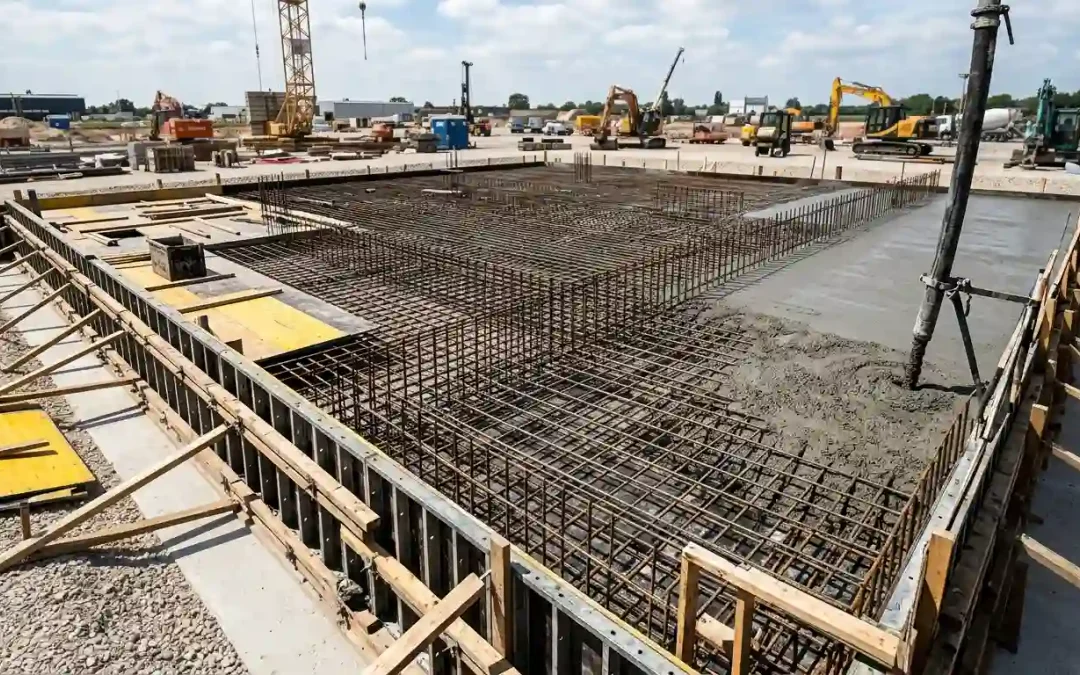
A formwork contractor builds and removes the temporary structure holding wet concrete in shape until it can carry itself: formwork design, falsework, deck, wall and column forms, jumpform on cores, edge protection, certification before loading, then stripping and backpropping.
That carries a real engineering obligation. Formwork must be built in line with AS 3610, and SafeWork NSW’s Formwork Code of Practice requires sign-off by a competent person before any load goes on the deck. Formwork collapse is one of construction’s highest-consequence risks, so that inspection is not a paperwork exercise.
An FRP contractor extends the scope across all three structural trades — formwork, steel fixing and concrete placement — under one scope of works.
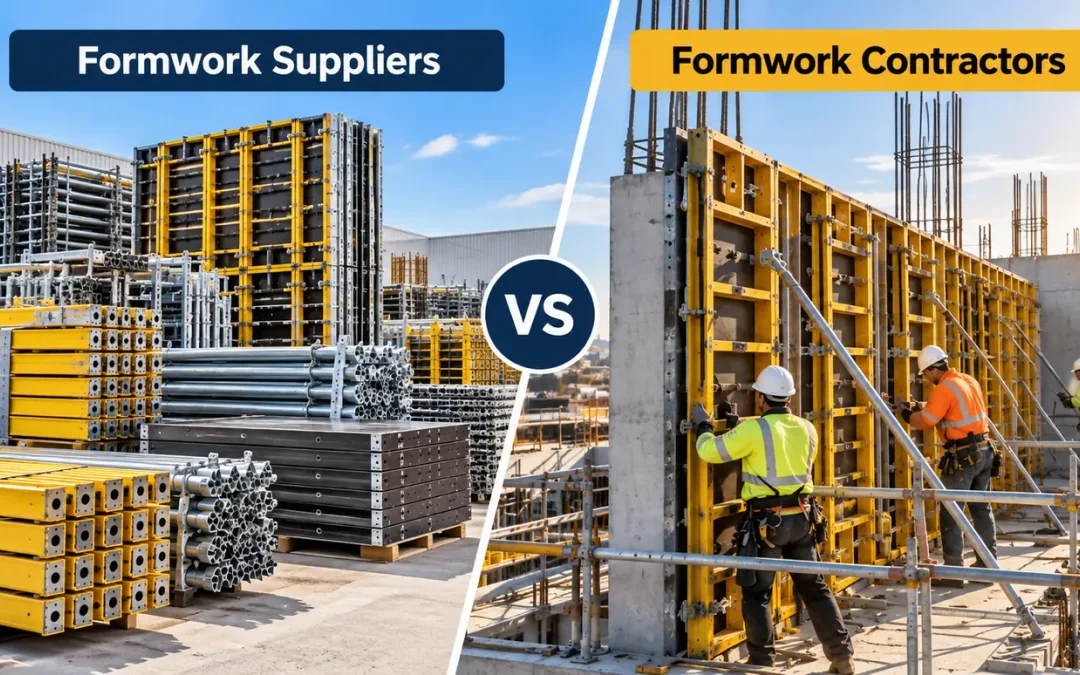
Contractor, supplier or hire company: what is the difference?
This catches out more contracts administrators than it should, usually when the cheap quote turns out to be equipment only.
| Formwork contractor | Integrated FRP contractor | Supplier or hire company | |
| What you buy | Installed formwork: labour, plant, supervision | Form, reo and pour as one package | Panels, props, beams, components |
| Design and certification | Their engineer and competent person | Their engineer, across the full cycle | System data only, if any |
| Erection and stripping | Their crews | Their crews | Yours, or another subcontractor’s |
| Programme risk | Carried by the contractor | Carried by the contractor | Carried by you |
| Pricing basis | Rate per m² contact area, or lump sum | Combined structural rate or lump sum | Weekly hire rate plus freight |
| Best used for | Whole structure packages | Large-scale or repetitive structures | One-off elements, specialist gear |
Hiring equipment does not transfer risk. Anyone comparing formwork companies in Sydney is looking at the first two columns.
What Sydney formwork and FRP contractors specialise in
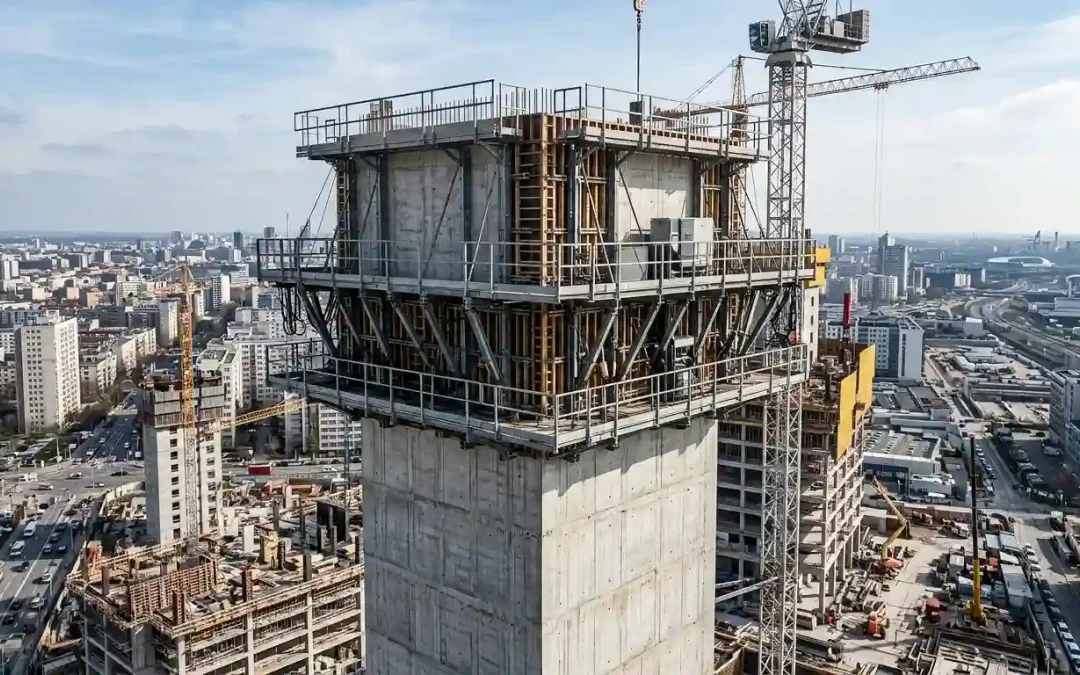
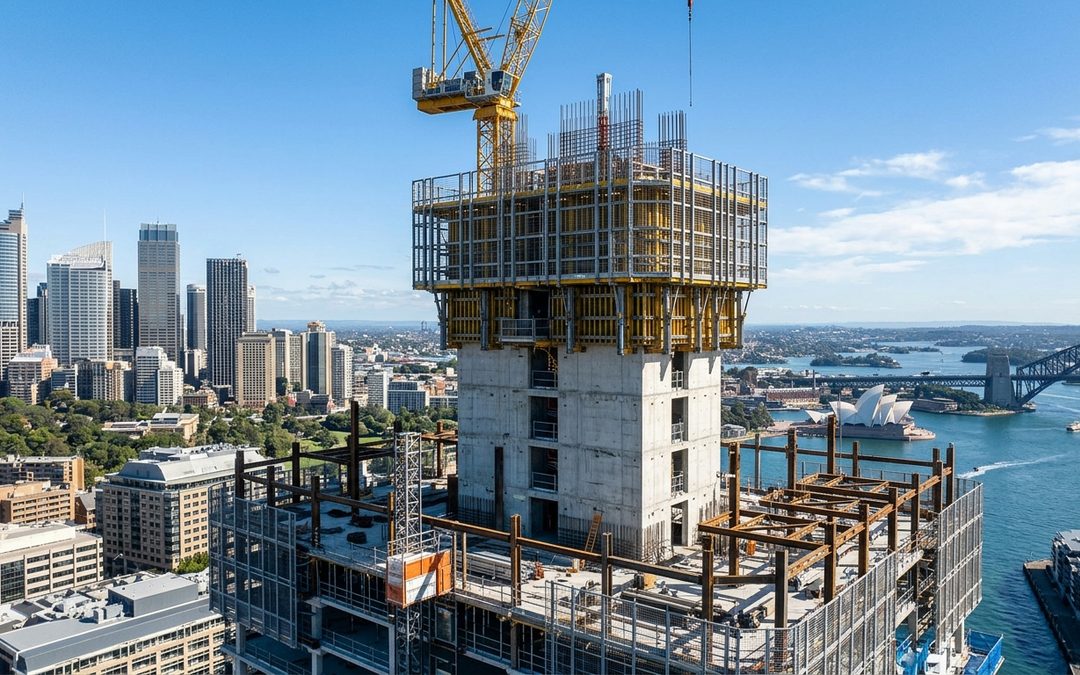
Sydney contractors are rarely generalists, and their rates reflect where their crews are efficient. Common specialisations include table form work on residential towers, jumpform for lift cores, high strutting and engineered scaffold systems for transfer levels and basements, civil formwork, and architectural off-form finishes.
The type of formwork system a contractor runs matters more than most tender assessments allow for. A business set up for repetitive residential decks prices a 30-storey tower well and a heavily transferred podium badly.
What should I check before awarding a formwork package?
Verify these before a contractor reaches your shortlist, not after they win.
- Licences. Scaffolding, dogging, rigging and crane work require a high risk work licence in NSW.
- Insurances. Current certificates of currency for public liability, workers compensation, plant and contract works.
- Certified systems. ISO 45001, ISO 9001 and ISO 14001.
- Safety performance. LTIFR and TRIFR figures and notice history; SafeWork NSW publishes construction incident and prosecution information.
- Financial capacity. Confirm they can carry payroll across the cycle and understand the Security of Payment Act.
- Comparable projects. Same structure type and scale — then call the head contractor’s project manager, not the nominated referee.
- Regulated buildings. On class 2 residential work, check their part of the Design and Building Practitioners scheme.
Assessing capability, resources and project suitability
Once a contractor clears compliance, the question is whether they can hold your cycle.
Matching experience. Twenty carparks tells you little about a 28-storey tower with curved cores. Look for the same structural challenge — transfer slabs, post-tensioning, jumpform cores, deep basements — in their project record.
Labour and supervision. Ask how many crews they run, how many are already committed, and who supervises your job by name.
In-house engineering. Contractors who design their own formwork answer design changes in days rather than weeks.
Quality control. Ask who signs the pre-pour inspection and how cover, laps and bar spacing are managed. This is where reinforcement defects become permanent.
How formwork and FRP package pricing is structured
Formwork is usually priced as a rate per square metre of formwork contact area — the form face touching concrete — split by element type, because a column costs far more per square metre than a flat soffit. Reo is priced per tonne and concrete placement per cubic metre, with prelims, cranage and engineering as separate line items.
Lump sum suits smaller structures. On large-scale work most contractors prefer measured rates against a schedule of quantities, because slab areas move as design develops.
What drives the cost of a formwork or FRP package
| Cost driver | Effect on price |
| Structure geometry | Repetitive floor plates are cheap; transfer levels and curved cores are not |
| Repetition and reuse | More identical cycles spread the cost of forms across more square metres |
| Surface finish class | An AS 3610 Class 1 or 2 off-form finish costs materially more than a Class 4 soffit |
| Target floor cycle | A six-day cycle needs more form sets and more labour than a ten-day cycle |
| Crane availability and site access | Limited crane hours or a tight CBD site push labour into unproductive waiting |
| Reinforcement density | Tonnage, bar diameter, congestion and cast-in items drive fixing hours |
Where two tenders differ by more than roughly 15 per cent, the cause is almost always a scope difference. Find it before you award.
Mobilisation: how long it takes and what delays it
For a standard suspended slab package with settled design, four to eight weeks from award to first deck is realistic. Where jumpform, bespoke formwork design or long-lead equipment is involved, plan for eight to twelve.
Mobilisation covers contract execution and insurances, formwork design and certification, equipment allocation, shop drawings, labour allocation and inductions, and site establishment.
Delays are predictable: drawings still at 80 per cent, unresolved penetrations, late contract execution, restricted crane availability, and reo schedules issued too late to suit the fixing sequence. Early FRP planning removes most of these before they touch the programme.
What a contractor needs from you to price properly
Send structural drawings and specifications, the programme with your target floor cycle, a schedule of quantities, access and laydown constraints, crane arrangements, finish requirements, subcontract terms and start date. Leave any out and you get a qualified price with assumptions attached. Require every tenderer to price identical scope and submit written exclusions — backpropping, edge protection, stripping, crane allowance and rectification are where scope quietly disappears.
Why FRP coordination decides your floor cycle
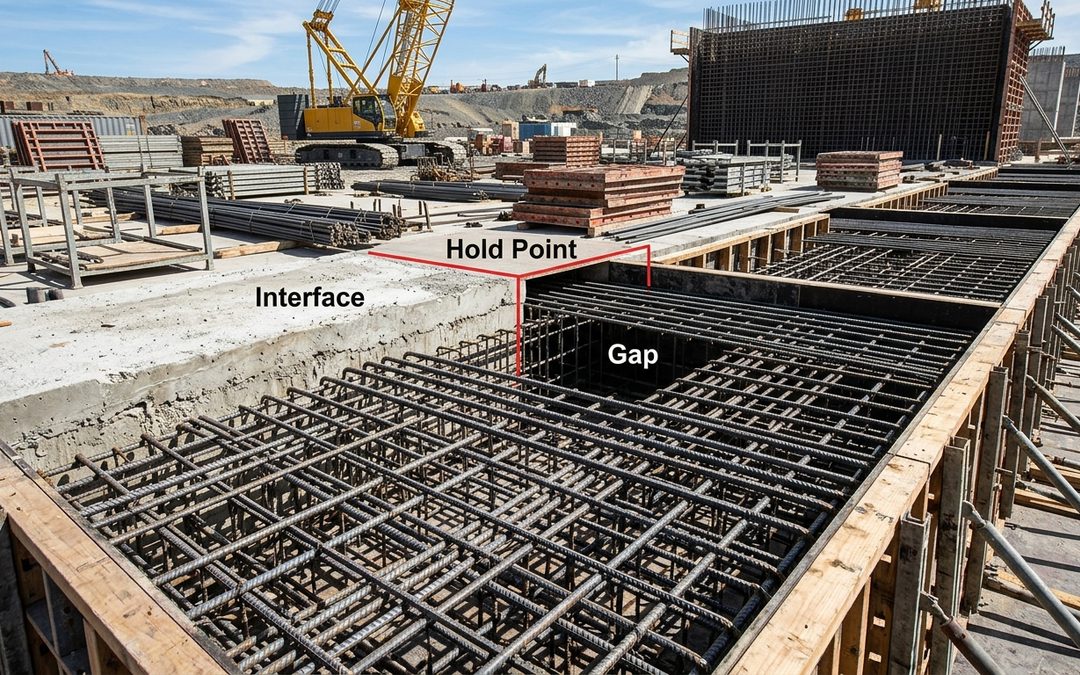
Most structural delay is not a trade failure. It is an interface failure. The deck is ready but the reo delivery is short. The pour is booked but the formwork certificate is outstanding.
Sequencing form, reo and pour as one continuous cycle separates a seven-day floor from a ten-day one. Where three subcontractors hold the three trades, each has a defensible position when the slab runs late — and you still have a late slab. Integrated FRP delivery removes those seams: one programme, one supervision structure, one party answering for the structural package.
Awarding the package on a large-scale project
Test the cycle claim — if a contractor commits to a six-day floor cycle, ask which project achieved it, with what crew size and how many form sets. Check the core strategy, because jumpform only pays back over enough levels. Agree the variation and standing time mechanism up front, and make sure the coordination approach is documented. The lowest tender is only the cheapest if it finishes on programme.
How Future Form can help
Future Form is a Sydney-based formwork and FRP contractor delivering structural packages for over two decades, founded in Western Sydney and now operating from the Sydney CBD and Austral.
The team self-performs the full FRP scope — formwork systems designed to the structure and the programme, jumpform for cores, high strutting and engineered scaffold systems, steel fixing, and concrete works through to finish and curing. That means one subcontract and one party accountable for the floor cycle. The business holds ISO 45001, ISO 9001 and ISO 14001 certification, backed by an experienced structural team.
Coverage centres on Sydney metro and Greater Western Sydney, with a delivery record that also extends to Canberra and the ACT. Future Form does not service every location, so confirm the footprint before tender. Project experience spans residential towers, mixed-use developments, commercial and hotel buildings, education and health facilities, and transport infrastructure.
A scope conversation starts with structural drawings, a target floor cycle and a programme. From there the team works through buildability, formwork strategy, reo scheduling, pour sizing and crane demand, then returns a priced structural package with a sequence attached. Get in touch if you have a package to award.
Frequently asked questions
1. How do I choose a formwork contractor in Sydney?
Work through compliance, then capability, then price. Verify licences, insurances, ISO certification and safety performance, confirm comparable completed structures at similar scale, then compare tenders on identical scope.
2. What should I check before awarding a formwork package?
Check certificates of currency, high risk work licences, certified safety and quality systems, financial capacity, comparable projects with contactable references, and named supervision. Confirm who carries backpropping, stripping and cranage.
3. What is the difference between a formwork contractor and a formwork supplier?
A formwork contractor supplies installed work — labour, plant, supervision, engineering and certification — and carries programme risk. A supplier or hire company provides equipment only; erection, stripping and risk stay with you.
4. What does an FRP contractor do?
An FRP contractor delivers form, reo and pour as one package: formwork design, erection, certification and stripping; steel fixing and cast-in items; and concrete placement, compaction and curing. One subcontract removes the handovers where most structural delay originates.
5. How is a formwork or FRP package priced?
Formwork is priced per square metre of contact area split by element type, reo per tonne, concrete per cubic metre. Cost is driven by geometry, repetition, AS 3610 finish class, floor cycle target, cranage and reinforcement density.
6. Can I get a formwork subcontractor for a residential tower in Western Sydney?
Yes. Western Sydney and Greater Western Sydney are well served by contractors experienced in residential tower work, and sites there often allow better laydown and craneage than a CBD block. Prioritise a demonstrated repetitive floor cycle.
Choose on capability, not on rate
Choosing between formwork contractors in Sydney comes down to one question: can this contractor hold the cycle your programme depends on, with the crews and engineering to prove it? Compliance gets a contractor onto the list. Comparable experience, resourcing depth and a clearly scoped price decide who wins it.
If you are scoping a structural package, start a scope conversation with Future Form.
Form, reo and pour only look like three trades. On your programme, they are one date.