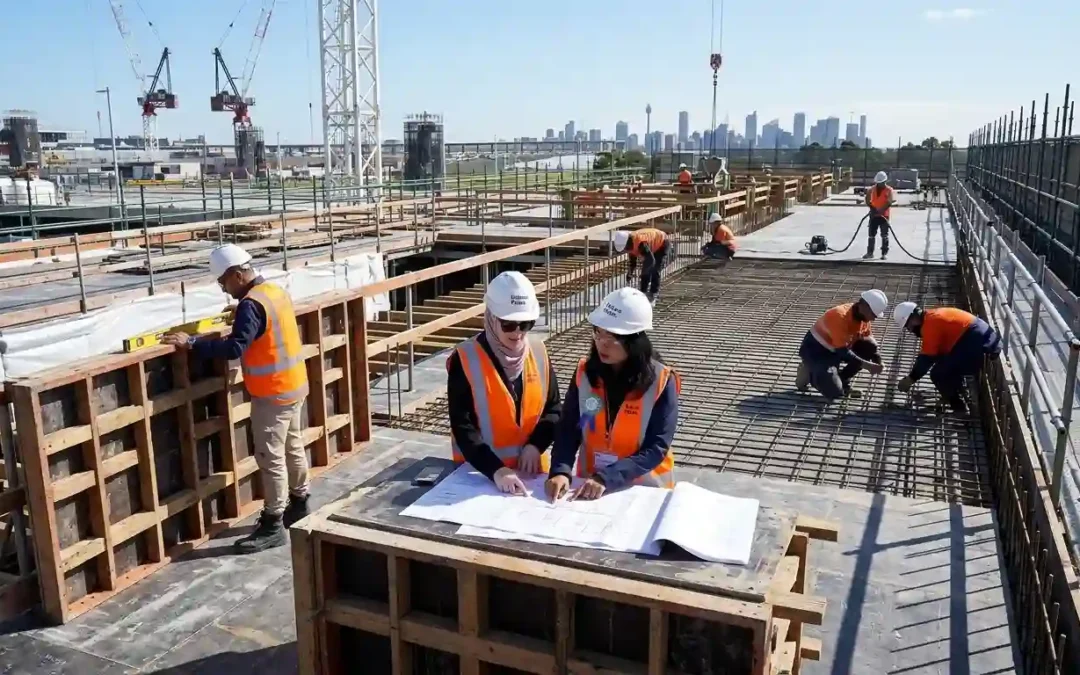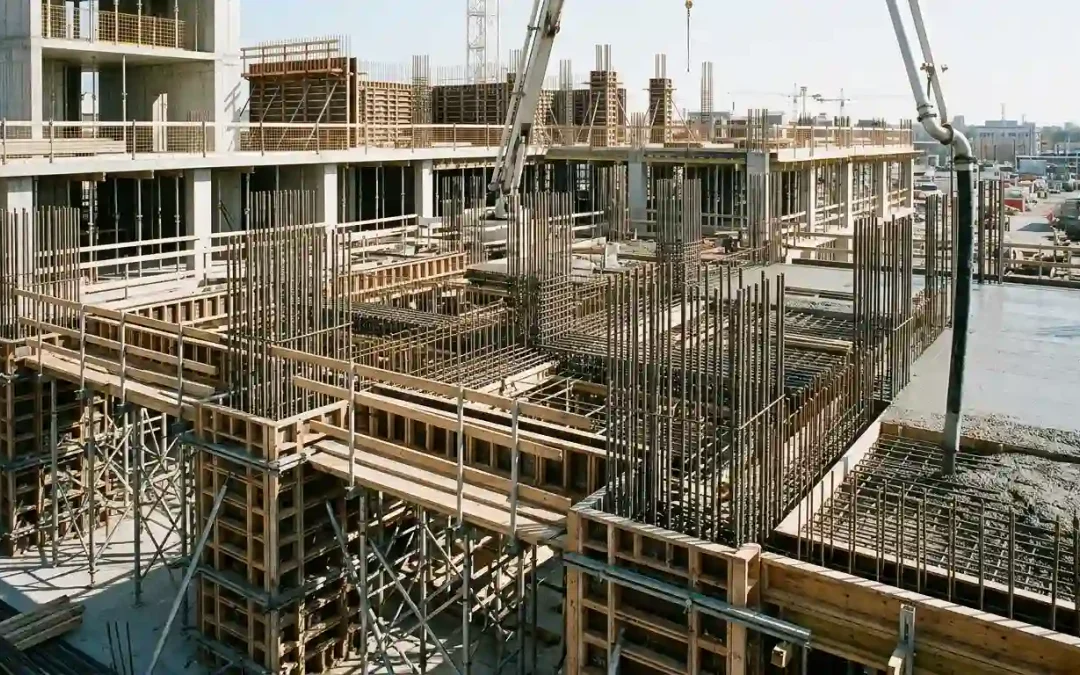
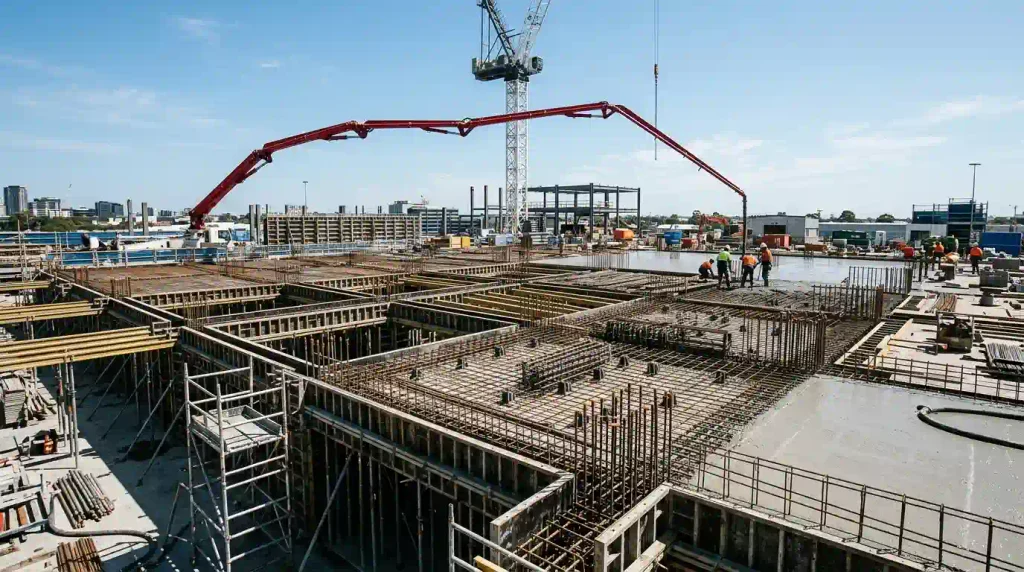
An FRP package covers Form, Reo and Pour — formwork and its temporary works, reinforcement supply or fixing, and concrete placement — let as one structural scope. What sits inside it is not fixed: it depends on the project, contract, drawings, specification, engineering requirements and what the parties agree.
Which is why “formwork, reinforcement and concrete” is not a scope of works. It is a heading. Below is a practical checklist for estimators and contracts administrators pricing or reviewing an FRP works scope.
Key takeaways
- An FRP package is Form, Reo and Pour — the subcontract sets each boundary, not the acronym.
- Clarify three things first: formwork certification, reo supply versus fix-only, concrete supply versus placement.
- Most variations start at the interfaces — crane time, set-out, penetrations, make-good, access.
- Exclusions must be stated. An unwritten exclusion is a priced inclusion in someone’s mind.
- Like-for-like comparison is impossible unless every tenderer prices the same inclusions and exclusions.
- No checklist is a contractual standard. Test it against your drawings, specification and contract.
Why a clear FRP works scope matters before tender
A vague scope does not remove risk; it moves it into the programme, where it gets expensive. If the scope is silent on who certifies the formwork, supplies the bar or pays for the pump, three tenderers make three different assumptions — and the cheapest price usually belongs to whoever assumed the least. That gap resurfaces after award as a variation, an argument, or a crew standing idle. Agreeing the form, reo and pour boundaries before pricing is one of the few scope risks fully in your hands.
What should be included under Form
Formwork is a designed temporary structure carrying live loads, not sheeting and props — and the design obligation is where scopes most often go quiet.
- Formwork design — who designs it, to what loads, against which deck layout
- Engineering and certification — who certifies before loading, per AS 3610 and Safe Work Australia’s formwork guide
- Falsework and high strutting — design, supply, erection, inspection, dismantling
- Backpropping — sequence, duration, design, and who releases the props
- Edge protection — supply, installation, maintenance, relocation, removal
- Penetrations and box-outs — who sets out, forms and seals them, and who supplies the information
- Set-out — builder-provided control lines, or the subcontractor’s own survey
- Materials and systems — system type, finish class, ply replacement, ties, release agents
- Stripping and make-good — patching, grinding, tie-hole filling, and to what standard
Backpropping and edge protection quietly move: usually in the price, usually priced against a shorter duration than the programme needs.
What should be included under Reo
The biggest commercial question in a reinforcement scope is whether the package is supply-and-fix or fix-only. That one line decides who carries steel price movement, delivery risk and shortfalls.
- Supply versus fix-only — who holds the supply contract, and who absorbs escalation
- Detailing and bar scheduling — who schedules, who checks, who wears an error
- Cutting, bending and delivery — bundle sequencing, delivery windows, laydown, offloading
- Chairs and spacers — cover delivers the durability assumed under AS 3600, with material compliance under AS/NZS 4671
- Accessories — starters, couplers, dowels, ferrules, cast-in items, and who supplies them
- Wastage and offcuts — the allowance, and who owns the scrap
- Pre-pour inspection attendance — including standing time for rework
Schedules built for economical fabrication rather than the fixing sequence can be correct on paper and slow on deck — a tension the Steel Reinforcement Institute of Australia works through in its guidelines for economical assembly of reinforcement.
What should be included under Pour
Concrete scopes fail on one distinction more than any other: supply is not placement. On most Australian packages the builder supplies and the FRP contractor places — but that has to be written down.
- Concrete supply — mixes, ordering, acceptance under AS 1379, and who pays for over-order, waiting time and rejected loads
- Concrete placement — placement, compaction, screeding, levels and falls
- Pumping — line pump or boom, set-up, hire, priming, washout location, standby
- Finishing — finish class, power floating, trowelling, and who accepts it
- Curing and protection — method, duration, protection from following trades
- Testing — sampling and slump testing under AS 1012 usually sits with the builder or a NATA laboratory, but hold points still need coordinating
- Joints — construction joints, saw cutting timing, joint preparation
- Out-of-hours and weather — night pours, hot and cold weather provisions, abortive pour costs
Placement, compaction and curing controls are set out in CCAA’s Guide to Concrete Construction, and placing equipment carries its own duties under SafeWork NSW’s concrete placing guidance.
The scope items that sit between Form, Reo and Pour
These belong to no single letter, which is exactly why they get missed — and become variations.
| Shared scope item | What to define | Common grey area |
| Crane time and craneage | Hours, priority, provider, cost of unavailability | Builder-allocated crane assumed free |
| Material handling | Hoisting, laydown, distribution on deck | Distribution beyond the hook |
| Labour and supervision | Supervision ratio, leading hands, attendance | Standing time versus productive labour |
| Plant and equipment | Vibrators, generators, lighting, scaffold interfaces | Lighting and power for night pours |
| Site access and logistics | Access hours, hoist and gate allocation, exclusion zones | Access disrupted by other trades |
| Interfaces with other trades | Penetrations, post-tensioning, precast, waterproofing | Trimming reo around late penetrations |
| Waste and removal | Bins, segregation, clean-down, frequency | Concrete washout and stripped material |
| Temporary works | Propping to existing structure, edge protection, screens | Works retained after the contractor leaves |
| Protection of completed works | Duration, method, damage repair | Damage caused by following trades |
Common grey areas and common exclusions
These generate the most post-award argument. None have a universal answer — the point is that each needs a stated position.
| Scope area | Grey area to resolve | Who confirms before pricing |
| Form | Design certification, and to which loads | Builder and structural engineer |
| Form | Backpropping duration and stripping times | Structural engineer |
| Form | Make-good standard, and who repairs what | Builder |
| Reo | Supply-and-fix or fix-only, and who carries escalation | Builder and estimator |
| Reo | Bar scheduling responsibility and checking | Engineer and FRP contractor |
| Pour | Concrete supply, pump supply and washout | Builder |
| Pour | Finish class and acceptance criteria | Builder and architect |
| Shared | Crane time, hours and priority | Builder |
| Shared | Set-out control and survey verification | Builder’s surveyor |
Exclusions worth stating explicitly, even when everyone “knows” them: concrete supply, pump hire, crane provision, survey control, NATA testing fees, permanent formwork, post-tensioning, waterproofing, precast supply, temporary power, rectification of others’ damage, and out-of-hours work.
What to check before going to market, and before award
Estimators, before issuing: confirm drawing and specification revisions, the deck cycle assumed, crane allocation, the supply split for reo and concrete, finish classes, access constraints, and which items are provisional. Price against a sequence, not a quantity — the form, reo and pour sequence drives labour far more than the rates do.
Contracts administrators, before award: confirm each tenderer priced the same inclusions, listed exclusions and qualifications, accepted the programme and cycle times, and confirmed certification and insurance. Under general conditions such as AS 4000:2025, the scope description is what a later variation claim gets measured against.
To compare tenders like for like, normalise first: add back excluded items at a consistent allowance, strip out inclusions only one tenderer offered, then compare adjusted totals. A price 8% cheaper because pumping and crane time were excluded is not cheaper. Where all three elements sit with one contractor the interface list shortens — the argument for integrated FRP delivery and disciplined FRP coordination.
How Future Form can help
Future Form delivers form, reo and pour as one integrated structural package, self-performing formwork, jumpform, high strutting and concrete works so a builder manages one interface rather than three. That is why we can help teams think through how the three elements connect — where formwork design shapes the reo fixing sequence, and where that sequence sets realistic pour sizes.
We can review or help draft an FRP scope of works before it goes to market, so inclusions, exclusions and interfaces are clarified before pricing rather than argued after award. Behind that sits over 20 years in the industry, an experienced structural team, ISO 9001, ISO 45001 and ISO 14001 certified systems, and a record across major projects in NSW and the ACT — with Future Form Civil covering civil and infrastructure structures.
Want this checklist as a working document? Just ask. Our complete guide to form, reo and pour covers the full structural scope, and our guide to choosing an FRP contractor covers what to test at tender.
Frequently asked questions
1. What is included in an FRP scope of works?
Formwork design, erection, stripping and backpropping; reinforcement fixing with chairs, spacers and accessories; and concrete placement, compaction, finishing and curing — plus labour, supervision, plant and the hold points between stages.
2. What is excluded from a formwork and reinforcement package?
Commonly excluded: concrete supply, pump hire, crane provision, survey control, NATA testing fees, permanent formwork, post-tensioning, waterproofing, temporary power and rectification of others’ damage.
3. Is concrete supply included in an FRP package?
Usually not. The builder normally supplies and pays for the concrete under AS 1379, and the FRP contractor places it. Allocate pumping, over-order, waiting time and rejected loads in writing.
4. Does an FRP contractor supply reinforcement or only fix it?
Either is possible, and the scope must say which. Supply-and-fix puts procurement, delivery and escalation risk with the contractor; fix-only prices labour, accessories and handling only.
5. Who is responsible for formwork design and certification?
It depends on the contract, but the obligation must be named. Formwork is a designed temporary structure under AS 3610, certified by a competent person before loading — state who designs, who certifies and who bears redesign costs.
6. What should a builder include in an FRP subcontract scope in Australia?
Define formwork, reinforcement and concrete placement separately, then the shared items: crane time, set-out, penetrations, material handling, supervision, access, waste and protection of completed works. Then list exclusions and flag provisional items.
Define the scope, and the price will make sense
An FRP package is only as good as the document describing it. Formwork, reinforcement and concrete are the easy part; the money sits in certification, supply splits, crane hours and make-good — detail at tender, variations by month six.
So write the boundaries down: who designs, who supplies, who fixes, who places, and who pays when the sequence slips. Then make every tenderer price that same document, so the cheapest number is genuinely the cheapest scope.
For a second set of eyes on a scope before it goes to market, or a copy of the checklist, speak with a Future Form expert.
Every FRP dispute started life as a sentence nobody wrote.