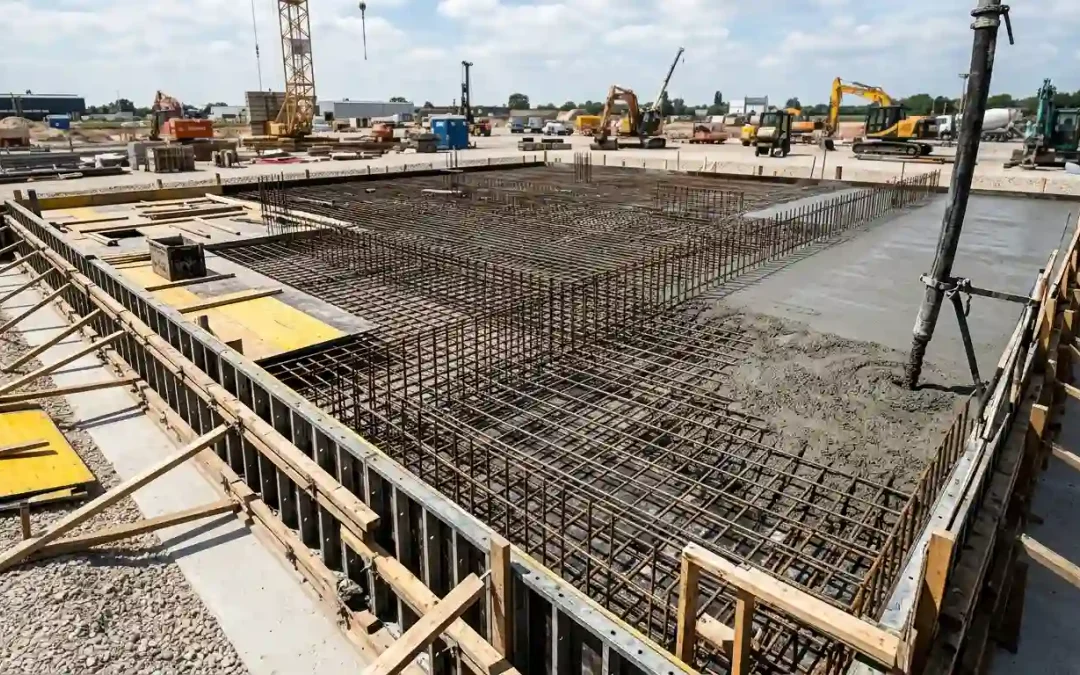
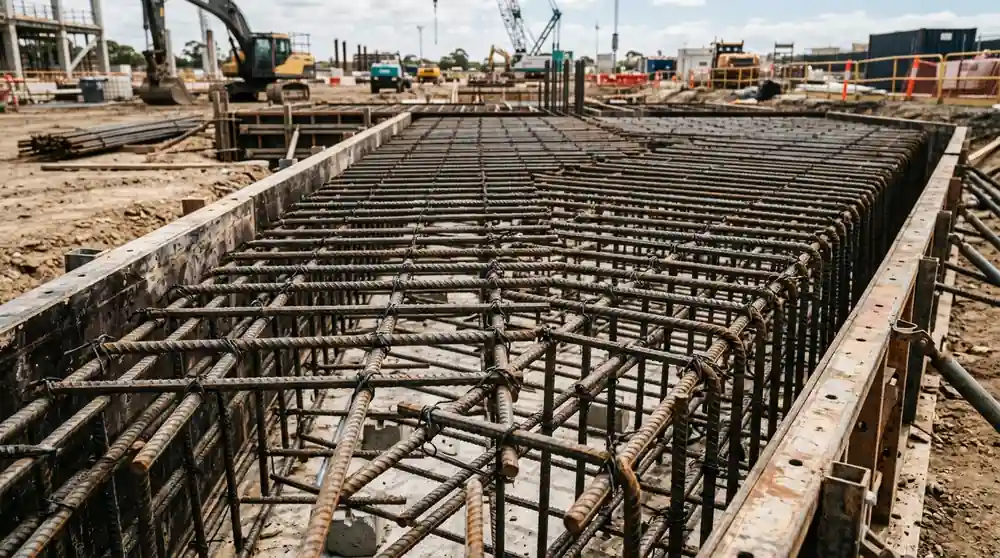
Reo is Australian construction shorthand for reinforcing steel: the bar, mesh and prefabricated assemblies fixed inside formwork so concrete can carry tension. It goes in before the pour, and it must match the drawings, hold its cover and fit around formwork, penetrations and starter bars. When reo is late or wrong, the booked pour moves.
Key takeaways
- Reo means reinforcement or reinforcing steel. It is a coordinated structural package, not steel simply dropped into concrete.
- Bar, mesh and prefabricated cages suit different elements. None is universally better.
- Steel fixing depends on formwork release, delivery, access, cover, chairs, spacers and starter bars being right.
- Reo scheduling should work backwards from the booked pour, with time for inspection and rectification.
- Delays can start in design, supply, formwork or coordination, not only on the fixing crew.
What does reo mean in construction?
Reo is short for reinforcement, and it is everyday vocabulary on Australian sites. Reinforcing steel gives concrete the tensile capacity it lacks on its own. The designer decides type, size, spacing and arrangement, and the reinforcement drawings and schedules record them. Structural changes go back through the engineer. AS 3600 governs concrete structures, and AS/NZS 4671 covers the steel itself. The ACRS certifies bar and mesh to that standard.
What is the difference between reo bar, mesh and prefabricated cages?
Reinforcing bar is individual lengths, straight or cut and bent to a schedule, tied on site. Reinforcing mesh is welded sheets of bar or wire, laid as a unit. Prefabricated cages are assemblies made up in advance, then lifted into position.
| Reinforcing bar | Reinforcing mesh | Prefabricated cage | |
| Typical use | Slabs, beams, walls, columns | Slabs and walls with regular layouts | Columns, beams, repeated elements |
| Handling | Bundles, manual fixing | Sheets, awkward in wind | Crane lifting, storage space |
| Key advantage | Adapts to complex detailing | Fast coverage of open areas | Assembly off the critical path |
| Key limitation | Labour-intensive in dense zones | Less suited to congested detail | Needs early design and lifting plan |
| Consider when | Geometry varies | Layout repeats | Repetition and access justify it |
Choice depends on design, geometry, density, repetition, access and programme. A project often uses all three.
What does a steel fixer do?
A steel fixer reads reinforcement drawings and bar schedules, identifies bar marks, positions and ties reinforcement, installs mesh, and fits chairs and spacers to hold cover. They also coordinate starter bars, work around penetrations and embedded items, and prepare the zone for inspection.
It is not simply placing steel inside formwork. The fixer works within the design, the formwork geometry, access conditions and the pre-pour inspection process. Manual handling is a real constraint, and SafeWork SA’s steel fixing guidance covers the injury risks. Because the fixers sit between the finished deck and the waiting concrete truck, steel fixing within a structural package tends to set the pace for everything after it.
How is reo scheduled and delivered?
Reinforcement scheduling on an Australian building site starts well before steel reaches the workface. Drawings become bar schedules, then fabrication and delivery orders, and deliveries need a place to land and a way up.
Schedule to the construction sequence, not just the total quantity. Reo that arrives too early clogs storage and handling. Reo that arrives late stalls the fixing sequence and can move the pour date. Deliver identified bundles to the zone being fixed next, not whenever space appears. We do not quote lead times, because they vary by project.
How does reo coordinate with formwork?
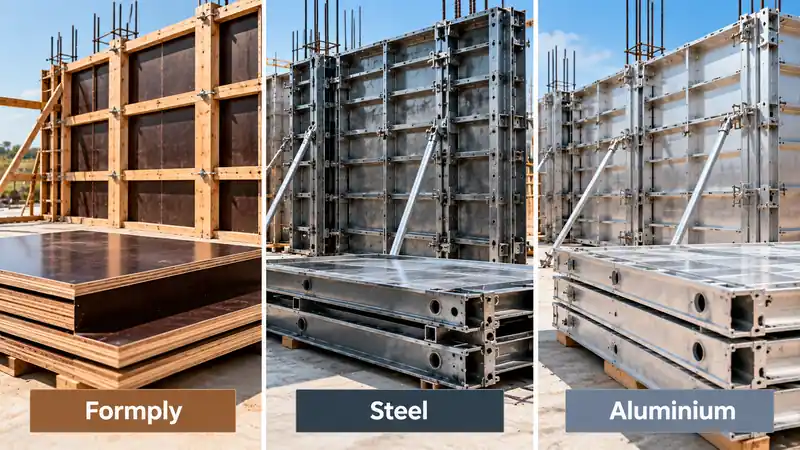
Formwork sets the geometry and boundaries reo must fit. Reo cannot be treated as a separate trade from it. Fixing can only start once formwork is released and checked, and reo access, cover and penetrations all depend on what the formwork crew has set. Each handover is a small hand-off with big consequences, which is why form, reo and pour sequencing is best read as one connected cycle, the idea behind FRP itself.
Why do cover, chairs and spacers matter?
Cover is the distance from reinforcement to the concrete surface, and the design sets it. Chairs support bars and mesh at the right height, and spacers hold them away from the form face. Without them, reinforcement can sag or shift under foot traffic and concrete load. Check cover before placement against the project documentation.
What are starter bars and why do they matter?
Starter bars project from one pour so reinforcement continues into the next element, such as a wall or column rising from a slab. If they are misplaced, the next stage cannot lap correctly.
How do penetrations and congestion affect reo?
Services need openings, sleeves and embedded items, and each affects the steel around it. Do not alter reinforcement on site to make room. Raise it with the engineer. Congestion at beam-column intersections, cores and transfer zones can make bars hard to place and concrete hard to compact, so review buildability early with the engineer and builder.
What happens during a pre-pour inspection?
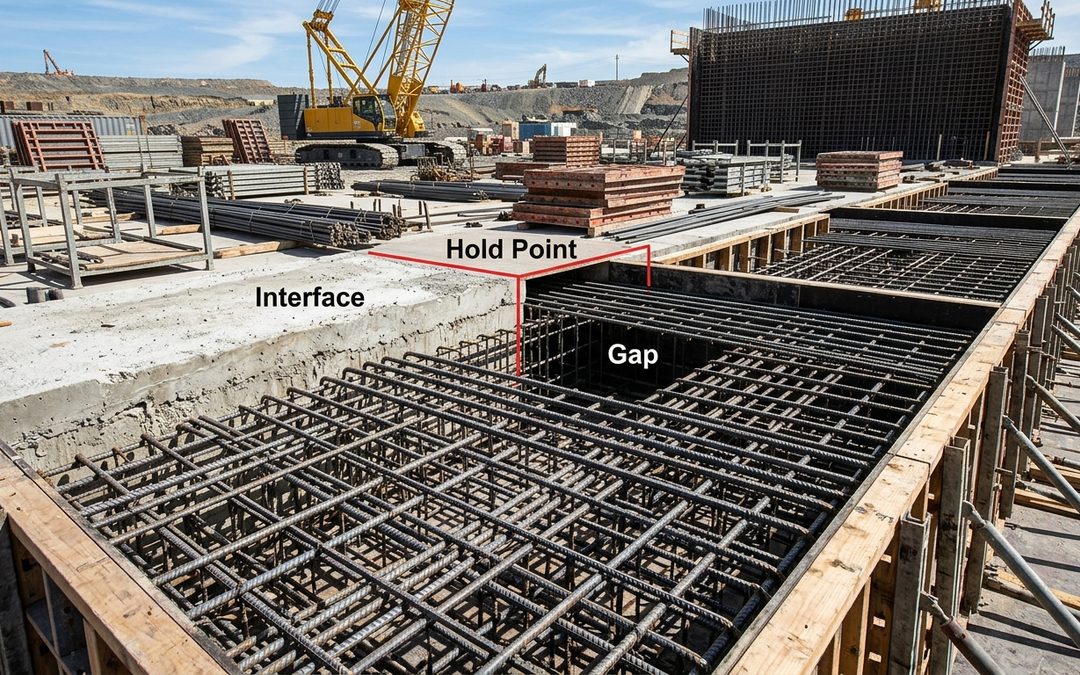
A pre-pour inspection is a readiness check before concrete is committed. Typical items include bar size and location, spacing, cover, chairs and spacers, starter bars, penetrations, embedded items, formwork cleanliness, access and records. The project’s inspection plan and contract set the actual hold points, which stop the pour until a required inspection is signed off.
Defects found here need rectifying before concrete is booked, or the booking is at risk. Concrete placement is only as ready as this check says it is.
Why can reo delay a concrete pour?
Reinforcement is often where pour readiness is won or lost, because it sits between formwork release and the booking. Causes include late delivery, incorrect or incomplete schedules, congestion, access, penetration conflicts, starter-bar errors, missing chairs, failed inspections, late design changes and too few fixers.
Not every delay starts with the fixing crew. Many begin in design, procurement, fabrication, formwork or coordination, so avoid blaming one trade.
How does reinforcement fit into the form, reo, pour cycle?
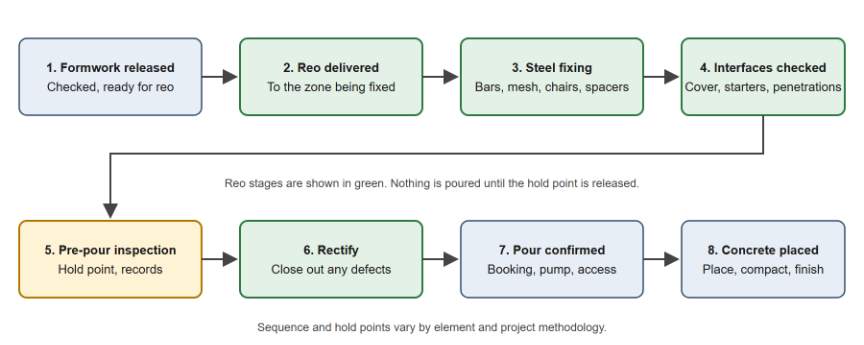
| Stage | Key coordination point | Potential delay | Readiness check |
| Formwork release | Set-out and access | Late release | Formwork checked |
| Delivery | Zone and lifting | Wrong or late material | Marks match schedule |
| Fixing | Cover, starters, penetrations | Congestion, labour | Cover verified |
| Inspection | Records, services | Open RFIs | Sign-off recorded |
| Pour | Booking, pump, access | Rectification | Pour confirmed |
The exact sequence varies by element and project methodology.
How should reo be scheduled against a booked pour?
Work backwards from the planned pour. Identify when reo must be complete, then allow time for fixing, coordination, inspection, rectification and final preparation. Durations vary with element, geometry, density, crew and access, so we do not offer a standard number.
How Future Form can help
Future Form is a Sydney-based structural package specialist with over 20 years in formwork. Reo is the R in our FRP approach, delivered alongside formwork and concrete as one package, so steel fixing can be sequenced against formwork release and booked pours instead of managed as a separate interface. We develop steel fixing schedules in parallel with formwork plans and pour cycles, with clear handover points before reo mobilisation. This does not remove every programme risk, and methodology is project-specific.
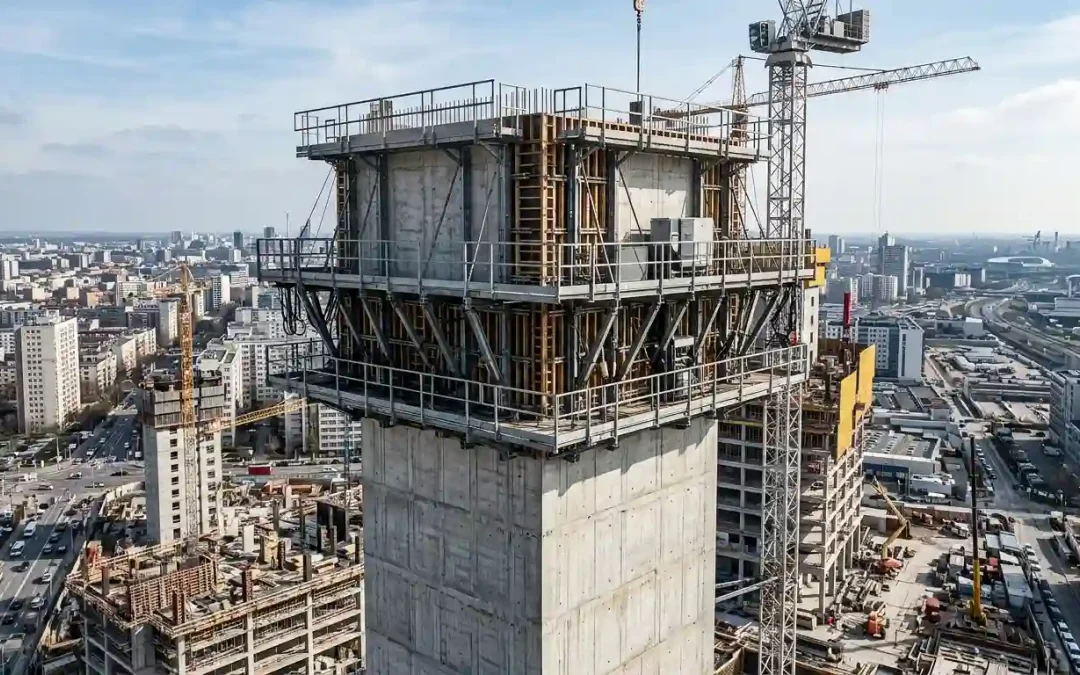
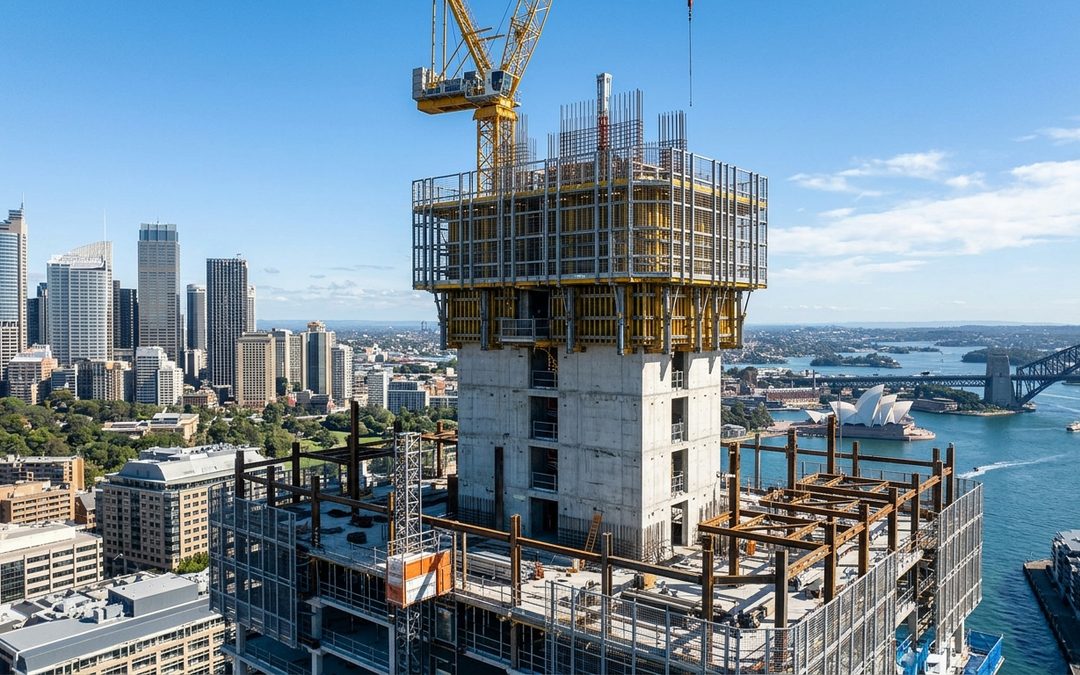
That thinking carries across our projects. On a 28-storey tower like Smith Street, Parramatta, curved jump-form cores mean reo has to be planned around formwork geometry long before the crew reaches the deck. At The Langston in Epping, three towers of 19 to 29 levels over four basement levels, with more than 5,000 m² of horizontal formwork on each basement level, used an early strip formwork system to accelerate the program, which tightens the window the next stage has to be ready in. At King & Phillip, prefabricated columns with pre-installed reo cages show the other end of the spectrum, where fixing moves off the critical path and into planning. Every project asks a different question of reinforcement, so the answer is always worked out for the job in front of us. It is also why the questions worth asking early are about formwork readiness and how an FRP contractor will hand over to reo, long before anyone talks about scope and services.
6 FAQ
1. What does reo mean in construction?
Reo is Australian shorthand for reinforcement or reinforcing steel, including bar, mesh and prefabricated assemblies, used to give concrete tensile capacity.
2. What does a steel fixer do?
A steel fixer positions and ties reinforcement from drawings and schedules, fits chairs and spacers to hold cover, coordinates starter bars and penetrations, and prepares the work for inspection.
3. What is the difference between reinforcing bar and mesh?
Bar is individual lengths tied on site and suits varied detailing. Mesh is welded sheets that cover open areas quickly. Neither is better everywhere.
4. Why can reo delay a concrete pour?
Reo sits between formwork release and the pour, so late delivery, congestion, access, defects or inspection failures move the booking. Many causes originate upstream.
5. What are chairs and spacers used for?
Chairs support reinforcement at the right height, and spacers keep it clear of the form face, so cover is maintained during the pour.
6. How does Future Form coordinate reo with formwork?
Future Form delivers form, reo and pour as one package, with steel fixing schedules developed alongside formwork plans and defined handovers before reo starts.
Reo is where the pour starts to become real
Reo is reinforcing steel, but on site it is a coordinated activity that depends on formwork readiness, delivery, access, cover, chairs, spacers and starter bars. The pre-pour inspection confirms it, and the schedule decides whether the booking holds. Form, reo and pour work best as one connected cycle.
If you want to understand how reinforcement can be scheduled and coordinated on an upcoming structural project, speak with a Future Form expert. A concrete pour is only as ready as the reinforcement beneath it.