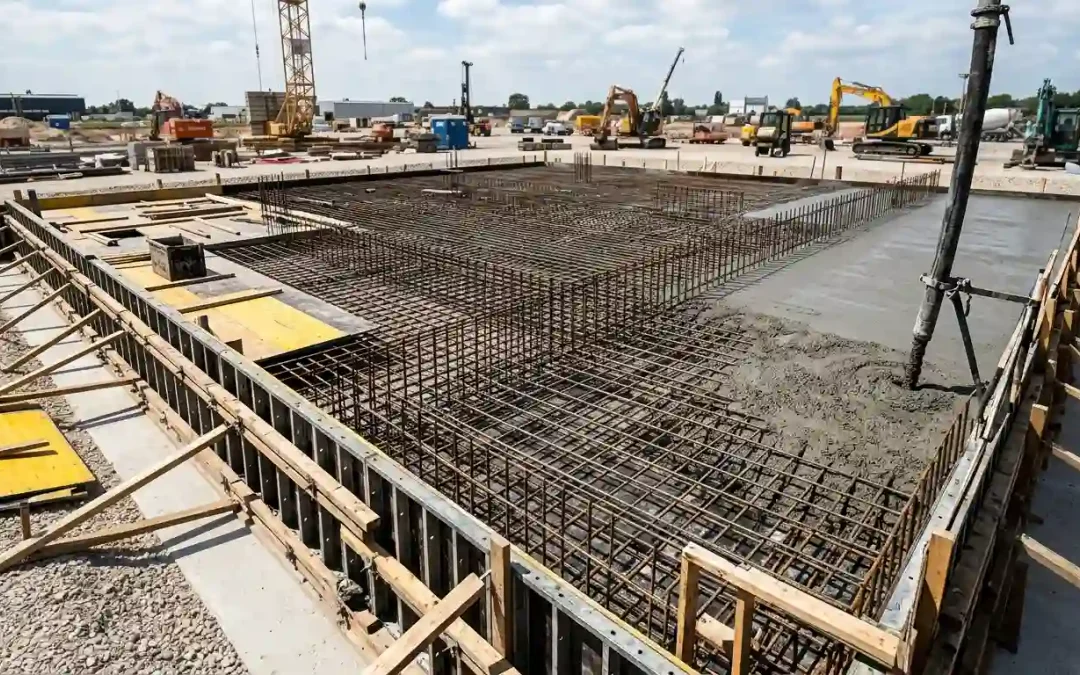

FRP stands for Form, Reo and Pour — the three coordinated stages that build an in-situ concrete structure. Form is the temporary structure that shapes and supports the concrete, reo is the steel reinforcement fixed inside it, and pour is the concrete placed, compacted and cured. On an Australian construction site, that is what the letters mean.
You will meet the term in a tender, a subcontractor discussion or a line on the programme, and it is rarely explained — everyone on site assumes you already know. Here is the plain version, plus the part that matters commercially: how the three stages fit together.
Key takeaways
- FRP means Form, Reo and Pour — formwork, reinforcement or steel fixing, and concrete placement.
- It is a sequence, not a product, run in fixed order with an inspection gate between each stage.
- FRP is broader than formwork. Formwork is only the first letter; reo and pour are separate scopes.
- An integrated FRP package hands all three to one contractor under a single structural scope.
- Coordination drives programme. Most structural delay happens at the handovers, not inside them.
- FRP has other meanings — usually fibre-reinforced polymer — but on an Australian site it means form, reo and pour.
What the letters in FRP mean and which trades they cover
Each letter is a distinct trade with its own labour, plant, standards and inspection regime. Together they produce one structural element.
| Letter | What it is | Typical scope on site | Key standard |
| Form | The temporary mould and support structure | Decks, wall and column forms, jumpform, falsework, box-outs, stripping, backpropping | AS 3610 |
| Reo | Steel reinforcement fixed inside the form | Bottom and top bar, mesh, ligatures, chairs, laps, starters, cast-in items | AS/NZS 4671, AS 3600 |
| Pour | Concrete placement and everything around it | Pump set-up, placement, compaction, screed, finish, joints, curing | AS 1379, AS 3600 |
Form — the temporary structure that shapes the concrete
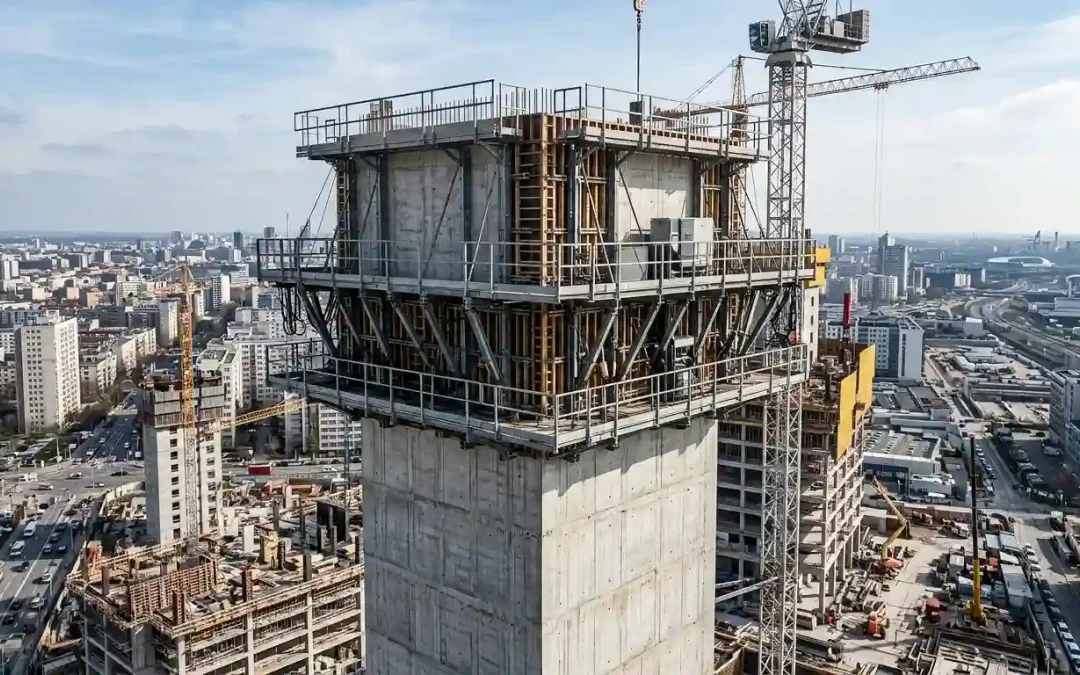
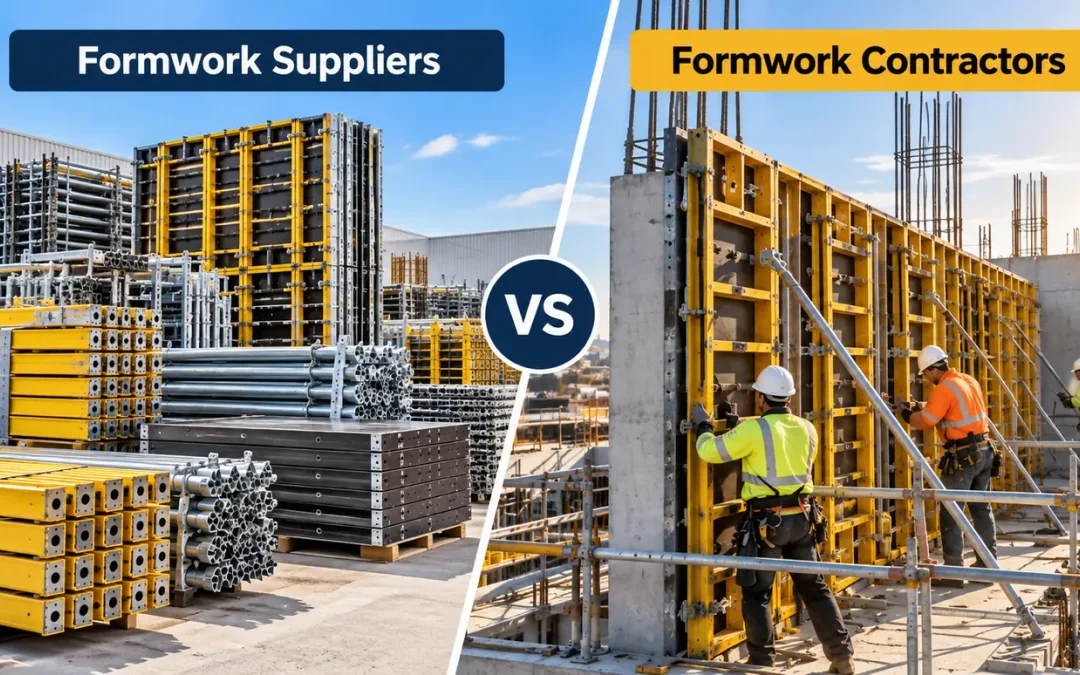
Formwork is the temporary structure that holds wet concrete in position until it can carry itself: falsework and props, deck and table forms, wall and column forms, jumpform on cores, edge protection, then stripping and backpropping.
Form is not carpentry with a deadline. It is a designed structure carrying live loads, built in line with AS 3610 Formwork for concrete and certified by a competent person before it is loaded, as Safe Work Australia’s formwork and falsework guidance sets out. The formwork system chosen also sets the cycle time for everything that follows.
Reo — the reinforcement that carries the tension
Reo is Australian shorthand for reinforcement, and the trade is usually called steel fixing. Concrete is strong in compression and weak in tension, so the steel does the tensile work: bottom and top bar, mesh, ligatures, chairs and spacers, laps, starter bars, trimming to penetrations, plus cast-in ferrules, dowels and conduit.
Reo is where tolerance discipline lives. Cover, lap length and bar spacing deliver the capacity and durability the engineer assumed under AS 3600, and the bar itself must comply with AS/NZS 4671.
Pour — the coordinated concrete placement stage
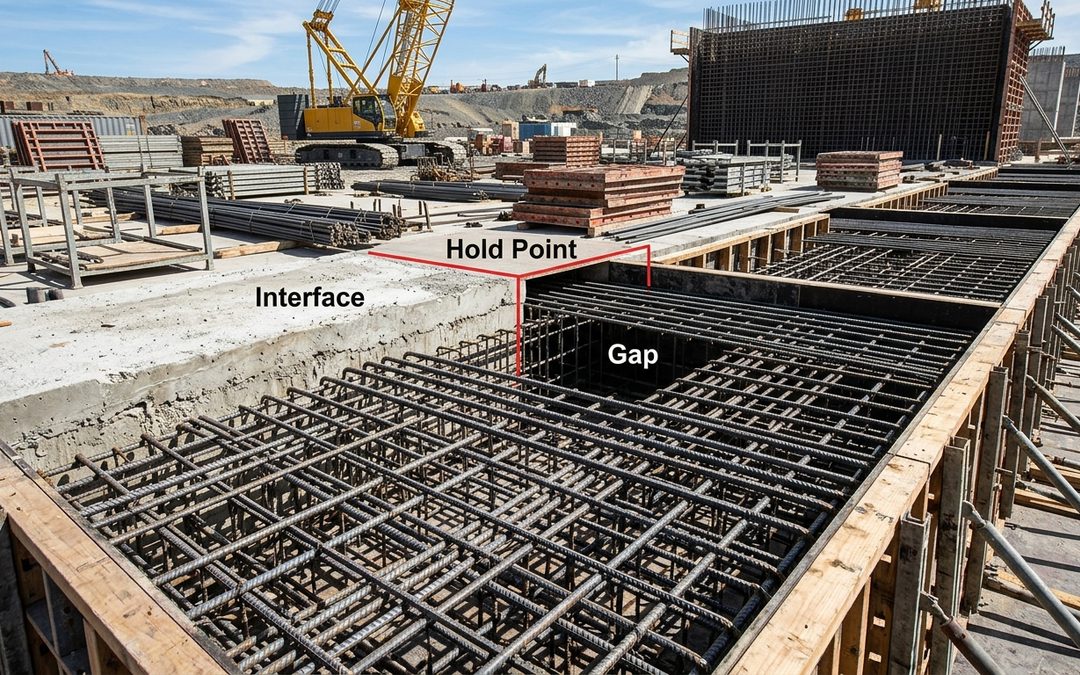
The pour runs from pre-pour hold points through pump set-up, placement, compaction, screeding, levels and falls, finish, joint formation, curing and protection. Supplied concrete is accepted under AS 1379, and placing equipment carries its own controls under SafeWork NSW’s formwork and concrete placing guidance.
Calling it “the pour” undersells it. Placement rate, lift heights, vibration access and curing are planning decisions made long before the trucks are booked — controls set out in Cement Concrete & Aggregates Australia’s Guide to Concrete Construction.
How form, reo and pour work together
The three stages are strictly sequential and each handover has a gate. Nothing progresses until the previous stage is signed off, which is why FRP is best understood as one continuous cycle rather than three separate jobs.
| Stage | Activity | Gate before the next stage |
| 1 | Survey and set out, erect falsework and deck | Level and stability confirmed |
| 2 | Complete formwork, penetrations and edge protection | Formwork certified |
| 3 | Fix bottom reo, chairs and spacers | Cover and spacing checked |
| 4 | Coordinate services and cast-in items | Penetrations agreed |
| 5 | Fix top reo and trimming steel | Pre-pour reo inspection passed |
| 6 | Place, compact and finish the concrete | Slump and finish accepted |
| 7 | Cure, strip and backprop | Strength gain confirmed |
That is the form, reo and pour sequence on a typical suspended floor: one deck, one crane, one cycle, repeated level after level.
Why coordination between the three stages matters
Because the stages are locked together, a delay in one is a delay in all three. Most structural lost time is not a trade failure; it is an interface failure. The deck is ready but the reo delivery is short. The reo is fixed but the electrician still needs conduit. The pour is booked but the formwork certificate is outstanding. Small problems, large idle crews.
Sound FRP coordination attacks those interfaces during planning — buildability checks ahead of the deck, reo schedules aligned to the fixing sequence, pours sized against realistic placement rates. That discipline shows up directly in programme, labour, access, safety and quality on a large-scale project.
Is FRP the same as formwork?
No. Formwork is only the first letter. An FRP package covers formwork plus reinforcement and concrete placement, so a formwork contractor and an FRP contractor are not offering the same scope.
The distinction matters at tender. A quote priced as formwork alone leaves reo and pour to be let separately, with the interfaces between them sitting on the builder. An integrated FRP package carries all three under one scope of works, one programme and one accountable party.
Who performs FRP work in Australia?
FRP work is performed by specialist structural subcontractors — formwork contractors, reinforcement contractors and concrete placement crews — engaged either separately or as one integrated FRP contractor that self-performs all three.
The difference is not only commercial. Split across three trades, the builder holds three programmes and three sets of incentives that do not naturally align; when a deck runs late, everyone has a defensible position and the slab is still late. Under an integrated structural package, labour flexes between the three stages, one supervision structure runs the cycle, and one contractor answers for it.
What FRP means in other industries
Outside the site fence, FRP most often means fibre-reinforced polymer — a composite of resin and glass, carbon or basalt fibres used for strengthening, pipework, gratings and corrosion-resistant structures, and researched at Australian institutions including the University of Sydney. Confusingly, it appears in concrete contexts too, as FRP wrapping and FRP reinforcing bar. In finance it means financial restructuring plan, which has no bearing on a structural scope.
How to tell which applies: read the surrounding document. In a programme, trade breakdown or subcontract scope, FRP means form, reo and pour. In a materials specification, durability report or strengthening design, it means fibre-reinforced polymer.
Getting this right is not pedantry. “FRP included” in a subcontract means an entire structural cycle — misread it as formwork only, and two trades quietly fall out of the price.
How Future Form can help
Future Form delivers form, reo and pour as one integrated FRP package, self-performing the full structural scope so a builder manages a single interface across the cycle rather than three.
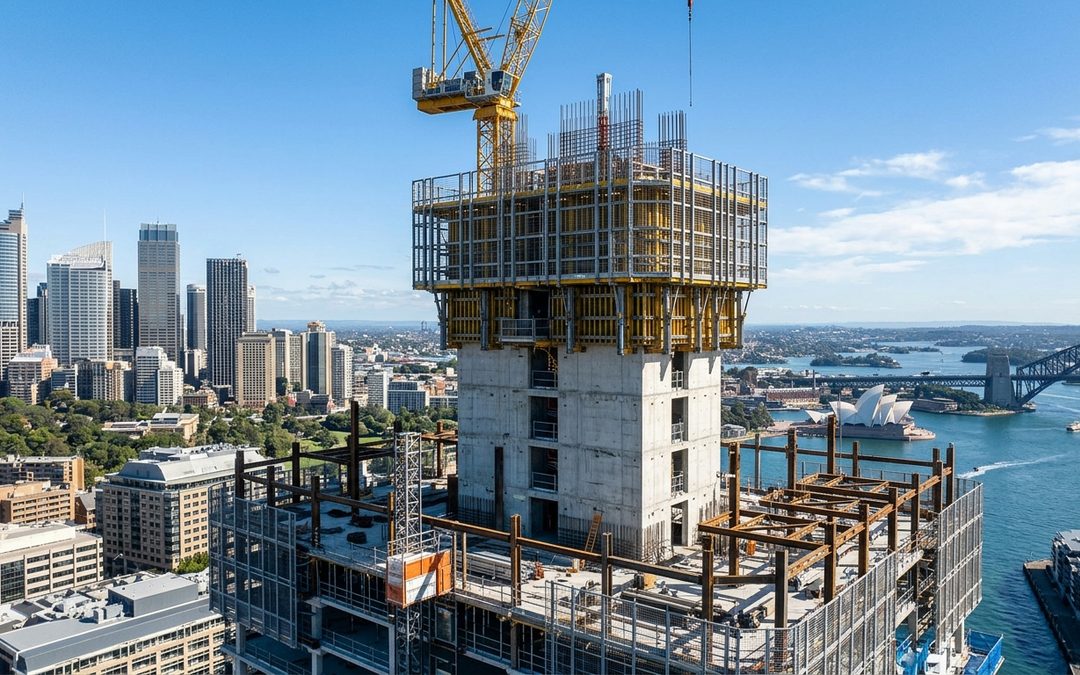
That scope covers formwork systems designed to the structure and the programme, jumpform for cores, high strutting and engineered scaffold, steel fixing across decks, walls, columns and cores, and concrete works through to finish and curing — with engineering, supervision and certification behind each stage. Future Form Civil applies the same approach to civil and infrastructure structures, where one-off geometry drives the method.
Behind it sits more than 20 years in the industry, an experienced structural team, ISO 9001, ISO 45001 and ISO 14001 certified systems, and a record across major projects in NSW and the ACT. For the full breakdown of a structural scope, our complete guide to form, reo and pour goes stage by stage.
Frequently asked questions
1. What does FRP stand for in construction?
FRP stands for Form, Reo and Pour — formwork, reinforcement or steel fixing, and concrete placement, run as one coordinated sequence to produce an in-situ concrete element such as a slab, core, column or wall.
2. What does Form mean in FRP?
Form means formwork: the temporary structure shaping and supporting wet concrete until it can carry itself. It covers falsework, decks, wall and column forms, box-outs, stripping and backpropping, and is certified under AS 3610 before loading.
3. What does Reo mean in FRP?
Reo means reinforcement — the steel fixed inside the formwork to carry tensile forces. The trade is steel fixing, covering bar, mesh, ligatures, chairs, laps, starters and cast-in items, with cover and spacing controlled to the structural drawings.
4. Is FRP the same as formwork?
No. Formwork is the first of the three stages. FRP covers formwork, reinforcement and concrete placement together, so an FRP scope is materially broader than a formwork-only scope at tender.
5. What is included in an FRP package?
Formwork design, certification, falsework, stripping and backpropping; reinforcement fixing, cover control and cast-in items; and pour preparation, placement, compaction, finishing, joints and curing — plus the hold points between each stage.
6. What does FRP mean on an Australian construction site?
Form, reo and pour. If a foreman says the FRP crew are on level 12, they mean the crew forming, fixing and pouring that deck — not fibre-reinforced polymer.
Three letters, one structural package
FRP is simple to define and easy to underestimate. Form shapes the concrete, reo gives it strength, pour completes it — but the value sits in how tightly the three are held together, because every gap between them is a gate someone has to close before work continues.
That is why the terminology is worth getting right. When FRP appears in a scope of works or a programme, you are looking at an entire structural cycle, not one trade — and that changes how you compare tenders, split a subcontract and plan a floor.
If you are scoping structural works and want to test what a coordinated form, reo and pour package looks like on your project, speak with a Future Form expert.
Three letters, three trades, one cycle — and the whole structure is standing on how well they are joined.