In construction, standards are not a badge. They are a system.
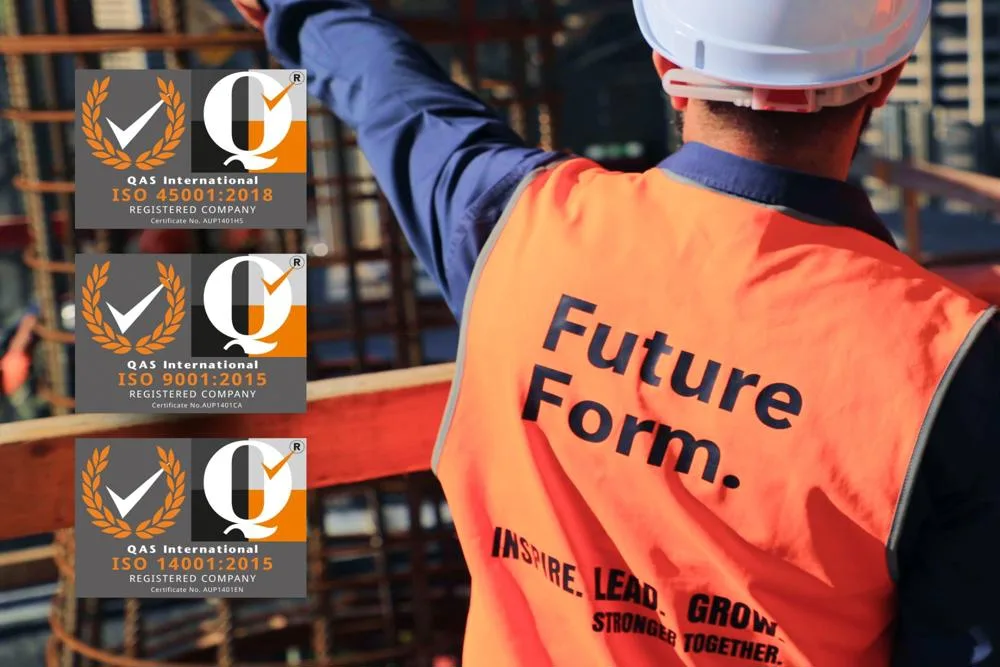
Future Form’s achievement of triple ISO certification marks a significant milestone—not just for the business itself, but for what it represents across the industry. At a time when project complexity continues to increase and expectations around safety, compliance, and performance are higher than ever, this certification signals a deeper commitment to operational excellence.
Rather than being a simple exercise in compliance, achieving ISO standards requires a fundamental shift in how an organisation operates. It demands alignment across every layer of the business—from leadership and strategy through to day-to-day execution on site. For Future Form, this means embedding consistency, accountability, and structured processes into every aspect of its operations.
The three ISO certifications typically cover quality management, environmental responsibility, and occupational health and safety. Together, they form a framework that ensures projects are delivered not only efficiently, but responsibly and sustainably. This is especially critical in construction, where even small inconsistencies can lead to significant downstream risks.
What sets this achievement apart is not the certification itself, but the discipline required to attain and maintain it. It reflects an organisation that prioritises long-term performance over short-term gains. Every process is documented, monitored, and continuously improved. Every decision is made with consideration for safety, environmental impact, and overall project outcomes. And every result is measured against a clearly defined standard of excellence.
In an industry where shortcuts can sometimes be tempting, this level of rigor creates a competitive advantage. It builds trust with clients, partners, and stakeholders, who can rely on a proven system rather than assumptions. It also reduces risk—both operational and reputational—by ensuring that quality and safety are never compromised.
For project owners and decision-makers, working with a contractor that operates under these standards provides a level of assurance that goes beyond traditional metrics. It means greater predictability, fewer disruptions, and a higher likelihood of achieving desired outcomes. In many ways, it shifts the conversation from reactive problem-solving to proactive performance management.
This is particularly relevant as the construction sector continues to evolve. Increasing regulatory scrutiny, rising client expectations, and the need for sustainable practices are all pushing the industry toward higher standards. Companies that embrace structured systems and continuous improvement will be better positioned to navigate these changes and deliver consistent results.
Future Form’s triple ISO certification is a clear example of what it takes to operate at this level. It demonstrates that excellence is not accidental—it is built through intentional systems, disciplined execution, and a commitment to doing things the right way, every time.
For organisations aiming to elevate their own performance, this serves as a strong benchmark. It highlights the importance of investing in processes, people, and systems that support long-term success rather than short-term wins.
To explore how this is being applied in practice, read the full article:
https://www.buildaustralia.com.au/business_insight/future-form-iso/