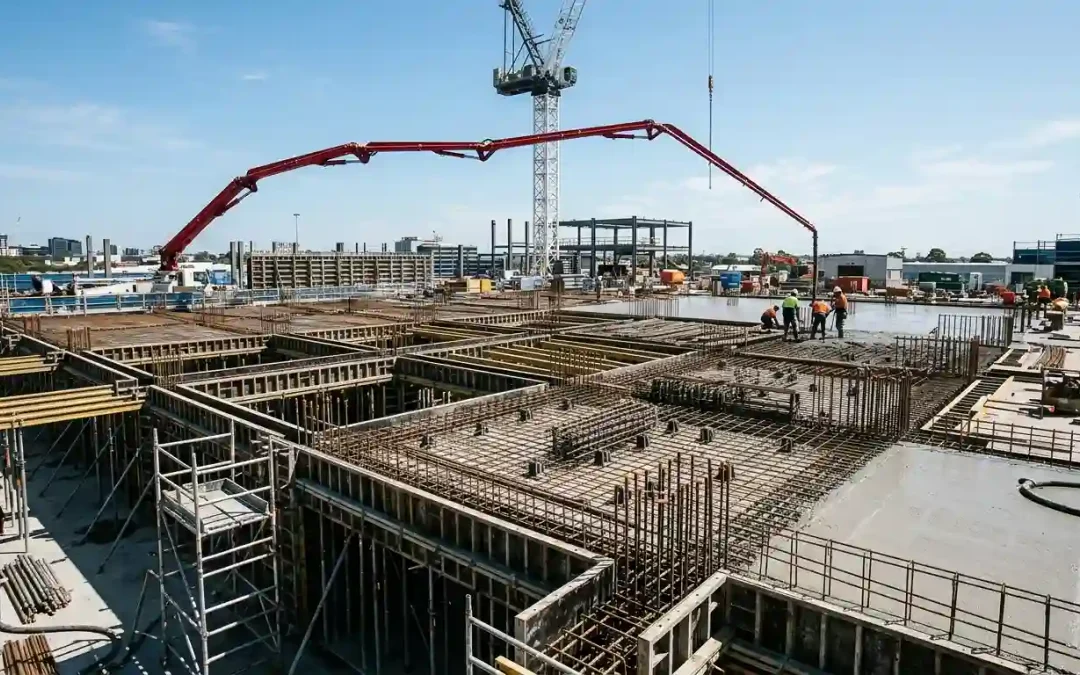
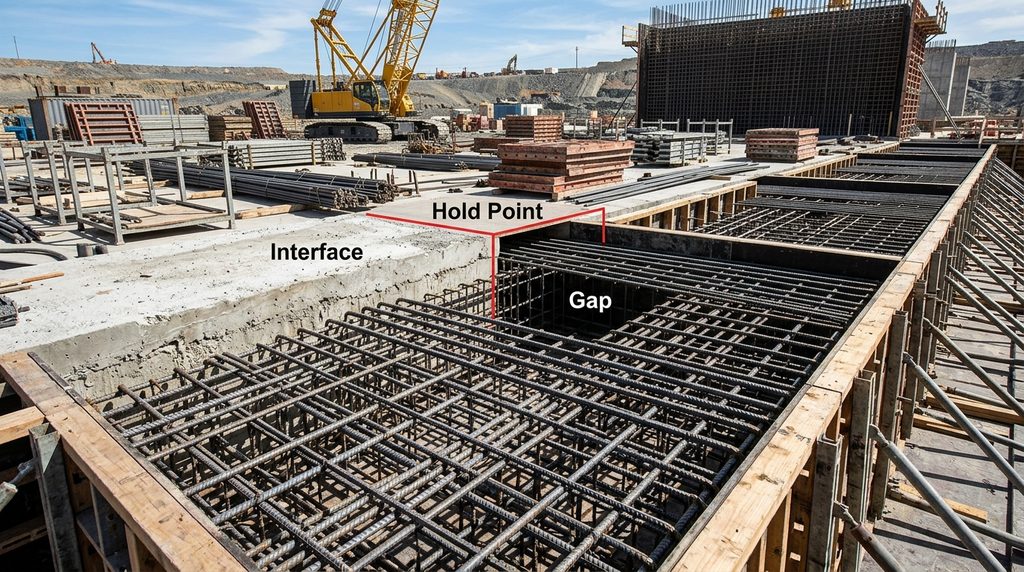
FRP stands for formwork, reinforcement and pour, the three activities that turn structural drawings into in-situ concrete. FRP coordination is the work of managing the interfaces between them so each stage is ready for the next. The risk rarely sits inside one trade. It sits in the gaps, where nobody has been told they own the problem.
This guide maps those gaps and the hold points that catch them. It is general information, not legal advice. Responsibility depends on your contract, specifications and procurement model.
Key takeaways
- Structure programmes usually lose time at trade interfaces, not within each trade.
- FRP coordination is a system of ownership, information flow and hold points. It extends to services, post-tensioning (PT), precast and embeds.
- Hold points stop work until a defined check is passed, and information must arrive before the activity that needs it.
- “Coordinate with other trades” is not a scope. Name the action, owner, deadline and approver.
- Pour readiness is a coordinated outcome, not just “formwork complete” and “reo complete”.
Where do structure programmes lose time?
Structure programmes lose time at hand-offs: formwork releasing late to the steel fixers, reo arriving after the inspection window, a penetration confirmed after the bars are tied, or a pour booked before an RFI is closed. Each trade can be on programme and the structure can still slip. Our guide to FRP coordination for large-scale projects covers the wider picture.
What are the main interfaces between formwork, reo and pour?
In a typical cycle, formwork is set out and closed, reinforcement is fixed to the schedule, services and embeds are located, the pre-pour inspection is passed and the concrete is placed. The interfaces are:
- Formwork and reinforcement: cover, levels, fixing access and who closes what.
- Reinforcement and pour: completion, inspection and release to concrete.
- FRP and services, PT, precast and embeds: penetrations, tendon layouts, connections and cast-in items.
- Temporary works: propping, back-propping and crane loads.
- Information: design to site, shop drawings to approved information, material lead times to programme.
How the form, reo and pour sequence is set up decides whether these hand-offs flow or stall.
What are hold points in concrete construction?
A hold point is a defined stage where work must stop until a nominated person has inspected and released it. Safe Work Australia’s formwork and falsework guidance points to inspection and certification before formwork is loaded, and SafeWork NSW’s formwork collapse alert urges a competent person to certify completed formwork before loading. A hold point matters most where work cannot be inspected once concrete covers it, such as reinforcement.
The actual process depends on the project’s Inspection and Test Plan (ITP), contract, specifications, builder procedures and regulatory requirements. Typical hold points include:
- Formwork readiness: line, level, bracing, cleanliness and certification where required. Checked by the formwork contractor, then the builder or engineer. Catches movement and leaks.
- Reinforcement inspection: bar size, spacing, laps, cover and chairs against the approved reinforcement schedule and the engineer’s design under AS 3600. Steel fixer, builder and engineer. Catches omissions that cannot be fixed later.
- Services, penetration and embed verification: locations and sizes against the penetration register.
- PT and precast interface verification: tendons, anchorages and connection inserts.
- Engineering sign-off and final pre-pour inspection: the above closed, RFIs resolved, access and concrete supply confirmed.
If a hold point is not passed, the pour waits. That is frustrating at 6am, but far cheaper than breaking out cast concrete.
Who owns each FRP interface?
There is no universal answer. Ownership follows contract scope, design responsibility, trade packages and the procurement model. The matrix below is a starting point for scope reviews and tender discussions, not a contractual allocation. Confirm every line against the project documents.
FRP interface matrix: trade, interface and typical owner
| Interface | Parties | Typical owner (confirm in contract) | Information required | Hold point / check | Risk if missed |
| Formwork ↔ reo | Formwork, steel fixer | Party holding the FRP package or builder-defined sequence | Approved formwork and reo drawings | Line, level, cover, access | Rework, pour delay |
| Reo ↔ pour | Steel fixer, concrete, engineer | Reo contractor completes; builder or engineer releases | Reo schedule, ITP | Reinforcement inspection | Failed inspection, missed booking |
| Formwork ↔ pour | Formwork, concrete | Formwork contractor, with temporary works designer | Pour sequence, pressures, certification | Formwork certification | Blowout, collapse risk |
| FRP ↔ services | Services trades, FRP | Services contractor supplies; FRP installs per register | Penetration register, coordinated drawings | Penetrations and sleeves verified | Coring, cutting, rework |
| FRP ↔ embeds | Façade, services, FRP | Supplier supplies; FRP fixes; builder verifies | Embed schedule, locations | Cast-in items checked | Missing or misplaced items |
| FRP ↔ PT | PT contractor, FRP | PT contractor owns tendon layout; FRP coordinates access | PT shop drawings | PT interface verified | Clashes, redesign |
| FRP ↔ precast | Precast, FRP, builder | Per package; connections to engineer’s details | Precast shop drawings, tolerances | Interface checked | Installation or pour delay |
| FRP ↔ temporary works | Temporary works designer, builder | Designer certifies; builder controls loads | Temporary works design | Certification, back-propping plan | Overload, stand-down |
| Design ↔ site | Designer, builder | Builder issues approved information | Current revision register | Revision check | Work to superseded drawings |
| Procurement ↔ programme | Supplier, FRP, builder | Party ordering the materials | Lead times, delivery dates | Material confirmed before inspection | Late reo, idle crews |
| Hold points ↔ booking | Builder, FRP, supplier | Builder or FRP, per contract | Pour card, closed RFIs | Final pre-pour inspection | Cancelled pour, standby cost |
How should RFIs, shop drawings and schedules flow?
Information must reach the right party before the activity that depends on it. Design drawings and revisions feed shop drawings and the reinforcement schedule, which are reviewed and returned approved. Formwork drawings, the penetration register and PT or precast drawings are cross-checked before anything is fixed.
A reinforcement schedule drives detailing, fabrication, delivery and the inspection date. A penetration register records every opening and sleeve in one place so services and structure are checked together.
An RFI is the right tool when information is missing, conflicting or ambiguous. A useful one names the drawing, location, trade and affected activity, and the decision needed by when. A vague RFI invites a vague reply. Close RFIs before work reaches a hold point; they are no substitute for proactive coordination. Late information means rework, stand-downs, missed bookings, extra crane demand and disputes.
How does FRP coordinate with services, PT and precast?
Resolve these well before the final pre-pour stage.
Services: mechanical, electrical, hydraulic and fire services need openings and cast-in items. Register and approve penetrations before formwork closes and reo is tied. A sleeve moved later means cut or re-fixed bars, which only the engineer can approve.
Post-tensioning: PT layout, anchorages and stressing access affect formwork edges and reo placement. The FRP team needs those drawings early.
Precast: panels, beams and columns bring connections, tolerances and temporary support. Specific solutions belong with the project engineer.
What happens when reo arrives late for a booked concrete pour?
The fixing crew compresses, inspection slips, the concrete booking and pump are wasted or rescheduled, and the next level starts late. One incomplete interface can hold up several finished activities.
Responsibility depends on the contract: who ordered the material, who owned the reinforcement schedule and approvals, whether drawings arrived late, and what notice obligations apply. Write those answers down before the pour. Pour readiness means form, reo, penetrations, embeds, PT, precast, inspections and RFIs are all closed, and supply and access are confirmed.
How should coordination responsibilities be written into an FRP scope?
Replace “coordinate with other trades” with specifics. For each obligation, state who performs the action, what information they must provide, when, who reviews and approves it, what counts as complete, and what happens if information is late or incomplete. Cover shop drawings, penetrations, services, PT and precast interfaces, RFIs, lead times, notice, coordination meetings, rework where information changed, and readiness confirmation before a booked pour.
Our FRP scope checklist lists items that commonly fall between trades, such as crane time and survey control. Have legal and commercial advisers review any wording. When procuring, ask who owns each interface, which hold points apply and what is excluded, and how an FRP contractor manages lead times and pour readiness.
How Future Form can help
Future Form is a Sydney-based integrated FRP contractor delivering formwork, steel fixing and concrete works, backed by more than 20 years in the industry and ISO 9001, 45001 and 14001 accreditation. Holding all three trades means those interfaces sit inside one package rather than between three contracts. Whether that suits a given project is worth weighing, and the thinking behind one FRP subcontractor or three separate trades is a useful place to start.
That has limits. Integration does not mean owning every interface. Services, PT, precast, design information and other contractors still need clearly defined responsibilities, and exclusions such as concrete supply, crane provision or post-tensioning should be stated in the scope.
Our project list shows the kind of interface-heavy structural work involved: Smith Street in Parramatta, a 28-storey residential tower with curved jumpform cores; King & Phillip, where columns were prefabricated with pre-installed reo cages; and 88 Walker Street in North Sydney, a mixed-use tower with a 252-suite hotel and 24 office levels. If you are reviewing an FRP scope or interface responsibilities, speak with a Future Form expert.
6 FAQ
1. What is FRP coordination?
FRP coordination is the management of interfaces between formwork, reinforcement and concrete pour, plus the services, PT, precast and information interfaces around them, so each stage is ready for the next.
2. What are hold points in concrete construction?
Hold points are mandatory stops where work cannot proceed until a nominated person has inspected and released it, such as before reinforcement is covered or concrete is poured. The project ITP and contract set the exact points.
3. Who is responsible when reo arrives late for a booked concrete pour?
It depends on the contract. Responsibility usually turns on who ordered and scheduled the reo, whether approved drawings and schedules were issued on time, and what notice and readiness obligations the scope sets out.
4. How is formwork, reinforcement and pour coordinated on a construction programme?
Through a sequenced programme, approved shop drawings and schedules, a penetration register, closed RFIs, defined hold points and a pour-readiness check before concrete is booked.
5. What should an FRP scope say about coordination responsibilities?
It should name who performs each action, what information is needed, when, who approves it, what completes it, and what happens if information is late. Avoid generic “coordinate with other trades” wording.
6. What does Future Form provide as an integrated FRP contractor?
Future Form delivers formwork, steel fixing and concrete works as one package from Sydney and Western Sydney. Interfaces with services, PT, precast and design remain subject to the project scope. See our FRP guide.
Own the interface, protect the programme
Most programme risk sits where trades meet, not inside them. Clear ownership, hold points, timely RFIs, current shop drawings and early services, PT and precast coordination keep a pour on its booking, and clear scope wording closes responsibility gaps before the site finds them. If you want to discuss FRP coordination, structural sequencing or interface responsibilities on an upcoming project, talk to a Future Form expert. The pour is only as ready as the interfaces behind it.