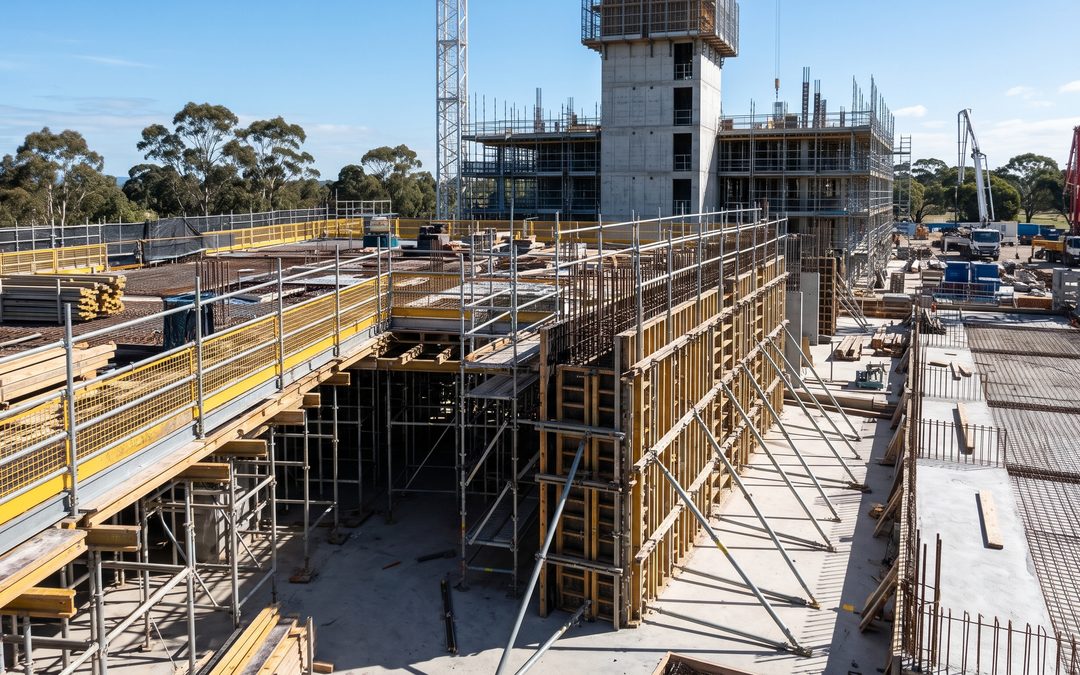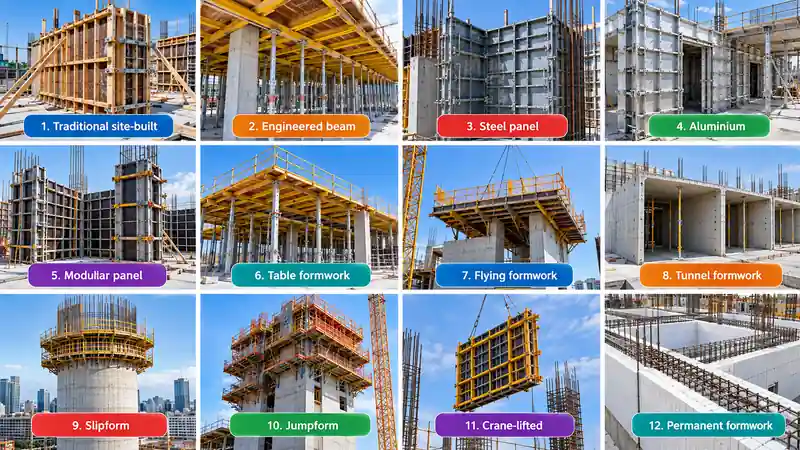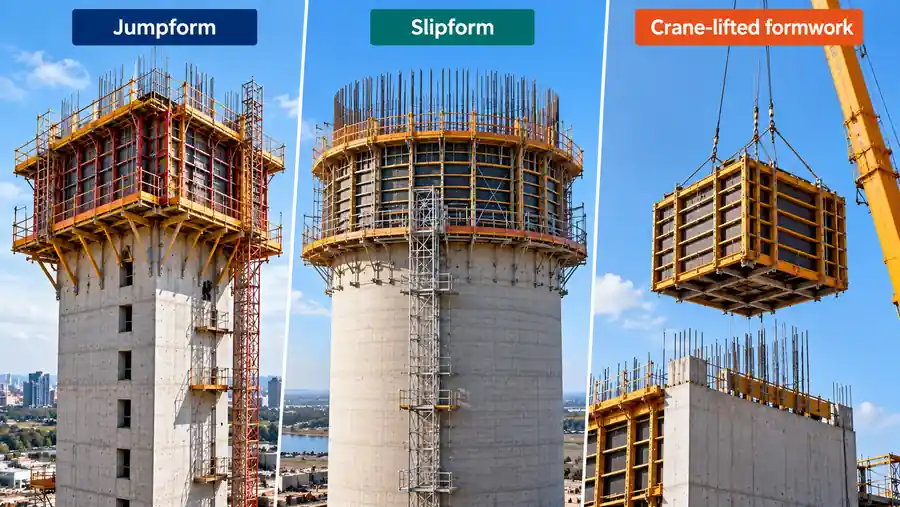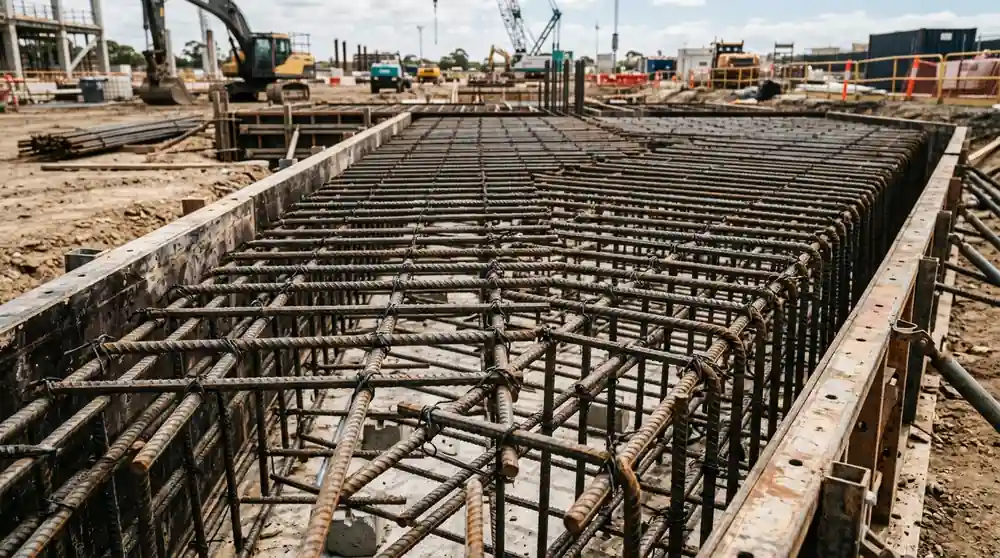
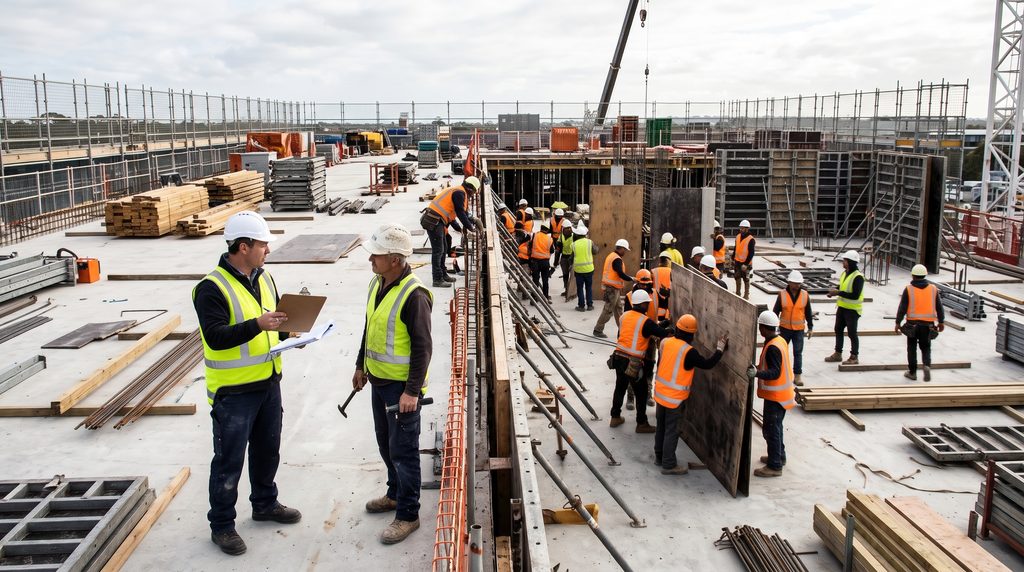
A formwork crew is the team that erects, checks and strips the temporary moulds on one work front, such as a deck or a core. A formwork carpenter is the skilled tradesperson who sets out and builds that formwork. A leading hand is the senior carpenter who runs the crew day to day under a foreman.
For builders, how that team is organised says more about delivery capacity than any headcount. For formworkers, it shows where each role fits and how to move up.
Key takeaways
- A crew is a structure, not a number. Labourers, carpenters, leading hands and foremen each carry distinct responsibilities.
- Crew size is project-specific. Formwork system, geometry, crane access and the target cycle matter as much as floor area.
- Leading hands run the work front. They solve routine issues, but design, sequence and safety changes go up the line.
- More workers don’t guarantee more output. Supervision, materials and trade coordination limit productivity first.
- Crew depth matters in prequalification. Builders should ask how many established crews exist and who leads them.
How is a formwork crew structured on an Australian high-rise?
A high-rise formwork crew is built around skilled formwork carpenters, supported by labourers and led by a leading hand, with a foreman directing one or more crews. A site supervisor connects those crews to the builder’s construction programme.
It helps to separate four groups:
- The core formwork crew: labourers, carpenters and the leading hand on one work front.
- The wider FRP workforce: steel fixers and concreters completing the form, reo and pour cycle.
- Site supervision: foremen, supervisors and project management.
- Support roles: crane crews, dogmen and logistics personnel sharing the deck.
No two projects use an identical structure, because the formwork system, geometry and programme all shape it.
Figure 1. How a high-rise formwork crew is structured (illustrative; reporting lines vary by contractor and project).
What are the roles within a formwork crew?
Labourers
Formwork labourers prepare work areas, move and sort materials, help with erection and stripping, clean components and keep access safe. They keep carpenters on skilled tasks rather than carrying ply, which lifts the whole crew’s output. They aren’t interchangeable with qualified carpenters.
What does a formwork carpenter do?
A formwork carpenter reads drawings, sets out, and installs soffits, beams, walls, columns and edge forms using props, bearers and bracing. They check levels and alignment, coordinate with steel fixers, then strip and prepare gear for the next cycle. The Certificate III in Carpentry is the usual entry qualification and absorbed the former formwork/falsework certificate. Set-out errors flow straight into reo, pour and finish, so experienced carpenters set the crew’s pace and quality.
What does a leading hand do on a formwork crew?
A leading hand allocates tasks, interprets drawings for the crew, tracks progress against the day’s plan, coordinates materials, checks workmanship, reinforces safety procedures and mentors newer workers. The difference from a carpenter is responsibility for other people. The Building and Construction General On-site Award reflects this, setting leading hand rates by the number of people in their charge.
A leading hand can usually decide how workers are reallocated within the work front, the order of routine tasks where the approved sequence allows, material distribution and minor coordination with other trades, and they report defects, delays and shortages.
A leading hand must escalate changes to the approved formwork design, structural or engineering concerns, sequence changes, significant delays, safety incidents or serious hazards, trade conflicts and quality issues needing formal review. They never authorise engineering changes or departures from approved documentation.
Foremen
A formwork foreman turns the programme into daily work. They plan activities, supervise leading hands, allocate labour across areas, book crane time, coordinate steel fixing and concrete placement, track productivity and quality, and report workforce needs to management.
Site supervisors and project management
A site supervisor oversees several crews and work fronts, manages priorities and resources, monitors quality and safety systems and is the builder’s main contact. Project management owns commercial, programme and risk reporting.
Table 1. Leading hand, foreman and supervisor compared
| Role | Main focus | Typical decisions | Escalates to |
| Leading hand | One crew, one work front, today | Task allocation, routine sequence, materials | Foreman |
| Foreman | One or more crews, this week | Labour across areas, crane bookings, trade timing | Supervisor |
| Site supervisor | All work fronts, the programme | Priorities, resources, builder coordination | Project management |
How big is a formwork crew?
There’s no universal Australian crew size or ratio. A deck crew on a repetitive floor plate and a core crew on a jumpform look very different, and both change from basements to typical floors.
Table 2. Typical formwork crew composition by work front
| Work front | Typical roles | Main responsibilities | What drives crew size |
| Suspended slab or deck | Carpenters, labourers, leading hand | Soffits, beams, edges, stripping, backpropping | Slab area, beams and columns, system, cycle target |
| Core | Carpenters, leading hand, system specialists | Wall forms, lift preparation, embeds | Core system, number of cores, lift height |
| Columns and walls | Carpenters, labourers | Column and blade wall forms | Number, size and repetition |
| Basements and transfers | Carpenters, labourers, leading hand | Complex soffits, high strutting | Geometry, loads, propping density |
Any headcount should state whether it covers the formwork crew alone or the full FRP workforce.
How many formworkers are needed to turn a slab cycle?
It depends on far more than floor area. Slab thickness and geometry, the number of columns, beams and set-downs, the formwork system and its repetition, concurrent work fronts, crane and hoist access, reo density, concrete placement, the target cycle, the construction sequence, weather and crew experience all change labour allocation. A crew on a repetitive floor plate gets faster each level, while transfer structures and curved forms need more experienced carpenters and closer supervision.
How many square metres can a formwork crew complete in a cycle?
Output is usually measured as square metres of formwork installed per crew per day or per cycle. That differs from slab area poured, stripping output, total FRP cycle output and floor cycle time, and the measures shouldn’t be swapped. A rate means little without the system, crew size, period and project conditions attached, so treat any figure as a planning reference, not a guarantee.
How do formwork crews work with steel fixers and concreters?
Formwork, steel fixing and concrete placement run as one sequence. Carpenters release areas to steel fixers, embeds are coordinated, the deck passes its pre-pour inspection, concreters place, then carpenters strip and backprop. These handovers repeat on every level as part of how one slab cycle runs, with the reo stage relying on formwork being ready in time for steel fixing in the FRP cycle. Because each stage relies on the one before it, a hold-up in one workstream tends to flow through to the next, which is why close coordination between the trades makes such a difference to the programme.
How are crews divided across multiple work fronts?
On multi-tower projects, each core and deck usually gets a dedicated crew and leading hand, with foremen overseeing several crews and negotiating shared cranes and materials daily. Moving workers between fronts suits short peaks, but stable crews keep repetitive work in rhythm. Every crew needs one clearly accountable leader.
How does a formwork contractor scale its workforce?
Good scaling adds capacity around a stable core of experienced carpenters and leading hands, backed by a reliable labour pool, developing future foremen, consistent methods, inductions and labour planned ahead of each stage. Scaling too fast thins supervision, puts inexperienced people in critical positions and creates gear bottlenecks. When accelerating a programme, extra headcount only helps if supervision and materials keep pace.
What does formwork career progression look like?
Many formworkers start as labourers or apprentices and build up through carpentry into leadership roles, as the illustrative pathway below shows.
Figure 2. An illustrative formwork career pathway, from labourer to project management. Actual progression varies by person, contractor and role availability.
Progress comes from practical experience, reading drawings, systems knowledge, workmanship, communication, safety awareness and, later, planning and leadership. Future Form’s early careers pathway runs from apprentice to qualified carpenter, leading hand or supervisor and site leadership, and Australian Apprenticeships explains how apprenticeships work nationally. Promotion is never automatic.
Why does crew depth matter during subcontractor prequalification?
A total employee count doesn’t show how many people can be allocated to a project, who leads them or whether they can cover several fronts. During Tier 1 prequalification, builders look at established crews, experience spread, leading hand and foreman coverage, mobilisation, supervision, FRP integration and productivity records, as covered in choosing the right FRP contractor.
How does Future Form structure its formwork workforce?
Future Form delivers formwork systems, steel fixing and concrete works as one FRP package across NSW and the ACT, with more than 20 years in the industry, ISO 9001, 14001 and 45001 certified systems, and a team whose qualified trades and management bring over 120 years of combined experience. On Smith Street, Parramatta, a 28-storey tower, our hydraulic jumpform platforms achieved a five-day core cycle and finished the core three weeks ahead of schedule. That’s one project’s core result, not a slab-cycle promise. Other projects include The Langston in Epping, with three towers of 19 to 29 levels.
The right crew on every front, with Future Form
We help builders plan FRP delivery and crew allocation across cores and decks, from early buildability input onwards. With formwork, steel fixing and concrete placement in one package, the trade interfaces sit inside one team, simplifying coordination and accountability across concurrent fronts. Our formwork, steel fixing and concrete capabilities are built around this kind of coordinated delivery, and we’re always happy to share prequalification information on crew structure and supervision with builders planning an upcoming project.
6 FAQ
1. How big is a formwork crew?
It varies by project. The work front, formwork system, slab geometry, crane access and target cycle all decide crew size.
2. What does a leading hand do on a formwork crew?
A leading hand runs one crew day to day, allocating tasks, coordinating materials and checking work, and escalates design, sequence and safety issues.
3. What is the difference between a formwork leading hand and a foreman?
A leading hand runs one work front today, while a foreman coordinates one or more crews, labour, crane time and trade timing.
4. How many formworkers are needed to turn a slab cycle?
It depends on the slab and system. Complexity, crane availability, reo density and the target cycle change the number needed.
5. How is formwork productivity measured?
Usually in square metres of formwork installed per crew per day or cycle, which differs from slab area poured and floor cycle time.
6. What is the career progression for a formwork carpenter?
A common path runs from apprentice to carpenter, leading hand, foreman and supervisor, built on experience, safety and leadership.
Every reliable pour has the right crew behind it
Each role, from the labourer keeping the deck clear to the supervisor balancing the programme, carries part of the cycle. Experienced carpenters set the quality, leading hands keep each front moving and foremen hold it together when several fronts run at once.
If you’re a builder weighing workforce capacity for an upcoming structure, or a formworker keen to join our team, get in touch with Future Form.
A big workforce can fill a site, but it takes a well-built crew to keep a structure rising, level after level.