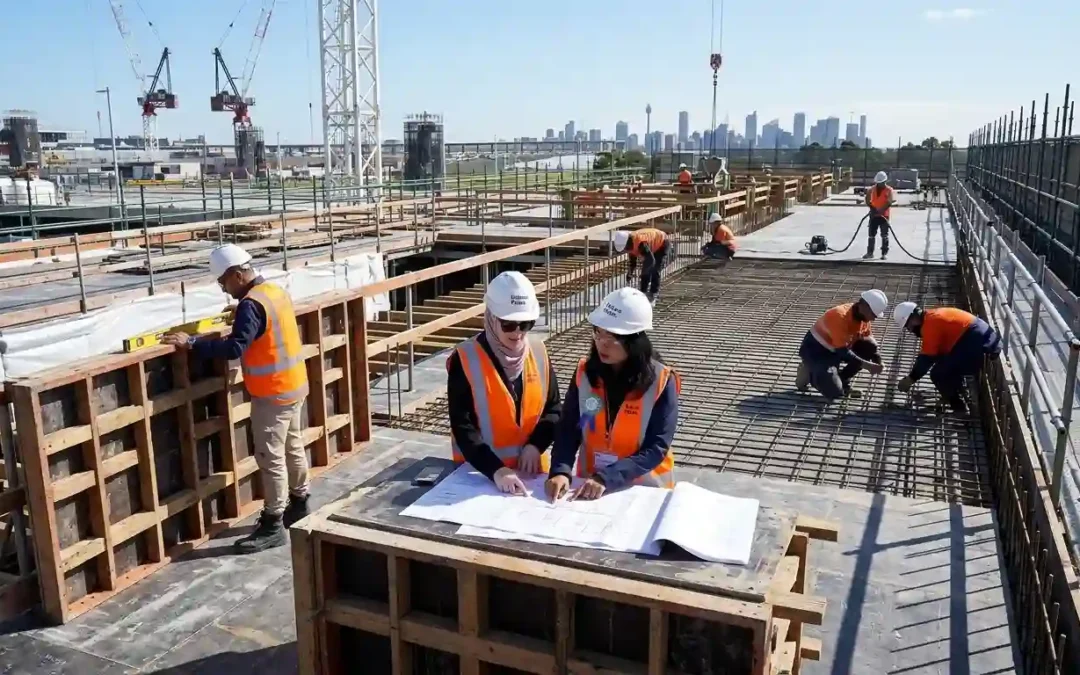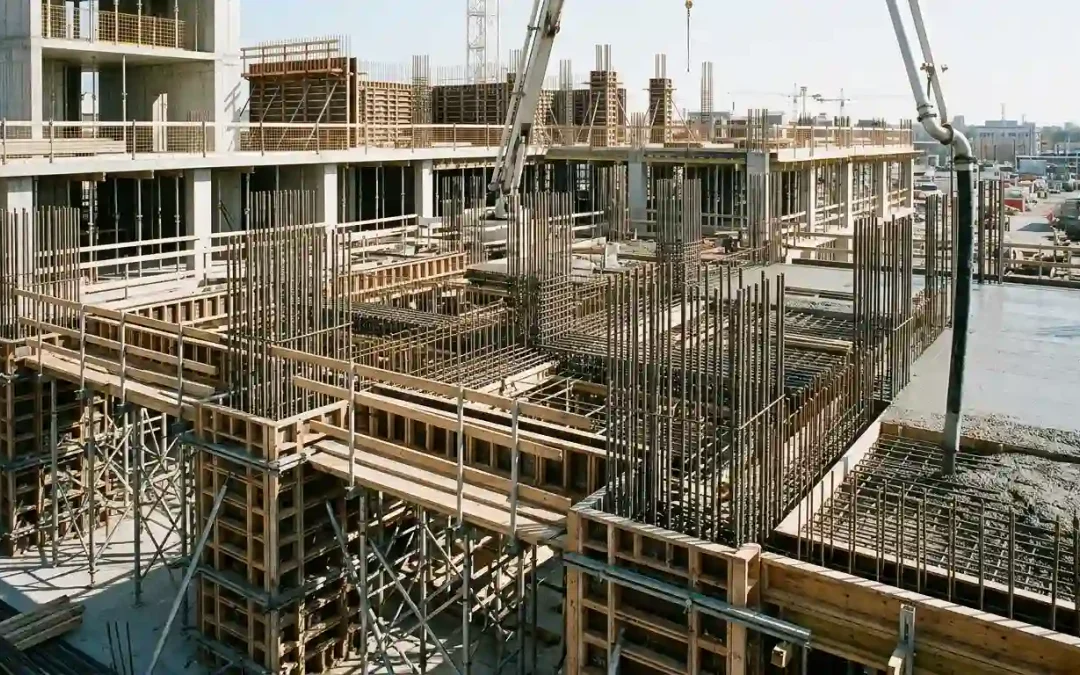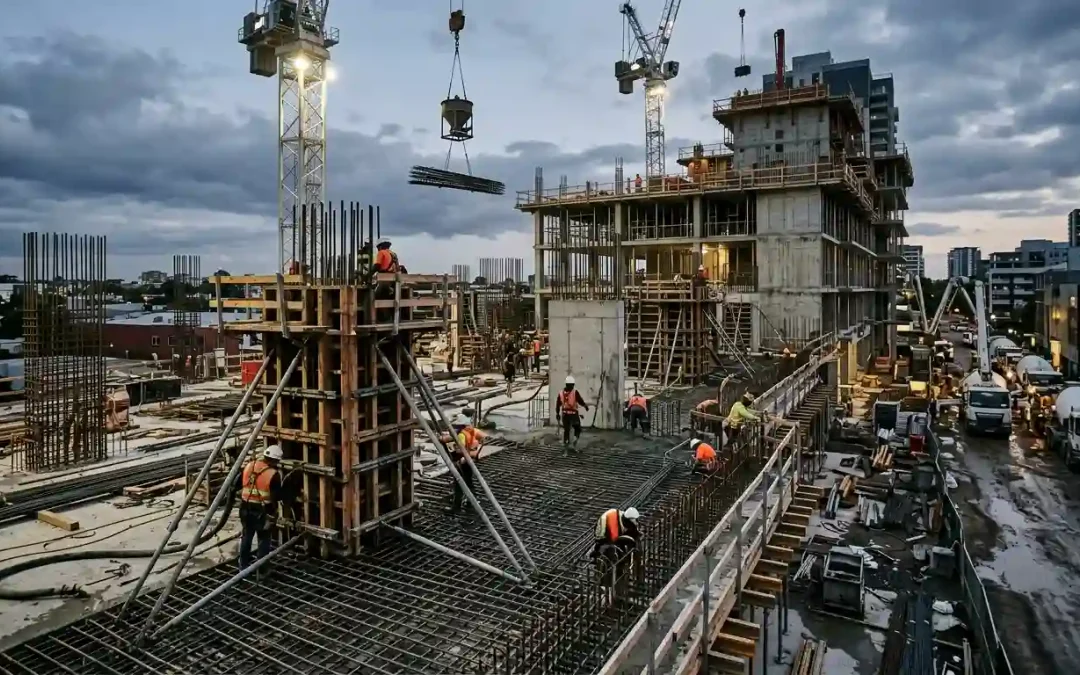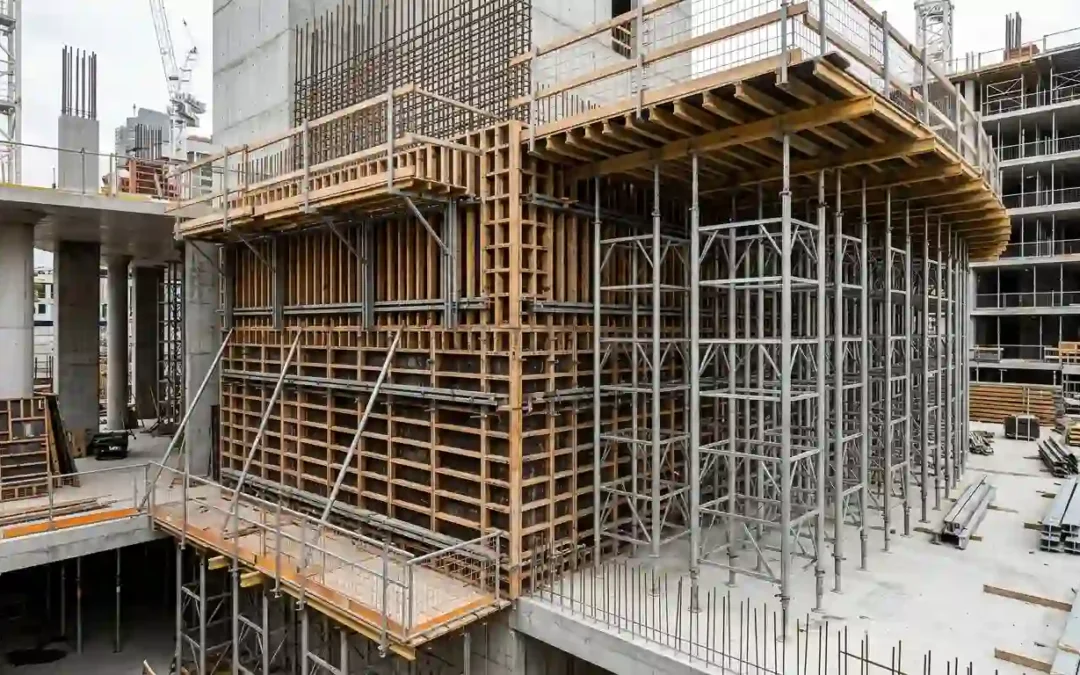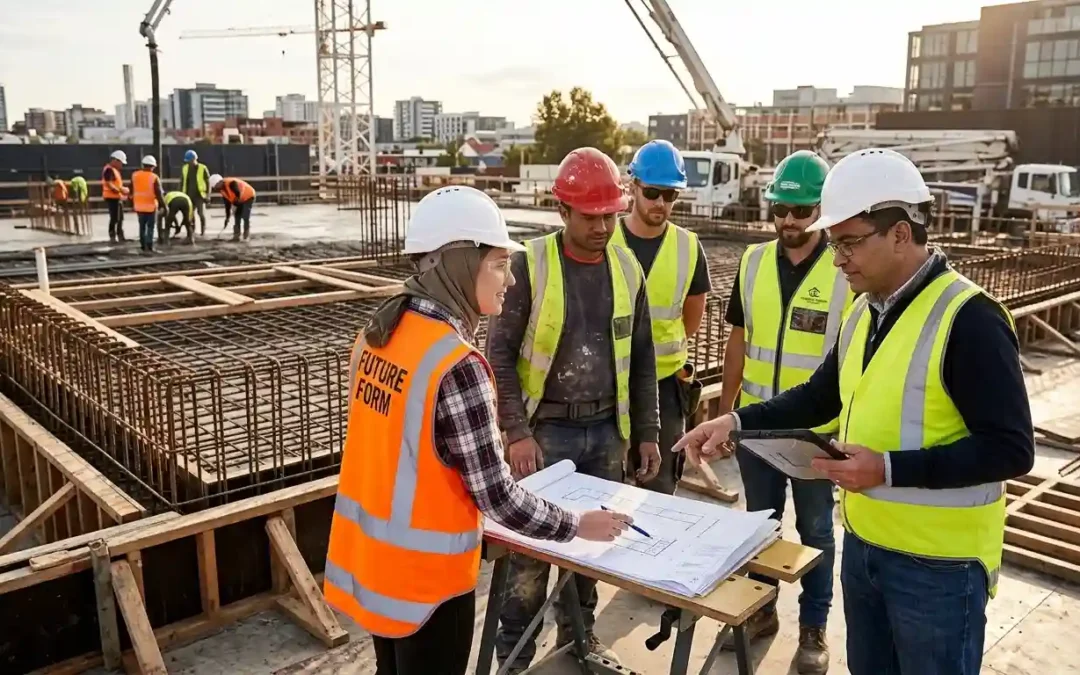
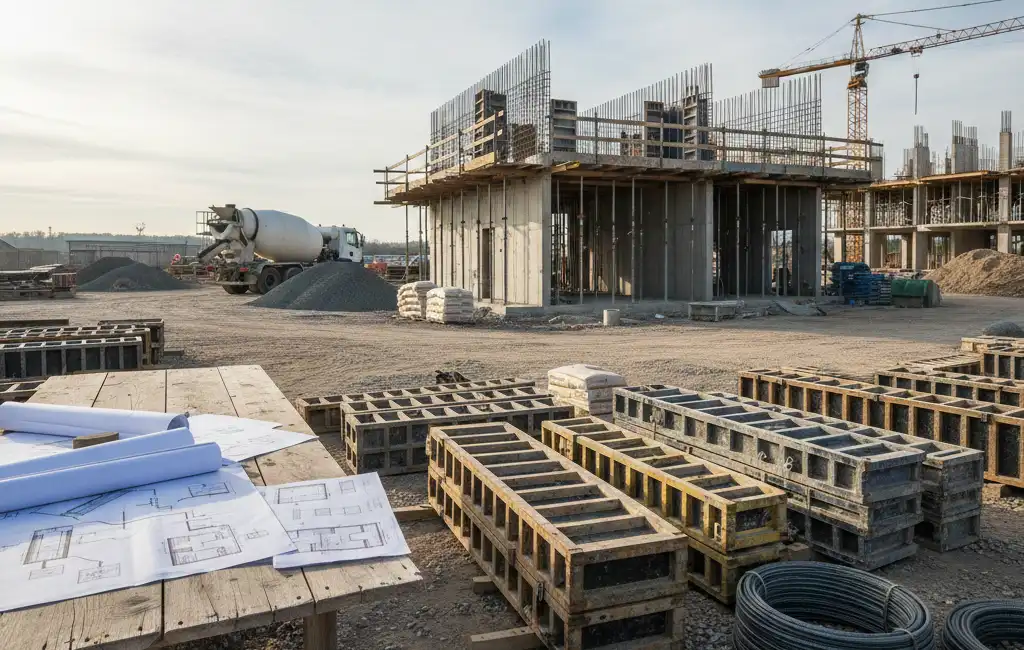
In large-scale construction, delays rarely come from one big failure. More often, they sneak in quietly—through assumptions, blurred responsibilities, and gaps between scope and execution. One of the most common pressure points in structural delivery sits right at the core of the build: FRP strategy.
Form, reo and pour are not separate activities, they are all parts of the same one structural process. Yet on many projects, they are treated as separate packages, spread across different contractors, timelines, and responsibility. When the FRP strategy is unclear, the structural program will also not be clear.
This is when projects start to feel out of control instead of planned. Program buffers disappear. Trades wait for each other. Concrete is booked before sites are truly ready. And it’s hard to hold people accountable when something goes wrong.
This blog explores why clarity in FRP strategy matters, how unclear ownership disrupts structural delivery, and why integrated FRP solutions are increasingly becoming a defining factor in successful projects in most countries.
Understanding FRP strategy as a single structural system
FRP refers to form, reo, and pour. But in real life, FRP is a coordinated system that supports the entire concrete structure.
- Form determines geometry, tolerances, and cycle time
- Reo defines structural capacity, sequencing, and congestion risk
- Pour locks everything in place, committing the program and cost
Each stage relies on the previous one being completed correctly and on time. Any disconnect—misaligned drawings, unclear handovers, or mismatched sequencing—has a direct impact on the structural program.
When FRP is split across multiple parties without a clear strategy, the project begins to rely on assumptions:
- Who confirms pour readiness?
- Who coordinates reo changes against formwork adjustments?
- Who owns defects that appear after the pour?
Without clear answers, the structure may still rise—but rarely without cost, stress, or compromise.
Why unclear FRP responsibility creates program risk
Structural delays are often blamed on external factors—weather, supply, labour—but unresolved FRP responsibility is a quieter and more persistent cause.
When no single party owns the full FRP scope, overlaps and gaps appear:
- Formwork is installed without full consideration of reo congestion
- Steel fixing progresses without alignment to pour sequencing
- Concrete is scheduled based on assumptions rather than readiness
This fragmentation creates problems between trades. Each contractor protects their own scope, while the structural program absorbs the consequences.
The result is a cycle of:
- Rework due to late changes
- Crew members are waiting for their next tasks.
- Compressed pours that increase quality risk
These little problems add up over time, making people less confident in the structural package and putting pressure on trades that come after it.
The structural program is only as strong as its FRP strategy
A structural program is more than a sequence of dates—it is a commitment that locks in cost, labour, and momentum. Once concrete is poured, there is little room for correction, which makes clarity at the FRP stage essential. A well-defined FRP strategy aligns form, reo and pour sequencing, sets clear handover points, and establishes responsibility for coordination rather than leaving it to assumption. When this alignment is in place, the structural program reflects real site conditions, not optimistic expectations.
Without that clarity, programs quickly lose reliability. Milestones are often based on the best-case scenario rather than actual readiness, leaving little flexibility when issues come up. This is especially clear in vertical construction, where short cycle times and repetition make even small problems worse. A single unclear FRP decision early in the build can carry forward through multiple levels, compounding delays and placing sustained pressure on the overall structural program.
Where assumptions usually creep in
Most projects do not deliberately leave FRP unclear. This problem often comes up during the buying process and early planning, when the scope is not clearly defined and people take on coordination duties without checking. People often think that formwork contractors will take care of reo interfaces, that steel fixers will be able to deal with last-minute changes to forms, or that pour readiness will be seen as a general site responsibility instead of the result of a clearly defined structural package.
These assumptions may seem small on their own, but when you put them all together, they make the whole structure weaker. As the build goes on and problems start to show up, it becomes harder to hold people accountable, and it takes longer than it should to fix things. Clear FRP management clears up these unclear areas early on, making it possible to deal with coordination problems before they affect the programme, quality, or confidence on site.
Integrated FRP solutions and why they change outcomes
Integrated FRP solutions bring formwork, reo, and pour under a single coordinated delivery model. Rather than managing three separate scopes, the project works with one accountable structural package.
This approach offers several advantages:
- Clear accountability across all FRP stages
- Improved sequencing, with form and reo designed together
- More reliable pour readiness, based on real-time site coordination
- Reduced rework, as clashes are resolved before execution
Integrated FRP does not remove complexity—but it centralises responsibility for managing it.
For developers and builders, this translates into greater confidence in the structural program. Decisions are made earlier, issues are resolved faster, and progress is measured against coordinated milestones rather than isolated trade outputs.
How clear FRP ownership improves frp strategy on site
Clear FRP ownership does more than keep the structural programme safe; it also makes it easier for teams to work together on site. When the responsibilities for form, reo, and pour are clear, trades know where their work starts and ends, which cuts down on confusion and overlap. Instead of reacting to problems, communication becomes proactive. This means that site teams spend less time settling conflicts and more time progressing work with confidence.
This clarity also helps people make better decisions when change is necessary. You can look at design changes, temporary work needs, or changes in the order of tasks across the whole FRP scope instead of just one part of it. This integrated approach often makes the difference between controlled progress and always having to catch up on complex builds. It lets teams deal with problems without losing speed or quality.
Structural packages need more than delivery—they need coordination
A structural package is not just about supplying materials or labour. It is about coordinating interfaces, sequencing tasks, and protecting the integrity of the structure as it evolves.
When FRP is fragmented, coordination becomes everyone’s responsibility and no one’s priority.
Clear FRP strategies treat coordination as a core function, not an afterthought. This includes:
- Early planning of form and reo compatibility
- Confirming pour methodologies aligned with site conditions
- Ongoing checks that execution matches the intended program
These steps do not eliminate challenges—but they prevent avoidable ones from escalating.
Concrete commitment demands clarity upfront
Concrete is unforgiving. Once it is poured, changes become costly, disruptive, and often irreversible, which is why clarity before the pour matters far more than speed in the lead-up. Projects that prioritise a clear FRP strategy are better positioned to lock in realistic cycle times, reduce last-minute adjustments, and maintain consistency across levels and zones, creating a more reliable foundation for structural delivery.
This approach does not slow projects down—it stabilises them. A controlled structural program allows work to progress with rhythm and predictability, reducing stress on site teams and downstream trades. In large-scale builds, it is this sense of flow, rather than raw speed, that sustains momentum and supports consistent, high-quality outcomes over time.
Why FRP clarity matters to everyone involved
The impact of an unclear FRP strategy is felt across the project:
- Developers face program uncertainty and financial risk
- Builders manage increased coordination pressure
- Consultants respond to late-stage changes
- Trades work reactively instead of efficiently
Conversely, when FRP is clear, the entire project benefits from predictability and confidence.
Clear FRP strategies support better forecasting, safer sites, and more reliable outcomes—regardless of project scale or location.
Bringing structure back to the structural program
At the centre of many well-controlled structural programs is one defining factor: clear ownership. This is where Future Form plays a critical role. By taking responsibility for the full FRP scope, Future Form removes the uncertainty that often arises when formwork, reo, and pour are treated as disconnected packages. This clarity allows structural delivery to be planned and executed as a single, coordinated system rather than a series of handovers.
Future Form’s approach ensures accountability across formwork delivery, steel fixing, and concreting execution, creating alignment between planning and site reality. With one party overseeing the interaction between form, reo and concrete, coordination becomes proactive, sequencing is more reliable, and readiness is clearly defined before key milestones are reached. In an environment where margins are tight and expectations are high, this level of clarity is not an added benefit—it is fundamental to maintaining control, confidence, and consistency throughout the structural program.
Building certainty into the structural program
If your FRP strategy isn’t clear, your structural program isn’t either. The connection is direct, and the consequences are real.
Clear FRP ownership reduces assumptions, protects timelines, and strengthens collaboration. Integrated FRP solutions offer a way to align form, reo and pour into one accountable structural package—providing the certainty that complex projects demand.
This is where Future Form supports projects by providing clear FRP ownership across formwork delivery, steel fixing, and concreting execution, helping teams move forward with confidence rather than assumption.
In the end, strong structures are not just built with concrete and steel. They are built on clarity, coordination, and confidence in the systems that support them.
References
Concrete Institute of Australia. (2022). Guide to concrete construction and practice.
Retrieved from https://www.concreteinstitute.com.au
Engineers Australia. (2021). Structural engineering practice and coordination guidelines.
Retrieved from https://www.engineersaustralia.org.au
Love, P. E. D., Edwards, D. J., & Irani, Z. (2019). Moving beyond optimism bias and strategic misrepresentation in construction projects. Construction Management and Economics, 37(7).
Retrieved from https://www.tandfonline.com
Smith, N. J. (2014). Engineering project management. Wiley-Blackwell.
Retrieved from https://www.wiley.com
Winch, G. M. (2010). Managing construction projects: An information processing approach. Wiley-Blackwell.
Retrieved from https://www.wiley.com