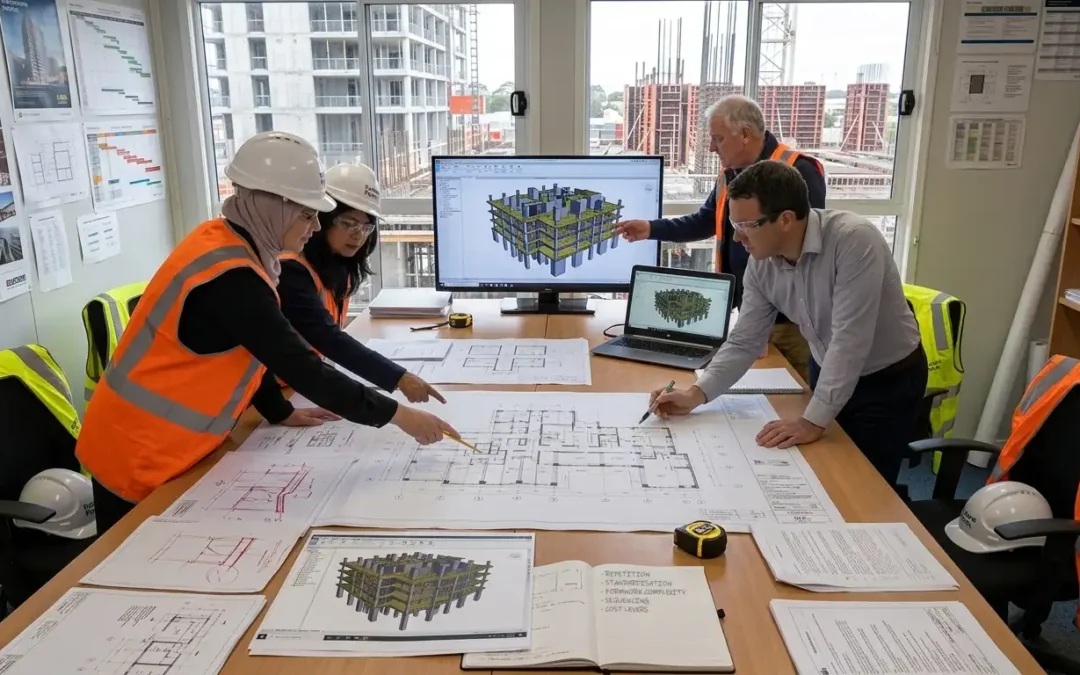
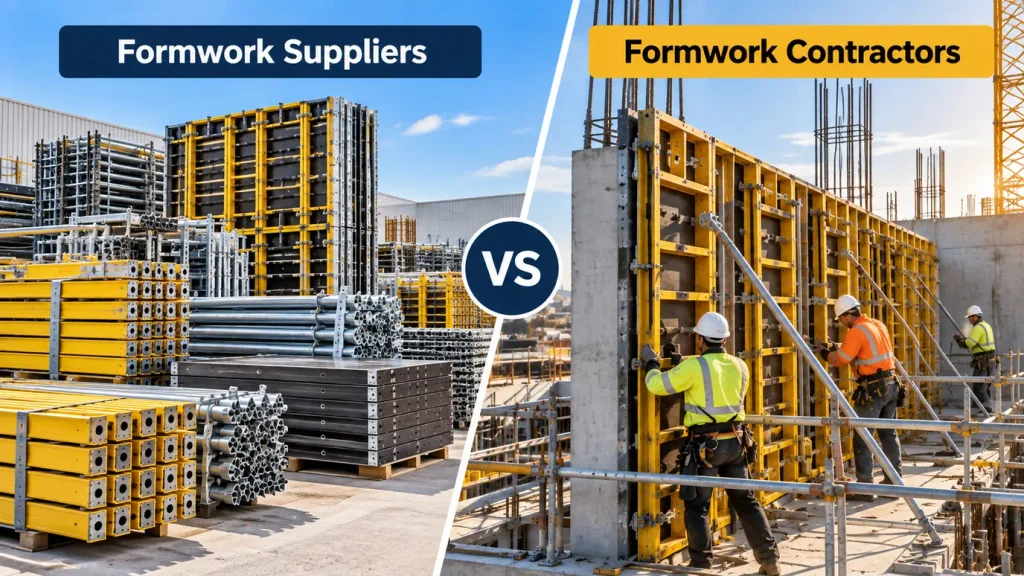
Ask three people on a project how they’re “getting the formwork” and you may hear three answers. One means buying equipment from a supplier. One means hiring a proprietary system. One means letting a subcontract to a formwork contractor who brings the crews, the system and the engineering.
They are not the same thing, and each quote prices something different. This guide explains the options for getting formwork onto an Australian construction site — including when buying or hiring is the better call.
Key takeaways
- A formwork supplier sells equipment, a hire company rents a system and a formwork contractor delivers an agreed scope. The terms are not interchangeable.
- Formwork hire rarely includes labour, supervision, installation or stripping. Check what the hire arrangement actually covers.
- Compare the cost of delivering the formwork scope, not just the cost of the formwork system.
- Buying or hiring can be the right choice for builders with experienced labour, supervision, engineering support and a simple or repetitive structure.
- A formwork contractor tends to suit greater scale, complexity and programme pressure — but is not automatically cheaper, faster or lower risk.
What formwork procurement actually means
Formwork procurement is deciding who provides, and who is responsible for, each part of forming the structure:
- Formwork system: the equipment — panels, decks, beams, props, ties and edge forms.
- Formwork labour: the crews who handle formwork installation and formwork stripping.
- Formwork engineering: designing the formwork for its loads, then documenting and certifying it.
- Temporary works: supporting structures such as falsework and high strutting.
- Backpropping: props under recently poured slabs that share construction loads through lower levels.
- Site supervision: directing crews and checking work against the design.
The exact split depends on the contract, drawings, specification, system selected and agreed scope.
Supplier, hire company or contractor: what’s the difference?
A formwork supplier sells formwork equipment or materials. The builder owns them, and stores, maintains and eventually disposes of them.
A formwork hire company rents a system, often proprietary, for a hire period. Some add system drawings, delivery or technical support; that varies. The builder generally provides labour, supervision and site management.
A formwork contractor is engaged to deliver an agreed scope — typically labour, supervision and the formwork system, plus engineering where included. The contractor manages its work; the builder manages the contractor.
In short, a supplier provides equipment. A contractor provides a delivered scope of work.
| Consideration | Buy formwork | Hire a formwork system | Engage a formwork contractor |
| Upfront cost | Capital outlay, recovered through reuse | Hire rates, freight, loss and damage | Contract price for the agreed scope |
| Labour and supervision | Builder | Builder, generally | Contractor, for its scope |
| Engineering and design | Builder arranges | Depends on the hire arrangement | May be included in the contracted scope |
| Installation and stripping | Builder manages | Builder manages | Contractor, within its scope |
| Temporary works and backpropping | Builder arranges | Builder coordinates; design support varies | As allocated in the subcontract |
| Craneage and material handling | Builder | Builder | Often shared — confirm |
| Storage and ownership | Builder stores and maintains | Returned at end of hire | Contractor’s equipment |
| Programme | Builder carries delivery risk | Builder coordinates system and labour | Contractor responsible for agreed scope |
| Defects and rectification | Builder | Builder; equipment faults per hire terms | Contractor for its work, per contract |
A general guide only. Inclusions depend on the agreed commercial arrangement; this is not a universal contractual standard.
System cost vs delivery cost: the question that matters
The most useful question in a tender comparison isn’t “What does the formwork system cost?” It’s “What does it cost to deliver the formwork scope?”
The system cost is the purchase price or hire rate. The delivery cost adds labour, supervision, engineering and certification, temporary works, backpropping, craneage, material handling, cleaning, lost components, extended hire when the programme slips, and the builder’s own site management time.
So the cheapest-looking supplier or hire quote may not be the cheapest way to get formwork installed, stripped and cycled. The reverse also holds: a contractor’s price carries overhead, margin and risk allowance for work an experienced builder may deliver more economically itself. Neither number means much until both cover the same scope — a trap we unpack in why cheap FRP can cost more later.
Who carries the responsibility on site
Engineering, temporary works and backpropping
Formwork is a designed temporary structure. SafeWork NSW’s formwork guidance expects site-specific designs by a competent person and certification before the pour, alongside AS 3610 and Safe Work Australia’s formwork and falsework guide. Hiring a system doesn’t transfer those obligations. Confirm who designs, certifies and backprops — the role of the formwork engineer — because these temporary works decisions shape stripping times and cycles.
Labour, supervision and site management
Buy or hire, and the builder finds, directs and supervises formwork labour. Subcontract, and crew management moves to the contractor, though the builder keeps overall site control and its duties under the Construction Work Code of Practice.
Craneage, logistics and programme
Every option needs crane time, laydown, deliveries and returns. The difference is who plans them around the form, reo and pour sequence, and who wears it when the cycle slips.
Risk, variations and defects
The NSW Construction Leadership Group’s Procurement Methods Guidelines treat procurement as a risk allocation decision. Buy or hire, and rework, variations and defects largely stay with the builder. Subcontract, and the contract allocates them — so it’s only as good as its scope. Our FRP scope checklist helps close the gaps.
When each option makes sense
Buying formwork may suit builders who have experienced internal formwork labour and supervision, already own suitable equipment or will reuse it across projects, and have storage and engineering resources in place.
Formwork hire may suit builders who want direct control over a specific system, have a simple or repetitive structure and the capacity to manage methodology and sequencing, have an established hire relationship, or are on a smaller project where a full subcontract package isn’t commercially justified. That’s why formwork hire in Sydney remains a common choice for well-resourced builders.
A formwork contractor may suit projects with greater scale, multiple structural elements, significant temporary works, programme pressure or limited internal formwork and engineering capacity.
How to compare the options commercially
Estimators should normalise every price to one scope before tender, pricing the builder’s own labour, supervision, engineering, craneage, handling and management time wherever it self-delivers. Contracts administrators should confirm engineering, certification, backpropping, craneage, defects and variation rates in writing before award.
| Ask formwork suppliers or a hire company | Ask a formwork contractor |
| What design, drawings or certification come with the system? | Is formwork engineering and temporary works design included? |
| What are the minimum hire period, extension rates and damage charges? | Who provides craneage, hoisting and material handling? |
| Are freight, returns and cleaning included? | What cycle time and resourcing is the price based on? |
| What technical support is available on site? | How are variations valued and backpropping allocated? |
How Future Form can help
Future Form delivers formwork as a contracted package — labour, formwork systems and engineering within an agreed scope — rather than equipment alone. Our services include formwork systems tailored to each structure, jumpform, engineered high strutting and concrete works, while our integrated FRP solutions bring formwork, steel fixing and concrete pour under one coordinated approach. In-house planning and formwork engineering mean pour sequences are modelled before construction begins.
That model suits projects where scale or complexity justifies a full formwork contractor, like those in our projects portfolio, with Future Form Civil for infrastructure. It isn’t the answer for every job: a smaller or simpler structure may be better served by formwork hire or direct management.
With more than 20 years in the industry, ISO 9001, ISO 45001 and ISO 14001 certified systems and an experienced team, we can help you weigh up systems, labour, engineering, temporary works and programme for your project.
Frequently asked questions
1. What is the difference between a formwork supplier and a formwork contractor?
A formwork supplier provides equipment; a formwork contractor delivers an agreed formwork scope. The contractor typically provides labour, supervision and the system, plus engineering where included. With a supplier, the builder generally arranges those itself.
2. Should I hire formwork or engage a subcontractor?
Hire formwork if you have experienced labour, supervision and engineering support and a manageable structure. Engage a subcontractor where scale, complexity, temporary works or programme pressure make coordinated delivery more valuable than direct control.
3. Does formwork hire include labour?
Usually not. Formwork hire generally covers equipment for a hire period, sometimes with drawings, delivery or technical support. Installation, stripping and supervision normally stay with the builder unless otherwise agreed.
4. Who is responsible for formwork engineering when hiring a system?
It depends on the hire arrangement. A hire company may provide system drawings, but site-specific design, pre-pour certification and backpropping design must be clearly allocated — in writing, before the equipment arrives.
5. Do I need to buy formwork or hire a formwork contractor in Sydney?
It depends on the project, not the postcode. Formwork suppliers in Sydney and hire companies can suit builders with capable internal resources and simpler structures; larger, more complex projects often justify a contractor. Our guide to choosing the right FRP contractor covers the next step.
6. What does Future Form provide?
Future Form delivers formwork systems, jumpform, high strutting and concrete works, including integrated Form, Reo and Pour packages, as a contracted scope backed by in-house planning and technical expertise, with projects across NSW, the ACT and Queensland.
Know what your formwork quote is really buying
Buying, hiring and subcontracting can each be the right decision. What changes is who provides the labour, who engineers the temporary works, who spends the management time and who carries the programme — and those costs exist whether or not they appear on the quote. Price the whole scope, match the model to the project, and be honest about your internal capacity.
If you’re weighing up formwork options for an upcoming project, speak with a Future Form expert about your requirements and the level of formwork responsibility that makes sense.
Anyone can quote you the formwork. The real question is who’s quoting the job.