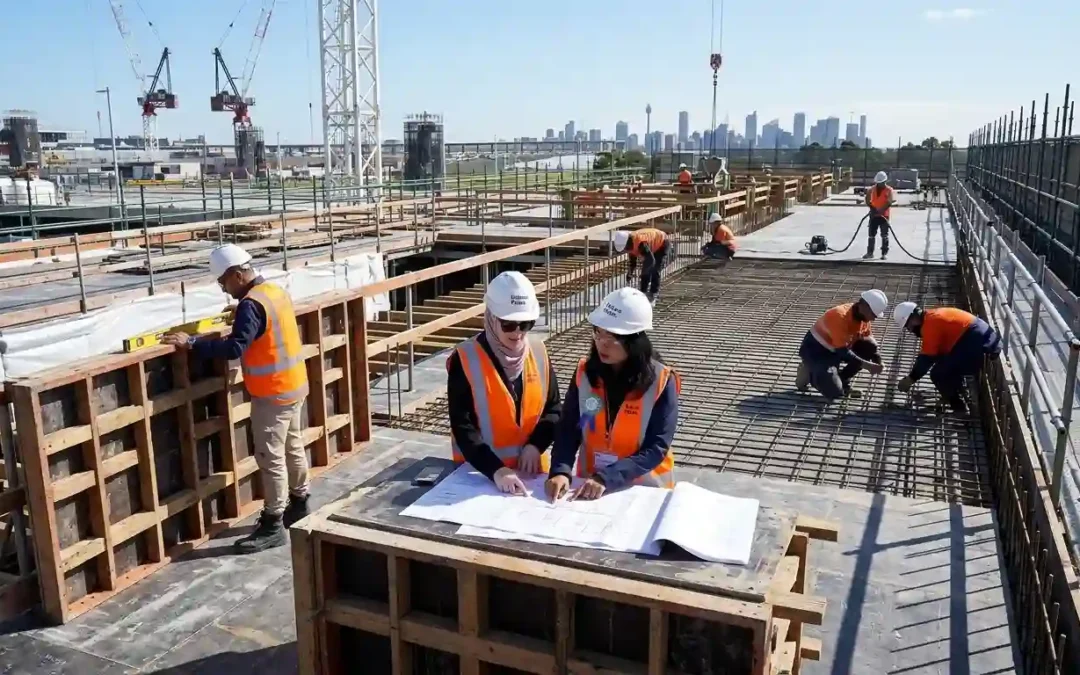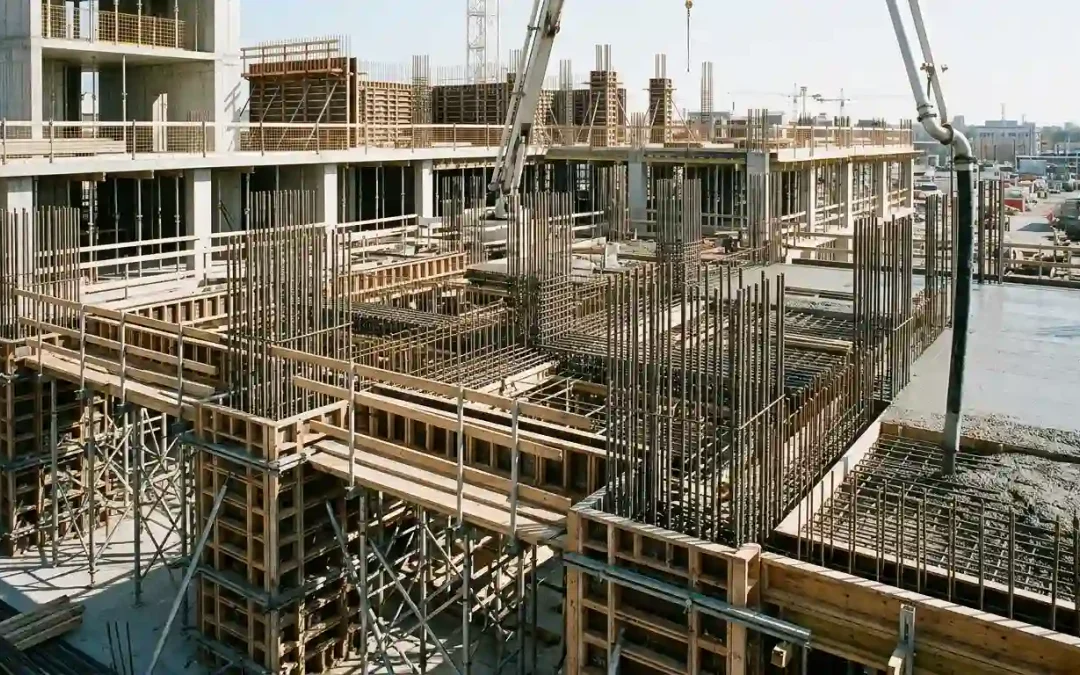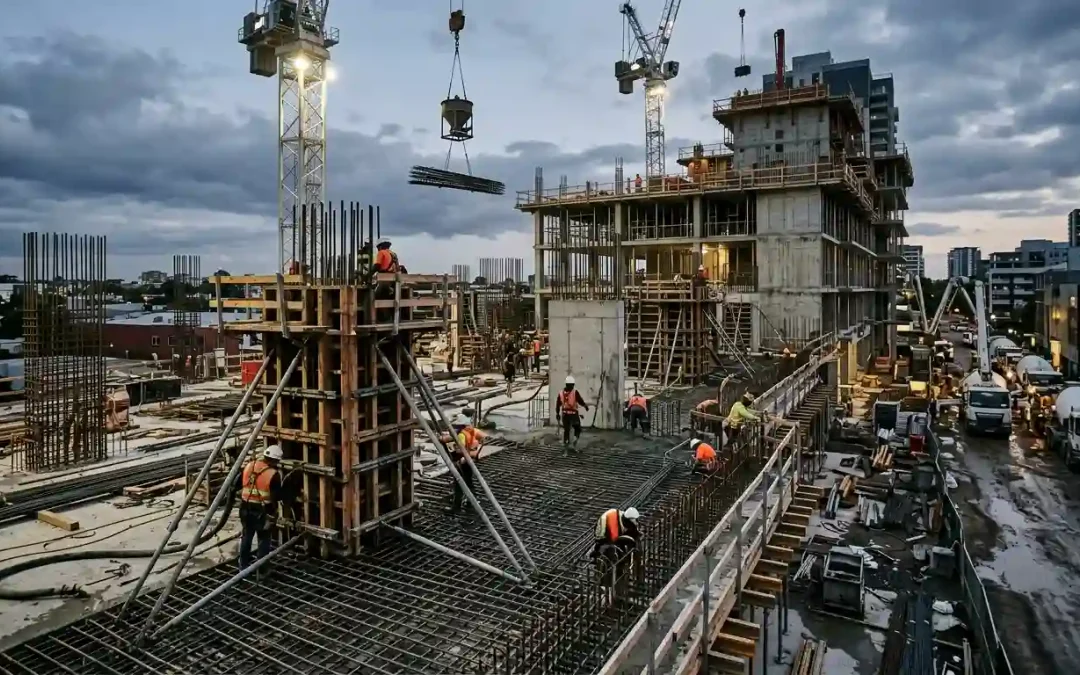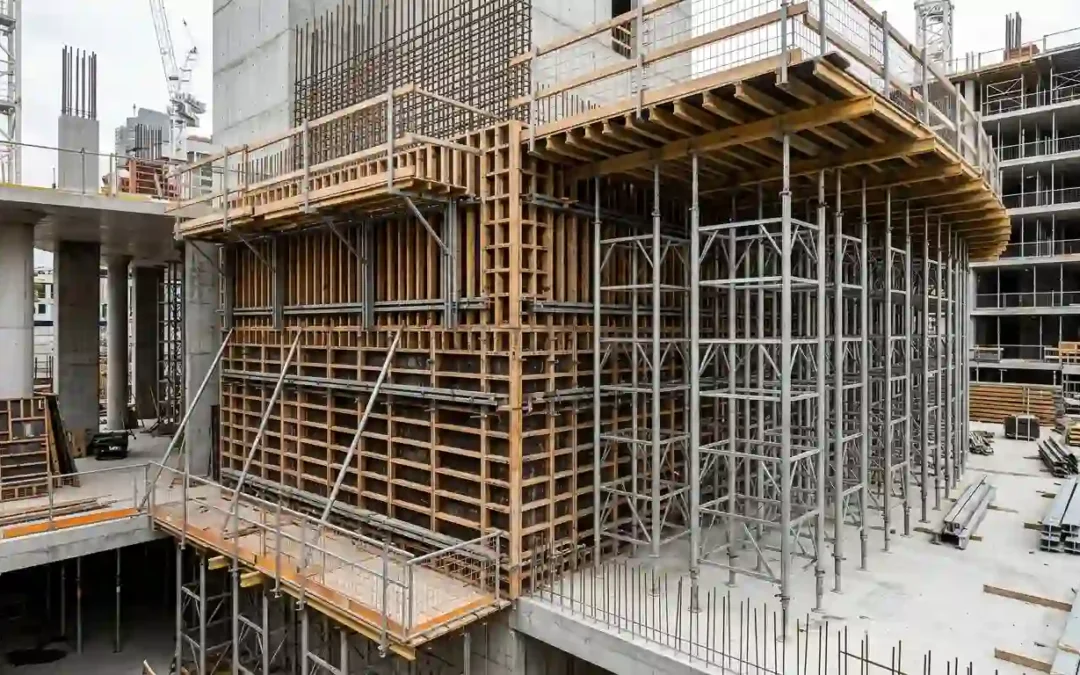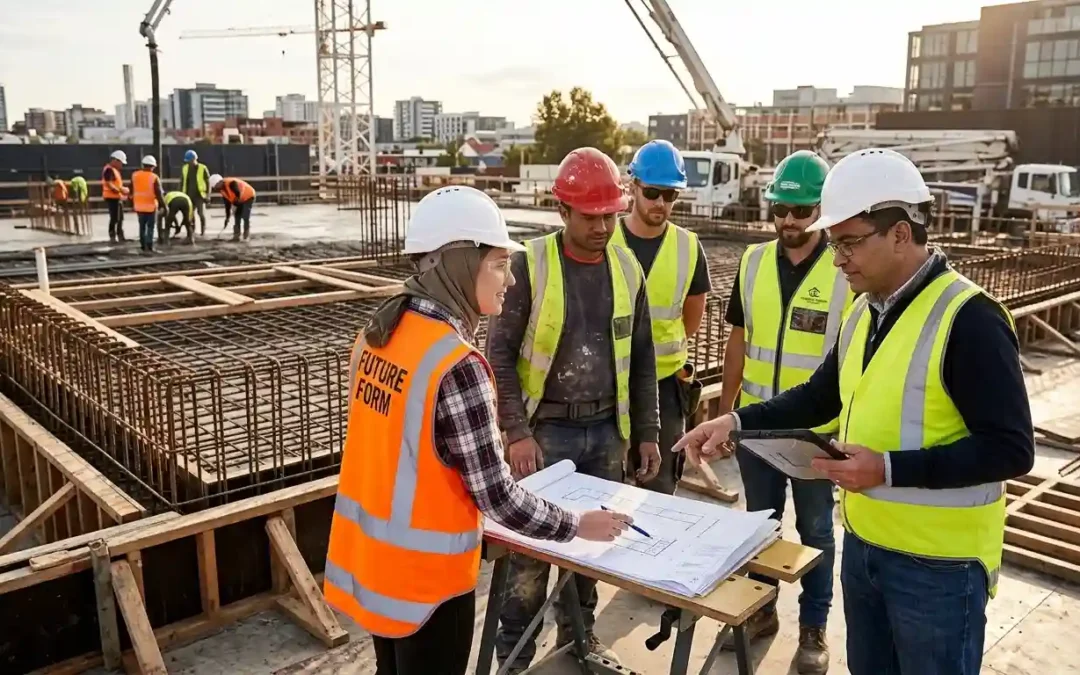
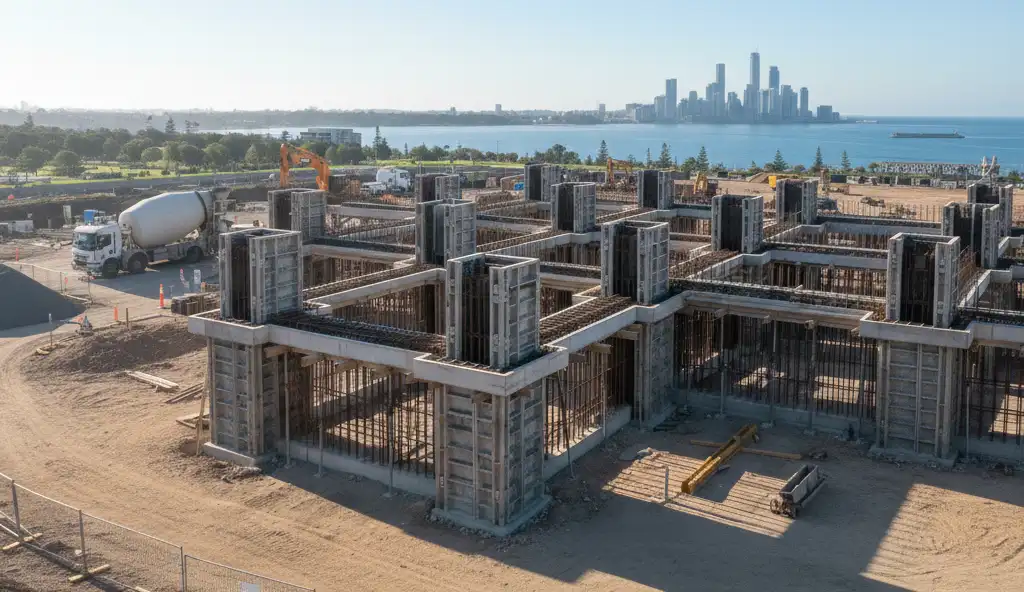
In large-scale construction, few stages carry as much risk as the structural phase. When FRP — form, reo, and pour — is treated as separate trades, the structural package often begins to fracture long before the first concrete is placed. Delays don’t usually announce themselves early; they surface when concrete is booked, flexibility disappears, and the programme is suddenly under pressure.
Projects that separate formwork, reo fixing, and pouring into silos rely heavily on assumptions rather than coordination. Form may be erected without certainty around reo readiness, reo may be fixed without full clarity on pour sequencing, and concrete bookings are made against optimistic timelines. The result is a structural package that looks organised on paper but struggles under real site conditions.
As projects grow in scale and complexity, the need for integrated FRP solutions becomes critical. Treating FRP as a single, coordinated system — rather than a series of disconnected scopes — is key to protecting programme certainty, structural quality, and delivery efficiency. This is where experienced FRP contractors, such as Future Form, help bring form, reo, and pour together into one aligned structural package.
Why FRP cannot function as separate trades
The idea that form, reo, and pour can be treated as independent trades is deeply embedded in many delivery models. Each contractor is often engaged separately, scoped narrowly, and assessed in isolation. On the surface, this can appear efficient. Each party focuses on their own scope, their own programme, and their own margins.
The issue is that FRP does not behave independently. Formwork geometry determines reo placement. Reo congestion affects concrete flow. Concrete sequencing depends on both form integrity and reinforcement readiness. When these elements are planned separately, coordination relies heavily on assumptions rather than shared accountability.
What often gets missed is that structural success is not defined by individual scopes being completed, but by all three components aligning at the same time, in the same location, under the same constraints. Without this alignment, the structural package becomes vulnerable to delays that are difficult to trace back to a single cause.
How fragmented form, reo, and pour create hidden delays
When FRP trades operate in silos, the earliest signs of trouble are rarely dramatic. Programmes still show progress. Drawings are issued. Materials arrive on site. Yet beneath this activity, small disconnects begin to accumulate.
Formwork may be erected based on assumptions about reo delivery that shift weeks later. Reo fixing may commence without full clarity on pour sequencing. Concrete bookings may be made against optimistic readiness dates. None of these issues, on their own, appear critical. Together, they create structural friction.
By the time concrete is booked, flexibility disappears. Pump availability, batch plant schedules, testing requirements, and labour commitments are locked in. If reo is incomplete or formwork adjustments are required, the delay becomes visible — and expensive. At this point, the structural package fractures, not because one trade failed, but because no single party owned the whole.
Concrete bookings as the moment of truth
Concrete does not wait. Once a pour is booked, the structure demands certainty. This is why so many FRP issues surface at this stage. The pour becomes the moment where every upstream decision is tested simultaneously.
When form, reo, and pour have been coordinated separately, the pour exposes gaps in communication, sequencing, and responsibility. Reo clashes that were previously theoretical become physical obstacles. Formwork tolerances that seemed acceptable now affect concrete finish and structural performance. Adjustments that might have been minor earlier now threaten the programme.
This is why concrete is often blamed for delays that originate much earlier. The reality is that concrete simply reveals what the structural package already knew: the system was not aligned.
The structural package as a single system
A structural package is not just a collection of trades; it is a system that must be designed, planned, and executed as one. Treating FRP as a unified process shifts the focus from individual outputs to collective outcomes.
In an integrated approach, formwork design is informed by reo detailing and pour methodology. Reo fixing is sequenced to support concrete flow and compaction. Pour planning accounts for form pressures, access, curing requirements, and inspection timing. Decisions are made with the entire system in mind, rather than optimising one element at the expense of another.
This systems-based thinking reduces rework, shortens feedback loops, and creates clarity around readiness. It also changes how accountability is managed across the structural phase.
Why fragmented accountability weakens delivery
One of the most common challenges on projects with separate FRP trades is the diffusion of responsibility. When issues arise, each contractor can point to their scope being complete, while the structure itself remains incomplete.
Formwork may be signed off as erected. Reo may be partially fixed but awaiting adjustments. Concrete may be available but unable to proceed. From a contractual perspective, everyone has done their part. From a project perspective, nothing moves.
This fragmentation creates delays that are difficult to resolve quickly. Coordinating multiple contractors at short notice increases risk, especially when changes are required under time pressure. Without a single point of accountability for the structural package, decisions are slowed and compromises become more likely.
The role of integrated FRP solutions
Integrated FRP solutions address this challenge by placing form, reo, and pour logic under one coordinated framework. Rather than treating each trade as a handover point, they are managed as interdependent components of the same delivery process.
Under this model, planning begins with the pour and works backwards. Readiness is defined collectively, not individually. Sequencing decisions are made with full visibility of constraints across formwork, reinforcement, and concrete execution.
This approach does not eliminate complexity, but it does make complexity manageable. Issues are identified earlier, when options are still available. Adjustments can be made before they affect concrete bookings, labour availability, or programme milestones.
How integrated FRP contractors change outcomes
FRP contractors operating as single-package providers bring a different mindset to structural delivery. Their focus is not on completing isolated tasks, but on ensuring that the structure progresses smoothly from form to finish.
Because formwork, reo, and pour are coordinated internally, communication is faster and decisions are aligned. Design changes are assessed across the entire structural system. Programme risks are identified earlier, and mitigation strategies can be implemented before delays become visible.
This does not mean fewer challenges on site. It means challenges are addressed within the structural package, rather than being pushed downstream. For developers and builders, this translates into more predictable outcomes and fewer surprises at critical stages.
Structural efficiency beyond speed
There is a tendency to associate integrated FRP solutions purely with speed. While programme efficiency is a clear benefit, the impact goes deeper. Structural efficiency also affects quality, safety, and cost control.
When formwork and reo are designed with the pour in mind, concrete placement is more controlled. This reduces the likelihood of defects, honeycombing, or remedial works. Safer access and clearer sequencing reduce congestion and improve site safety. Fewer last-minute changes reduce waste and unplanned labour costs.
These outcomes are not achieved through acceleration alone, but through alignment. The structure progresses at a pace that reflects readiness, rather than pressure.
Lessons from projects where FRP is fragmented
Across many projects, a consistent pattern emerges when FRP is treated as separate trades. Early stages appear to progress smoothly, while later stages absorb the cost of misalignment. Delays are compressed into critical milestones. Teams are forced into reactive decision-making. Relationships between trades become strained under pressure.
These projects often rely heavily on informal coordination to bridge gaps between scopes. While this can work temporarily, it is not a sustainable strategy for large-scale or complex structures. As projects grow in height, density, or complexity, the margin for error narrows.
The lesson is not that individual trades are ineffective, but that the system they operate within must reflect the reality of structural interdependence.
Reframing FRP as a strategic decision
Choosing how FRP is delivered is not just a procurement decision; it is a strategic one. The structure is the backbone of the project, and how it is managed sets the tone for everything that follows.
When FRP is integrated, the structural package becomes more predictable, more transparent, and more resilient. Programme decisions are based on real readiness, not assumptions. Risks are owned collectively, not passed between scopes.
For industry partners and suppliers, this clarity improves coordination and planning. For developers and builders, it reduces uncertainty at the most critical phase of construction.
How Future Form supports integrated structural delivery
Future Form operates as a single FRP contractor, bringing formwork, reo fixing, and concreting logic together into one coordinated structural package. By integrating these elements, structural sequencing, readiness, and accountability are aligned from early planning through to execution.
This approach supports clearer programme visibility, earlier issue identification, and smoother transitions between structural stages. Rather than managing handovers between separate trades, the structural package is delivered as a cohesive system, reducing the risk of fractures that typically surface at the pour stage.
Closing thoughts on structural alignment
When FRP is treated as separate trades, the structure may still stand, but the delivery process becomes fragile. Delays, rework, and last-minute coordination are not anomalies; they are symptoms of fragmentation.
Integrated FRP solutions recognise that form, reo, and pour are inseparable in practice, even if they are distinct in scope. By aligning these elements under a single structural package, projects gain predictability, efficiency, and control at the point where it matters most.
In an industry where margins are tight and programmes are compressed, structural alignment is no longer optional. It is foundational.
References
Eastman, C., Teicholz, P., Sacks, R., & Liston, K. (2018). BIM handbook: A guide to building information modeling for owners, designers, engineers, contractors, and facility managers (3rd ed.). Wiley.
Retrieved from: https://www.wiley.com/en-us/BIM+Handbook%2C+3rd+Edition-p-9781119287537
Institution of Structural Engineers. (2020). Manual for the design of reinforced concrete building structures. IStructE.
Retrieved from: https://www.istructe.org/resources/manuals/manual-for-the-design-of-reinforced-concrete-building-structures/
McGeorge, D., & Palmer, A. (2019). Construction management: New directions (3rd ed.). Wiley-Blackwell.
Retrieved from: https://www.wiley.com/en-us/Construction+Management%3A+New+Directions%2C+3rd+Edition-p-9781119199717
Neville, A. M. (2012). Properties of concrete (5th ed.). Pearson Education.
Retrieved from: https://www.pearson.com/en-gb/subject-catalog/p/properties-of-concrete/P200000006289
Winch, G. M. (2010). Managing construction projects (2nd ed.). Wiley-Blackwell.
Retrieved from: https://www.wiley.com/en-us/Managing+Construction+Projects%2C+2nd+Edition-p-9781405192813