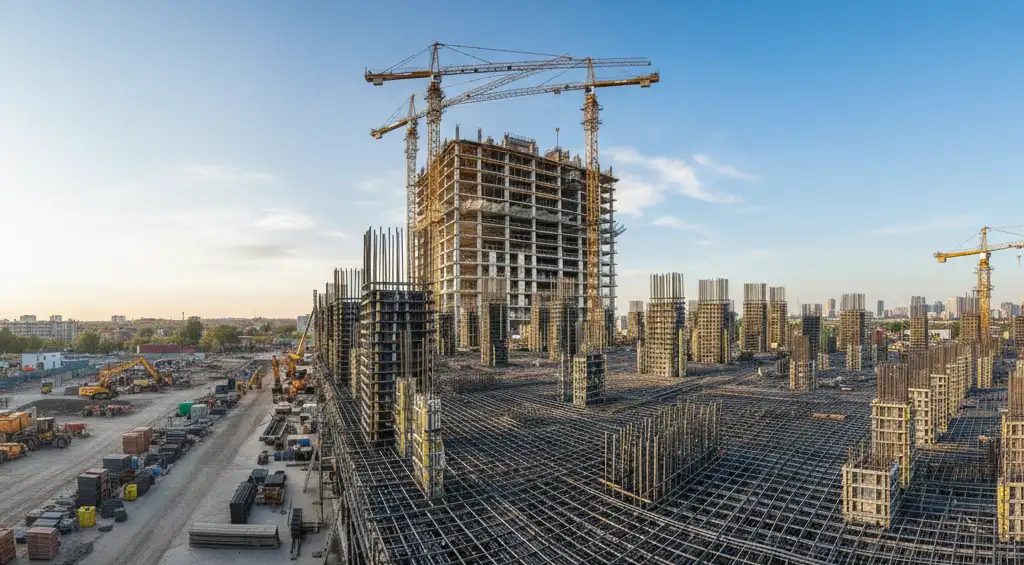
In large-scale construction, progress is rarely defined by a single trade. It is defined by how well multiple disciplines move together. Nowhere is this more evident than in the structural package — particularly within the FRP cycle: form, reo and pour.
At Future Form, we see first-hand how structural progress accelerates when FRP is treated as one coordinated system rather than three separate scopes. Steel fixing, in particular, performs at its best when it is sequenced correctly within the broader FRP workflow. When reo is rushed or compressed between formwork and concrete pours, quality, safety and efficiency suffer. When it is integrated, the entire structure benefits.
This blog explores why optimising steel fixing through an integrated FRP approach is critical for developers, construction professionals, industry partners and suppliers — and how coordinated FRP contractors deliver cleaner, faster and more reliable outcomes.
Understanding FRP in the structural package
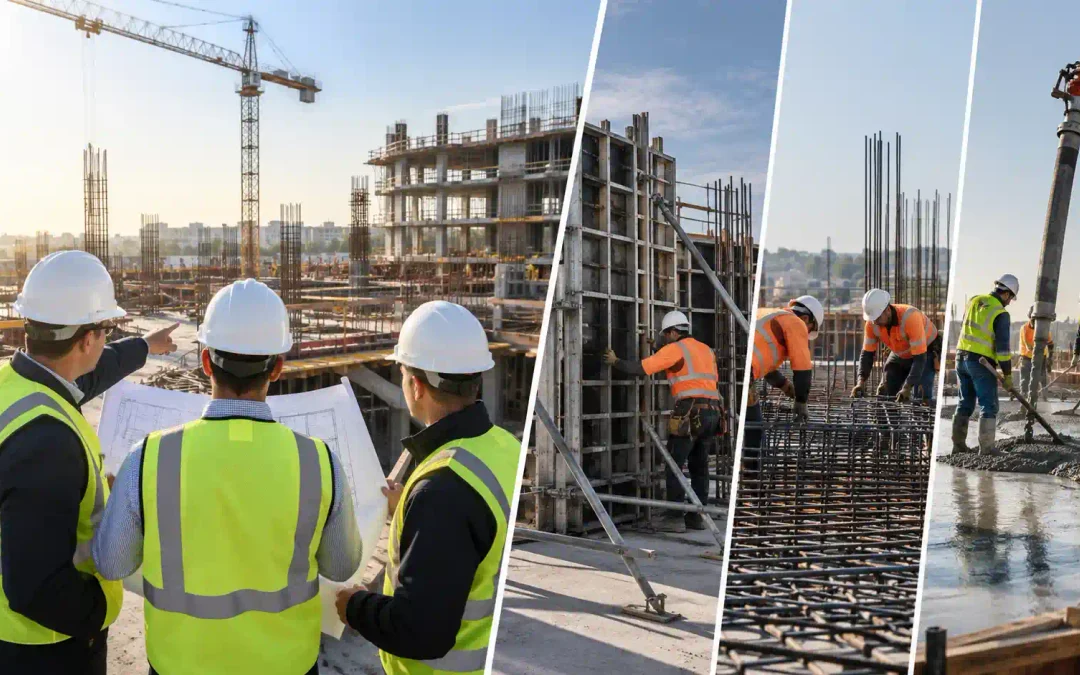
FRP stands for form, reo and pour — the essential cycle that drives vertical and horizontal structural progress in reinforced concrete construction.
- Form: The installation of formwork systems that shape and support the concrete.
- Reo: Steel fixing — the placement and tying of reinforcement in accordance with engineering design.
- Pour: The placement and finishing of concrete to create the structural element.
These three elements are interdependent. Formwork defines geometry and support. Steel fixing provides structural integrity and load capacity. Concrete binds the system into a single structural element.
Yet on many projects, these trades operate in silos. Formwork teams race ahead to meet crane cycles. Reo crews are squeezed into narrow windows. Pour planning becomes reactive. The result is congestion, rework and compromised productivity.
An integrated FRP approach treats these stages as a single structural package. Rather than asking “When can reo fit in?”, the question becomes “How do form, reo and pour move together to optimise structural progress?”
Why steel fixing struggles in fragmented programmes
Steel fixing is often the most constrained phase within the FRP cycle. When sequencing across form, reo and pour is fragmented, steel fixing becomes reactive rather than strategically planned. If formwork overruns, reo is expected to recover lost time. Crews are pushed to accelerate reinforcement installation, increasing fatigue and the likelihood of errors. At the same time, site congestion intensifies as multiple trades operate within limited deck space, creating physical clashes, restricted access and heightened safety risks. In many cases, formwork handover is incomplete or inconsistent, forcing steel fixers to work around unfinished edges, penetrations and access constraints, further reducing productivity and workflow clarity.
Pressure increases again when the pour is locked in due to pump bookings or broader programme commitments. Reo teams face immovable deadlines, often compressing inspection windows and limiting quality assurance checks. Steel fixing is not merely labour-intensive; it is precision-driven. Bar spacing, laps, cover and anchorage must align exactly with engineering documentation to ensure structural integrity. When sequencing is rushed or poorly coordinated, that precision is compromised. For developers and project managers, the consequences extend beyond one trade — structural compliance, inspection outcomes and overall programme reliability are directly affected.
For developers and consultants overseeing complex builds, fragmented FRP sequencing introduces unnecessary programme risk, cost escalation and exposure to compliance issues that can compromise the entire structural package.
The structural impact of poor FRP coordination
Reinforced concrete structures rely on precise integration between steel and concrete. When the reo stage is compromised:
- Bar placement may deviate from design intent.
- Cover tolerances may not be achieved.
- Access for inspection becomes limited.
- Concrete flow and consolidation may be affected.
These issues can lead to rework, additional engineering review, or in severe cases, structural remediation.
More subtly, structural progress slows. When one FRP cycle is delayed or reworked, the impact multiplies across floors. Crane utilisation suffers. Labour costs escalate. Downstream trades face knock-on delays.
An integrated FRP approach reduces these risks by aligning steel fixing with formwork readiness and pour planning from the outset.
What an integrated FRP approach really means
An integrated FRP approach is not simply about bundling trades under one contract; it is a structured method of coordinating planning, sequencing and accountability across form, reo and pour. Steel fixing schedules are developed in parallel with formwork installation plans and concrete pour cycles, ensuring each stage is realistically timed and properly resourced. Clear handover points are established so formwork readiness is confirmed before reo mobilisation, reducing partial access, disruption and rework. By mapping each phase of the FRP cycle together, projects gain predictable workflow and stronger structural control.
Equally important, integrated FRP solutions actively manage deck congestion, embed quality inspections within the cycle and maintain crew continuity across levels. Work zones are structured to limit trade overlap, inspections are conducted before pour pressure builds, and experienced teams move consistently through each cycle to maintain performance standards. For developers and head contractors, this coordinated structural package provides greater visibility over structural progress and reduces reliance on fragmented subcontractor management, allowing the build to move forward as one cohesive unit.
How integrated FRP solutions improve structural progress
Structural progress in high-rise and large-scale builds depends on rhythm. When FRP contractors operate cohesively, each cycle becomes predictable.
Reduced clashes
By aligning formwork installation with reo sequencing, penetrations, embeds and edge details are anticipated rather than discovered mid-installation.
Cleaner decks
When reo is not rushed, bar placement is organised and accessible. This improves pour quality and reduces obstruction during concrete placement.
Improved safety
Less congestion means clearer access routes and reduced manual handling pressure.
Consistent cycle times
Predictable FRP cycles allow downstream trades to plan with confidence.
Fewer defects
Integrated planning minimises miscommunication between trades, reducing rework and inspection failures.
Over multiple levels, these incremental gains compound. Developers see stronger programme reliability. Project managers gain clearer forecasting. Industry partners benefit from stable workflow conditions.
The role of FRP contractors in modern construction
FRP contractors are increasingly responsible for delivering integrated structural packages rather than isolated trade scopes.
This shift reflects the complexity of contemporary construction:
- Taller structures
- Tighter programmes
- Higher compliance standards
- Greater emphasis on safety and quality
When formwork, reo and pour are managed independently, coordination risk sits with the head contractor. When integrated FRP contractors deliver the structural package, accountability is clearer.
This does not eliminate collaboration — it enhances it. Engineers, suppliers and project teams operate within a structured framework where steel fixing is recognised as a core driver of structural success.
Why steel fixing deserves programme priority
Steel fixing is not merely an intermediate task between form and pour. It is the structural backbone of reinforced concrete.
Reinforcement carries tensile forces, controls cracking and ensures load distribution. Without accurate reo placement, concrete cannot perform as designed.
Giving steel fixing appropriate time and sequencing:
- Protects structural integrity
- Supports compliance with engineering documentation
- Enables efficient inspection
- Improves concrete performance
An integrated FRP approach ensures reo is not treated as an afterthought but as a central element of the structural package.
How Future Form supports integrated FRP delivery
Delivering this level of coordination requires more than scheduling — it demands a structured, integrated FRP mindset. At Future Form, steel fixing schedules are aligned with formwork readiness and pour planning from the outset. Rather than isolating reo between two high-pressure milestones, our team coordinate it as a core component of FRP.
This approach includes:
- Early structural programme mapping
- Defined form-to-reo handovers
- Congestion planning within deck zones
- Integrated quality checkpoints
- Close coordination with engineering and site teams
By treating form, reo and pour as a unified system, we reduce congestion, prevent clashes and support clean, compliant concreting outcomes.
For developers and construction professionals, this translates into measurable structural progress. For industry partners and suppliers, it provides a stable framework for delivery. For clients, it means confidence in the integrity of their build. You can see how this integrated FRP approach translates into real structural outcomes across our completed projects.
The broader industry perspective
Across global construction markets, integrated delivery models are increasingly recognised as drivers of efficiency. Reinforced concrete structures remain dominant in residential, commercial and infrastructure sectors.
Research consistently highlights the importance of sequencing and coordination in structural works. Poor integration between trades contributes significantly to productivity loss and rework in construction projects. Similarly, industry studies emphasise that collaborative planning improves safety and quality outcomes in complex builds
The principles behind integrated FRP solutions align with these findings. When structural trades operate cohesively, projects benefit from reduced variability and stronger performance outcomes.
Moving from reactive to proactive structural delivery
Optimising steel fixing through an integrated FRP approach is ultimately about shifting from reactive coordination to proactive planning.
Rather than resolving clashes on the deck, they are addressed in programme development. Rather than compressing reo to recover time, schedules are structured realistically. Rather than treating FRP as three trades, it is managed as one structural system.
For large-scale developments, this shift can significantly influence cost certainty, risk mitigation and programme performance.
Steel fixing thrives when it has the space and structure it needs to succeed. When embedded within integrated FRP solutions, it becomes a catalyst for structural progress rather than a bottleneck.
Building structural confidence through integration
In modern construction, success is measured not only by speed, but by reliability and quality. An integrated FRP approach strengthens all three pillars.
By coordinating formwork, reo and pour as a unified structural package, projects achieve:
- Improved structural integrity
- Greater programme certainty
- Reduced congestion and risk
- Cleaner, compliant concrete outcomes
For developers, construction professionals, industry partners and clients seeking dependable structural performance, optimising steel fixing through integration is not optional — it is strategic. If your next project demands stronger structural coordination, a well-planned FRP framework can provide the foundation for consistent progress and long-term performance.
If you would like to explore how integrated FRP solutions can strengthen structural delivery on your next project, our team is available to discuss your structural package requirements and project sequencing in more detail.
References
Eastman, C., Teicholz, P., Sacks, R., & Liston, K. (2018). BIM handbook: A guide to building information modeling for owners, designers, engineers, contractors, and facility managers (3rd ed.). Wiley. Retrieved from: https://www.wiley.com/en-au/BIM+Handbook%2C+3rd+Edition-p-9781119287537
Love, P. E. D., Edwards, D. J., & Smith, J. (2016). Rework causation: Emergent theoretical insights and implications for research. Journal of Construction Engineering and Management, 142(6), 04016010. Retrieved from: https://ascelibrary.org/doi/10.1061/%28ASCE%29CO.1943-7862.0001114
Ogunlana, S. O., Promkuntong, K., & Jearkjirm, V. (1996). Construction delays in a fast-growing economy: Comparing causes and effects. International Journal of Project Management, 14(1), 37–45. Retrieved from: https://www.sciencedirect.com/science/article/pii/0263786395000099
Sacks, R., Koskela, L., Dave, B. A., & Owen, R. (2010). Interaction of lean and building information modeling in construction. Journal of Construction Engineering and Management, 136(9), 968–980. Retrieved from: https://ascelibrary.org/doi/10.1061/%28ASCE%29CO.1943-7862.0000203