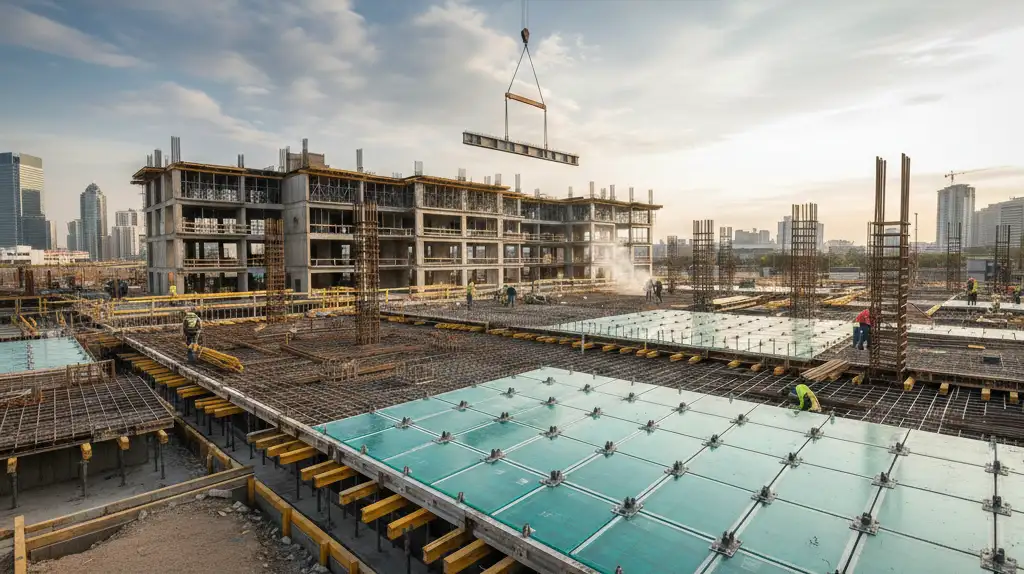
At the heart of every successful large-scale structure is a frp ownership that understands how early decisions shape long-term outcomes. At Future Form, this philosophy underpins how complex structural packages are planned, coordinated, and delivered — with a strong focus on clarity, accountability, and buildability across every stage of construction.
On every major project, structural progress is where momentum is either protected or lost. While design intent, procurement, and approvals all play an important role, the real test begins on site — once formwork rises, reo is fixed, and concrete is booked. This is where FRP — form, reo and pour — becomes the true engine room of delivery, and where a coordinated approach makes the greatest difference.
Yet despite its importance, FRP ownership is often fragmented. Formwork may be managed by one party, reo by another, and pouring coordinated separately. On paper, each scope appears covered. On site, however, this division frequently leads to assumptions replacing planning, misaligned programmes, and stalled structural progress — particularly on fast-paced or high-rise builds.
Through its integrated FRP solutions, Future Form addresses this challenge by treating form, reo and pour as a single, accountable structural package rather than disconnected trades.
This approach is driven by experienced teams who understand the realities of live construction environments and the importance of sequencing, timing, and accountability across the entire FRP scope.
This blog explores why clear FRP ownership is critical to predictable structural progress, the risks created by fragmented responsibility, and how a unified FRP approach helps large-scale projects maintain momentum from the ground up.
Why FRP ownership matters more than ever
Structural programmes today are under increasing pressure. Tighter programmes, constrained labour availability, higher material costs, and increased scrutiny on safety and quality mean there is little tolerance for rework or delay. In this environment, FRP is no longer just a trade sequence — it is a system that must perform reliably cycle after cycle.
FRP ownership matters because it governs how formwork readiness aligns with reo fixing, how steel congestion is managed, and whether pours occur as planned or are repeatedly deferred. Without a single point of responsibility, even minor misalignments compound quickly.
For example:
- Form may be completed, but reo detailing is incomplete.
- Reo may be fixed, but formwork tolerances are not pour-ready.
- Concrete may be booked, but access, inspections, or sequencing are unresolved.
Each issue on its own seems manageable. Together, they erode trust in the programme and disrupt structural progress.
The hidden cost of fragmented FRP responsibility
Fragmented FRP responsibility often appears efficient at tender stage. Different FRP contractors are engaged for formwork, reo, and pouring, each responsible for their own scope. In practice, however, this structure creates gaps where no one truly owns the interfaces.
Common consequences include:
- Conflicting assumptions about readiness
- Delays caused by late design clarifications
- Reo congestion due to uncoordinated detailing
- Last-minute changes to pour sizes or sequences
- Increased safety risk from rushed works
When responsibility is split, accountability becomes diluted. Issues are identified late, and resolution becomes reactive. Structural progress then depends on firefighting rather than planning.
Over time, this fragmentation impacts the entire structural package. Cycle times stretch, costs escalate, and confidence in delivery weakens across stakeholders.
Clear FRP ownership creates accountability, not complexity
Clear FRP ownership does not add another layer of management. Instead, it simplifies decision-making by establishing one accountable lead for form, reo and pour.
A single FRP owner:
- Coordinates sequencing across all FRP activities
- Aligns formwork, reo fixing, and concrete availability
- Identifies clashes and constraints early
- Protects pour readiness and quality outcomes
- Maintains continuity across structural cycles
This clarity ensures that the structural package is managed as an integrated system rather than isolated tasks. Decisions are made with the full FRP picture in mind, not just individual scopes.
FRP as a single structural workflow
When FRP ownership is clear, form, reo and pour are treated as one continuous workflow. This mindset shift is critical for maintaining structural progress on complex builds.
Formwork is no longer viewed as complete when panels are erected. Completion is measured by readiness for reo fixing and pouring. Similarly, reo is not considered finished until it supports safe, efficient pours with minimal congestion and compliant cover.
Concrete pouring, in turn, becomes a planned outcome rather than a reactive event. Bookings are aligned with genuine readiness, inspections are anticipated, and quality is protected.
This integrated FRP workflow reduces waste, improves predictability, and strengthens programme certainty.
How clear FRP ownership protects structural progress
Consistent structural progress depends on rhythm. Once cycles are established, maintaining that rhythm is essential. Clear FRP ownership supports this by ensuring each stage feeds smoothly into the next.
Key benefits include:
- Stable cycle times across levels or zones
- Reduced rework and remedial works
- Improved safety through better planning
- Stronger collaboration between FRP contractors
- Greater confidence for developers and builders
By owning the entire FRP scope, risks are identified earlier, and mitigation strategies are built into the programme rather than applied under pressure.
Integrated FRP solutions reduce programme risk
Integrated FRP solutions bring formwork, reo, and pouring under one coordinated plan. This approach recognises that the structural package is only as strong as its weakest interface.
Rather than managing trades in isolation, integrated FRP solutions:
- Align detailing with constructability
- Sequence works to minimise congestion
- Optimise pour sizes and timings
- Improve access and safety planning
- Support consistent concrete quality
This integration is especially valuable on large-scale projects where repetition and scale amplify both success and failure.
The role of FRP contractors in modern structural delivery
FRP contractors play a critical role in delivering predictable structures. However, without clear FRP ownership, even experienced contractors can be constrained by fragmented information and misaligned expectations.
Clear ownership provides FRP contractors with:
- Defined sequencing and priorities
- Transparent programme expectations
- Coordinated interfaces with adjacent trades
- A single point of escalation and decision-making
This clarity allows contractors to focus on execution rather than negotiation, improving productivity and outcomes across the structural package.
Strengthening the structural package through ownership
The structural package is the backbone of any major project. Its performance directly influences follow-on trades, façade installation, services coordination, and overall project confidence.
Clear FRP ownership strengthens the structural package by:
- Reducing uncertainty at interfaces
- Improving programme reliability
- Enhancing communication across teams
- Supporting better quality control
- Maintaining momentum through critical stages
When structural progress is consistent, downstream activities benefit, and the project moves forward with fewer disruptions.
How Future Form supports clear FRP ownership
Clear ownership only works when it is backed by structured systems, experienced leadership, and disciplined coordination on site. Future Form approaches FRP as a unified responsibility rather than a collection of trades. By taking full ownership of the form, reo and pour scope, Future Form provides clarity where projects often experience fragmentation.
This approach includes:
- Coordinating formwork, reo, and concrete activities under one plan
- Managing interfaces between FRP contractors
- Aligning sequencing with real-world site conditions
- Protecting pour readiness and quality
- Maintaining accountability across the structural programme
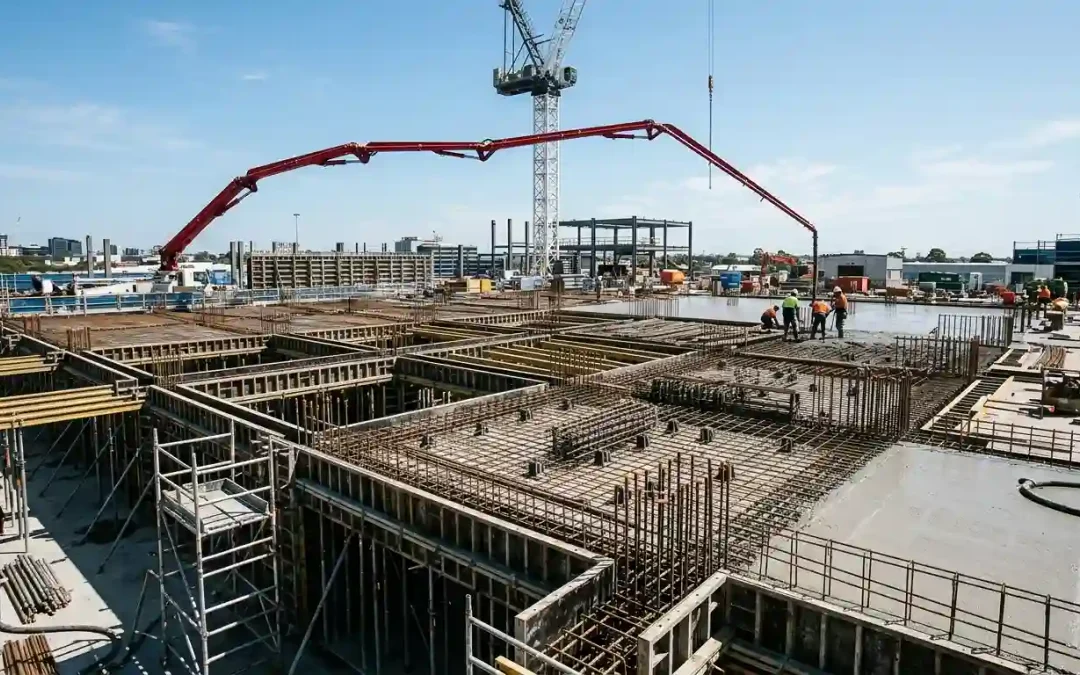
This integrated approach is reflected across a diverse range of structural builds delivered by Future Form, where clear FRP ownership has supported consistent structural progress from ground works through to topping out.
By owning the FRP scope, Future Form removes ambiguity, supports smoother coordination, and helps protect consistent structural progress across complex builds.
Why developers and project teams value clear FRP ownership
For developers, consistency matters. Predictable structural progress supports financing milestones, reduces holding costs, and builds confidence in delivery.
Clear FRP ownership provides:
- Greater certainty in programme forecasting
- Improved visibility of structural risks
- Reduced reliance on recovery strategies
- Stronger alignment between design and construction
- More reliable outcomes across the build lifecycle
For project teams, it creates an environment where collaboration replaces conflict and planning replaces assumption.
Structural progress is not accidental
Consistent structural progress does not happen by chance. It is the result of deliberate planning, clear accountability, and integrated execution. FRP sits at the centre of this equation.
When FRP ownership is fragmented, progress becomes reactive. When ownership is clear, progress becomes repeatable.
As projects continue to grow in complexity and scale, the need for clear FRP ownership will only increase. Treating form, reo and pour as a single, accountable scope is no longer optional — it is fundamental to reliable structural delivery.
Building confidence through clear FRP ownership
Clear FRP ownership is not just a contractual decision; it is a strategic one. It shapes how structural packages are planned, executed, and delivered. By unifying form, reo and pour under one accountable lead, projects gain clarity, reduce risk, and protect structural progress.
For large-scale developments, this clarity can be the difference between a programme that constantly recovers and one that consistently performs.
Future Form’s integrated FRP solutions are designed to support this clarity, providing a coordinated approach that strengthens structural delivery and supports long-term project success.
If you are planning an upcoming structural package and want to explore how clear FRP ownership can support consistent structural progress, our team welcomes a conversation about your project requirements.
For teams seeking greater confidence in their structural programmes, clear FRP ownership is a powerful place to start.
References
Eastman, C., Teicholz, P., Sacks, R., & Liston, K. (2018). BIM handbook: A guide to building information modeling for owners, designers, engineers, contractors, and facility managers (3rd ed.). Wiley. Retrieved from: https://www.wiley.com/en-au/BIM+Handbook%2C+3rd+Edition-p-9781119287537
Love, P. E. D., Edwards, D. J., & Smith, J. (2016). Rework causation: Emergent theoretical insights and implications for research. Journal of Construction Engineering and Management, 142(6), 04016010. Retrieved from: https://ascelibrary.org/doi/10.1061/%28ASCE%29CO.1943-7862.0001114
Ogunlana, S. O., Promkuntong, K., & Jearkjirm, V. (1996). Construction delays in a fast-growing economy: Comparing causes and effects. International Journal of Project Management, 14(1), 37–45. Retrieved from: https://www.sciencedirect.com/science/article/pii/0263786395000099
Sacks, R., Koskela, L., Dave, B. A., & Owen, R. (2010). Interaction of lean and building information modeling in construction. Journal of Construction Engineering and Management, 136(9), 968–980. Retrieved from: https://ascelibrary.org/doi/10.1061/%28ASCE%29CO.1943-7862.0000203