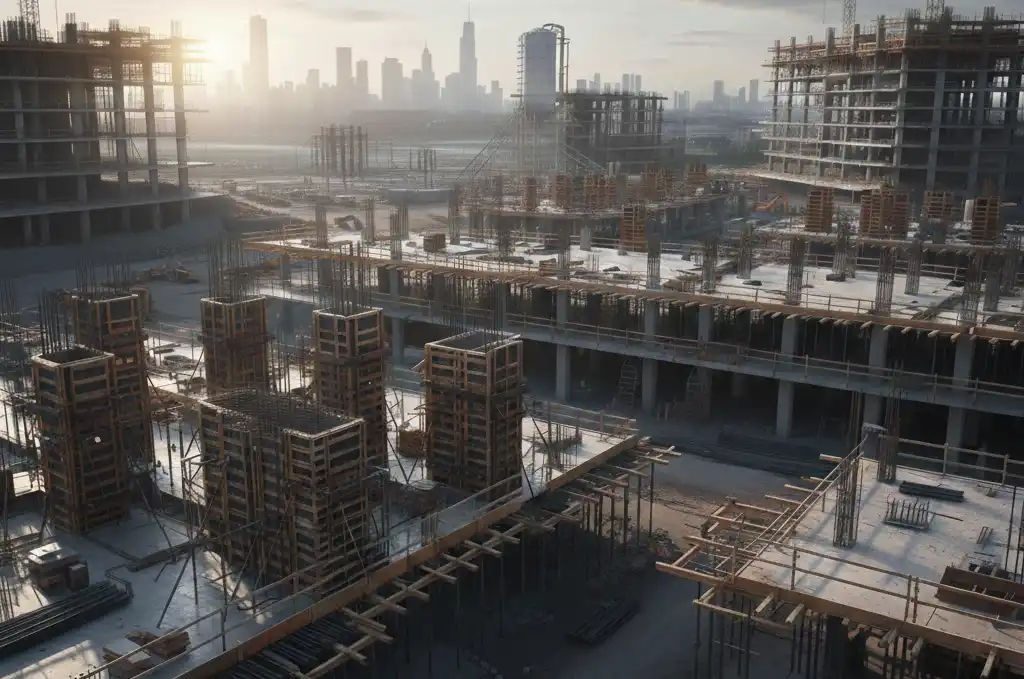
In today’s construction environment, delivering a successful structural package is no longer just about speed or scale. It is about coordination, clarity, and control. As projects become taller, tighter, and more programme-driven, the way structural works are planned and executed has a direct impact on build quality, safety, and certainty of outcomes. This is where experienced structural delivery specialists, such as Future Form, play a critical role in shaping how modern concrete structures are built.
Across complex developments, the strength of a structural package depends on how well formwork, steel reinforcement, and concrete pours are aligned from the outset. A delivery model that brings these elements together under a single strategy creates smoother sequencing, stronger accountability, and fewer disruptions on site. This approach sits at the core of Future Form’s structural delivery services, where coordination and readiness are treated as essential, not optional.
This is where FRP — form, reo, and pour — plays a defining role. When these three components operate as a single, integrated system rather than isolated trades, structural packages perform better across every metric that matters: programme reliability, concrete quality, labour efficiency, and risk management. Achieving this level of integration relies not only on systems and planning, but also on the experience of the people delivering them — from site leadership to technical expertise — supported by Future Form’s specialist team.
Modern construction increasingly recognises that FRP integration is no longer “nice to have”. It is a critical foundation for predictable structural delivery, particularly on large-scale and complex developments where consistency, control, and long-term performance are non-negotiable.
Understanding FRP as a single system
FRP refers to the three core components that bring reinforced concrete structures to life: form, reo, and pour. Individually, each element carries its own technical requirements, labour demands, and sequencing constraints. Together, they form the backbone of every structural package.
When FRP is planned as a unified system, formwork erection supports efficient steel fixing, reo placement is optimised for concrete flow and compaction, and pours are executed with confidence and consistency. The result is a structure that performs as designed, without unnecessary rework or last-minute compromises.
Problems arise when FRP is fragmented. Separate scopes, misaligned programmes, and unclear responsibility often lead to rushed pours, congestion within formwork, and compromised concrete outcomes. Over time, these issues compound, placing pressure on downstream trades and overall project delivery.
Why FRP coordination matters more than ever
Modern projects operate under tighter margins and higher expectations than ever before. Programmes are compressed, labour availability fluctuates, and structural tolerances are increasingly unforgiving. In this environment, poor FRP coordination is exposed quickly.
A well-integrated FRP strategy ensures that each stage of the structural package is genuinely ready before the next begins. Formwork is completed with steel fixing access in mind. Reo installation is sequenced to suit pour methodology. Concrete placements occur when form, reo, and site conditions are fully aligned.
This approach reduces reactive decision-making on site and replaces it with deliberate, well-planned execution. It also creates a safer working environment, as crews are not forced into rushed or overcrowded conditions to meet pour deadlines.
The role of FRP in structural programme certainty
Structural programmes are often the critical path on major developments. Delays or inefficiencies at the FRP stage ripple through the entire project, affecting follow-on trades, façade installation, and finishing works.
Integrated FRP solutions provide greater programme certainty by aligning formwork cycles, reo fixing rates, and pour sequencing into a single delivery rhythm. This allows project teams to forecast progress with confidence and maintain consistent cycle times across levels or zones.
When FRP contractors manage the structural package holistically, they are better positioned to identify risks early. Potential clashes, access issues, or sequencing constraints can be resolved during planning rather than during execution, where changes are more costly and disruptive.
Concrete quality starts with FRP planning
Concrete quality is not determined at the pour alone. It is influenced by every decision made during formwork design, reo detailing, and placement sequencing. Poor FRP coordination often results in congested reinforcement, inadequate vibration access, or formwork deflection under load.
By treating FRP as an integrated process, these risks are significantly reduced. Formwork systems are selected and installed to support correct reinforcement cover and alignment. Reo layouts are coordinated to allow proper concrete flow and compaction. Pour methodologies are matched to the structure’s geometry and constraints.
This level of planning leads to improved surface finishes, reduced defects, and structures that perform as intended over their design life. For developers and clients, this translates into long-term asset value and reduced maintenance exposure.
Reducing rework through integrated FRP solutions
Rework remains one of the most expensive and avoidable costs in construction. In many cases, rework stems from breakdowns in coordination between form, reo, and pour activities.
Integrated FRP solutions reduce rework by establishing clear ownership of the structural package. When a single FRP contractor oversees sequencing and readiness, there is less scope for assumptions or miscommunication between trades.
Issues such as misplaced reinforcement, incomplete embeds, or misaligned formwork are identified and addressed before concrete is placed. This proactive approach protects both programme and quality, while also improving site morale and efficiency.
FRP and risk management in structural delivery
Risk in structural packages often emerges at the interfaces — between trades, between design and construction, and between programme commitments and site realities. Fragmented FRP delivery increases these interface risks by introducing gaps in responsibility and accountability.
An integrated FRP model consolidates these interfaces under a unified delivery strategy. This clarity allows risks to be assessed and managed collectively rather than reactively. Temporary works, pour sequencing, and structural stability considerations are coordinated as part of a single plan.
For project stakeholders, this approach provides greater confidence that structural risks are being actively managed rather than deferred to the point of execution.
The evolving role of FRP contractors
FRP contractors today are expected to deliver more than labour and materials. They are increasingly relied upon to provide leadership across the structural package, bridging the gap between design intent and site execution.
Experienced FRP contractors bring a deep understanding of how formwork systems, reo installation, and concrete behaviour interact in real-world conditions. This knowledge allows them to advise on sequencing strategies, cycle optimisation, and constructability improvements that benefit the entire project.
Rather than operating as isolated trade providers, modern FRP contractors function as integrated delivery partners, contributing to programme certainty and build quality from early planning through to final pour.
Structural packages benefit from clear FRP ownership
One of the most common challenges in structural delivery is unclear ownership of FRP coordination. When formwork, reo, and pour are contracted separately, responsibility for readiness is often diluted.
Clear FRP ownership ensures that sequencing, access, and pour readiness are actively managed rather than assumed. This clarity supports smoother handovers between stages and reduces the likelihood of last-minute delays or scope disputes.
Projects that establish defined FRP leadership early typically experience fewer disruptions and more consistent progress throughout the structural phase.
How integrated FRP supports scalability
Large-scale developments demand repeatability and consistency. Integrated FRP solutions are particularly valuable on projects with multiple levels, zones, or structural typologies, where maintaining uniform quality and cycle times is critical.
By standardising FRP processes and sequencing strategies, teams can scale operations without compromising control. Lessons learned on early pours inform later stages, driving continuous improvement across the structural package.
This scalability is essential for projects where even small inefficiencies, when repeated across dozens of pours, can significantly impact programme and cost.
Future Form’s approach to FRP delivery
Successful FRP delivery does not happen by chance — it requires clear leadership, disciplined planning, and accountability across every concrete stage. Future Form approaches FRP as a single, coordinated system rather than a collection of disconnected tasks. Our role as an experienced FRP contractor is to align form, reo, and pour activities into a structured delivery strategy that supports certainty and quality at every stage.
We focus on sequencing, readiness, and execution, ensuring that each pour is genuinely prepared before concrete is placed. By managing FRP holistically, we reduce risk, improve programme reliability, and deliver structural packages with consistency and control.
Our approach is built on practical experience across complex structural environments, allowing us to anticipate challenges and address them through planning rather than reaction.
Why FRP integration defines modern structural success
As construction continues to evolve, the importance of integrated FRP solutions will only increase. Projects that succeed are those that recognise structural delivery as a system — one where formwork, reo, and concrete are inseparable.
FRP integration supports better outcomes for all stakeholders: developers gain programme certainty, construction teams benefit from safer and more efficient sites, and end users receive structures built to a higher standard.
In modern structural package delivery, FRP is not just a process. It is a strategic advantage.
Why FRP integration matters for long-term structural performance
The importance of FRP in modern structural package delivery lies in its ability to create certainty where complexity is unavoidable. When form, reo, and pour operate as one coordinated system, structural works progress with intent rather than urgency, and quality becomes a planned outcome rather than a variable risk.
Integrated FRP solutions provide a practical framework for delivering concrete structures that perform as intended over time. By aligning sequencing, readiness, and execution, project teams reduce rework, improve programme reliability, and maintain greater control across every concrete stage. For large-scale developments, this level of integration supports consistency, safety, and long-term structural performance.
For projects where structural certainty, coordination, and execution quality are critical, understanding how FRP can be structured as a single delivery system is an important starting point. To learn more about FRP-led structural delivery approaches, you can get in touch with the Future Form team for further information.
References
Concrete Institute of Australia. (2022). Guide to concrete construction and practice.
Retrieved from https://www.concreteinstitute.com.au
Engineers Australia. (2021). Structural engineering practice and coordination guidelines.
Retrieved from https://www.engineersaustralia.org.au
Love, P. E. D., Edwards, D. J., & Irani, Z. (2019). Moving beyond optimism bias and strategic misrepresentation in construction projects. Construction Management and Economics, 37(7).
Retrieved from https://www.tandfonline.com
Smith, N. J. (2014). Engineering project management. Wiley-Blackwell.
Retrieved from https://www.wiley.com
Winch, G. M. (2010). Managing construction projects: An information processing approach. Wiley-Blackwell.
Retrieved from https://www.wiley.com